


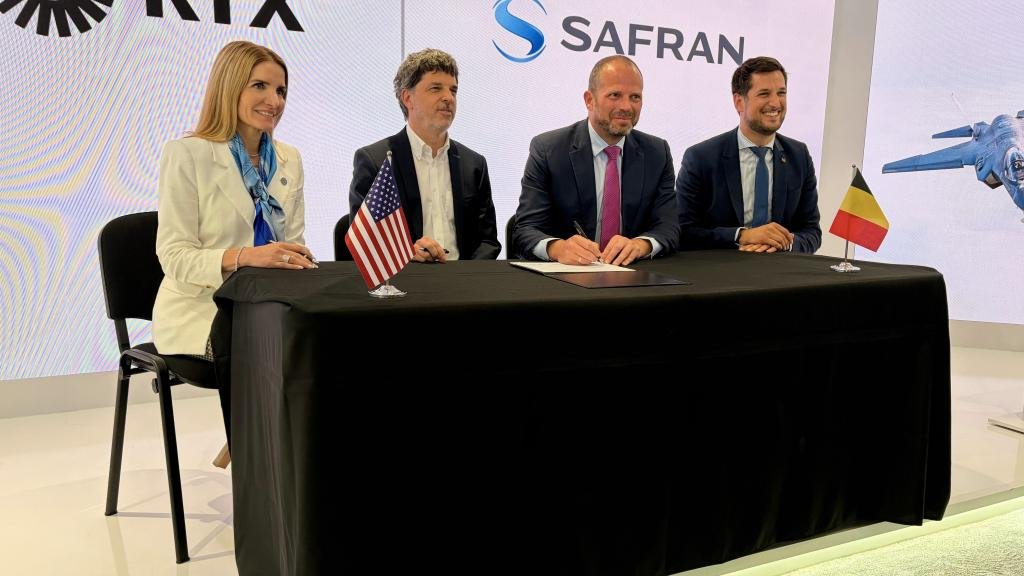
Belgium-based Safran Aero Boosters has signed an agreement with Pratt & Whitney to qualify and deliver large-scale, highly complex components for the F135 engine that powers the F-35 Lightning II. The deal was formalized at the Farnborough International Airshow on July 22, 2026, in the presence of Theo Francken, Belgium’s Minister of Defence, and Adrien Dolimont, Minister-President of Wallonia.
The work will be carried out with Flanders-based BMT Aerospace, Safran Aero Boosters’ longtime partner on the program. Both companies have demonstrated strong capabilities in additive manufacturing for aerospace applications, and Safran frames the project as a significant step toward validating the technology at scale, while positioning Belgium as a source of high-technology supply chain solutions for U.S. aerospace companies.
A Belgian Program Years in the Making
The Farnborough signing isn’t a standalone deal, it’s the latest step in a partnership that dates back to December 2023, when Safran Aero Boosters and BMT Aerospace signed a Memorandum of Understanding with Pratt & Whitney at Lockheed Martin‘s Fort Worth facility, timed to Belgium’s first F-35 rollout. That MoU covered a research and technology project to produce F135 structural parts using new manufacturing processes, with Safran Aero Boosters CEO François Lepot framing the ambition around a large industrial prize: roughly 700 million euros in business return for Belgium tied to the country’s F-35 purchase.
That framework was consolidated inOctober 2025, when Belgium’s government and Pratt & Whitney signed a strategic industrial agreement at Florennes Air Base marking the arrival of Belgium’s first F-35, which formally committed to building production capability for F135 components on Belgian soil. The new agreement is the point where that multi-year groundwork converts into an active qualify-and-deliver program.

Building the F135 Through Alliances
The F135 has never been a single-company build, and Pratt & Whitney is leaning further into that model as demand outpaces capacity. Rather than expanding its own factories to absorb every bottleneck, the company is qualifying a widening ring of partners, each handling a different piece of the engine, each entering through a formal, multi-year agreement rather than a one-off order.
Safran Aero Boosters and BMT Aerospace’s July 2026 deal is one link in that chain; the parallel Technology Development Agreement Pratt & Whitney signed with GKN Aerospace during the same Farnborough Airshow is another. That agreement targets a full-scale, laser-directed energy deposition F135 engine case, with a first demonstrator component due in 2027 and a certified product by the end of 2028, work the companies describe as likely to be among the first of its scale in a military engine application.
Belgian officials struck the same note when that October 2025 agreement was signed. Belgium’s Deputy Prime Minister called the F-35 program “a strategic investment in Belgium’s security, sovereignty, and industrial strength,” while Defence Minister Theo Francken framed the deal as ensuring “Belgian innovation in an essential component: the F-35’s engine.”
This isn’t new territory for Pratt & Whitney’s use of alliances in engine production, either. The company has previously partnered with Norsk Titanium, the University of Notre Dame‘s Turbomachinery Laboratory, and TURBOCAM International to develop and test a 3D printed integrally bladed rotor for future engine programs, inspecting the additive material against the same specification used for forged turbomachinery components.
The throughline across these efforts is consistent: Pratt & Whitney treats qualification as something to be distributed across trusted partners, not centralized in-house, and the F135’s current supply pressure is the clearest test yet of how far that model can scale.
3D Printing Industry is inviting speakers for its 2026 Additive Manufacturing Applications (AMA) series, covering Energy, Healthcare, Automotive and Mobility, Aerospace, Space and Defense, and Software. Each online event focuses on real production deployments, qualification, and supply chain integration. Practitioners interested in contributing can complete the call for speakers form here.
To stay up to date with the latest 3D printing news, don’t forget to subscribe to the 3D Printing Industry newsletter or follow us on LinkedIn.
Explore the full Future of 3D Printing and Executive Survey series from 3D Printing Industry, featuring perspectives from CEOs, engineers, and industry leaders on the industrialization of additive manufacturing, 3D printing industry trends 2026, qualification, supply chains, and additive manufacturing industry analysis.
Featured image shows Safran Aero Boosters has signed an agreement with Pratt & Whitney. Photo via Safran Aero Boosters.
