


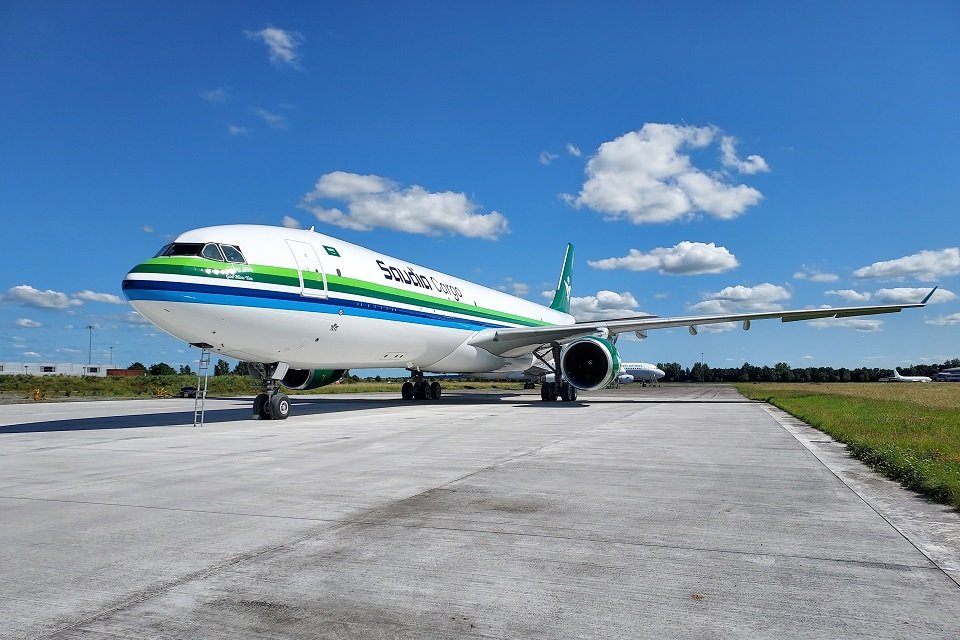
Saudia Cargo has reported a successful 2025, on the back of several initiatives, despite flat cargo volumes.
The airline saw its cargo volumes last year decline by 0.8% to 573,000 tonnes across around 4,000 flights.
According to IATA, airlines based in the Middle East region lagged overall market growth of 3.4% last year, registering an increase of 0.3%.
The airline association highlighted a challenging Middle East-Europe trade lane, where 2025 demand was down 3.4% year on year.
“Given that this corridor accounted for one-third of Middle Eastern international cargo demand in 2024, its weakness weighed disproportionately on regional outcomes and highlights the sensitivity of hub-dependent flows to geopolitical and trade disruptions,” IATA said.
However, the airline remained positive, pointing to a net promoter score of 57 – scores above 50 are considered positive – while it also maintained its on-time performance above 90%.
“This reflects the company’s strategic focus on handling high-value and sensitive products with efficiency and reliability,” Saudia Cargo said in a press release.
The year also saw the carrier announce a series of strategic partnerships that “strengthened Saudia Cargo’s local and international presence”.
These included agreements with the Saudi Tourism Authority and the Al-Ahsa Development Authority to support national development.
Internationally, partnerships were formed with China Cargo Airlines and China’s Henan Group to enhance connectivity between Asia and Europe via Zhengzhou and Riyadh.
The company also entered into a strategic agreement with ASL Aviation for the lease of two Airbus A330-300F freighter aircraft.
These aircraft are scheduled for delivery and operation in 2026 to increase capacity and meet customer demand.
The company also added permanent cargo destinations Zhengzhou in China and Milan in Italy.
The company also launched “Saudia Cargo Global”, in partnership with Hong Kong-headquartered GSSA TAM Group to establish a ‘Saudia Cargo Global’ entity that will focus on enhancing commercial reach, service capabilities, and customer engagement in Greater China and Asia-Pacific (APAC).
“This is a strong indication to enhance the national carrier’s presence in the Asian market, which is one of the world’s most vibrant commercial environments,” the carrier said.
The company also obtained IATA CEIV Fresh certification for the handling of perishable goods.
