


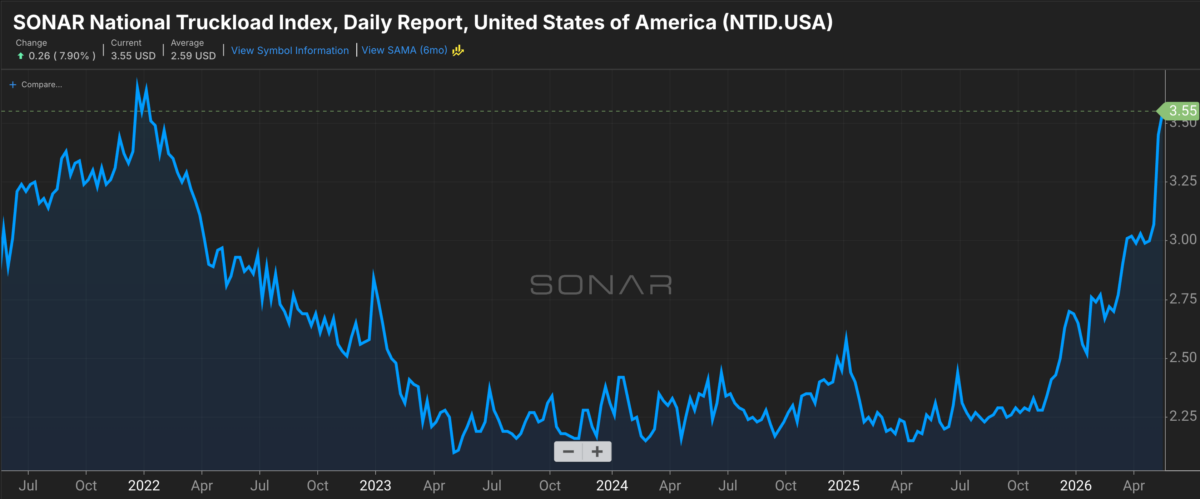
Spot rates hit $3.55 a mile yesterday — a clear signal that capacity is not flowing in to relieve the tightness we saw during road check week. And we’re heading into Memorial Day, which historically creates a surge as shippers push product out ahead of the holiday and carriers take time off with their families. Capacity is going to tighten through the rest of the week.
Could we see record rates this week? Absolutely possible. The all-time high is $3.68 a mile — the highest we’ve ever recorded. We hit $3.61 last week, the highest in this cycle, and there isn’t any reason to think we couldn’t push another 14 cents through it.
But the bigger story in trucking right now isn’t Memorial Day seasonality. It’s the Supreme Court’s decision last week in Montgomery v. Caribe Transport II, LLC, and the impact on rates and market structure is going to be significant.
$5/mile for truckload spot rates on the horizon?
With 30% of the trucks in the market either having no safety-rating or a conditional safety rating, we could see a large percentage of those carriers drop out of the market.
Rates are definitely going up – the question is how… pic.twitter.com/KN1nunqKxx— Craig Fuller
(@FreightAlley) May 19, 2026


 (@FreightAlley)
 What the Court Did
On May 14, the Supreme Court ruled 9-0 that federal law does not shield transportation brokers from state-level personal injury lawsuits. Justice Amy Coney Barrett wrote the opinion. Justice Kavanaugh filed a concurrence joined by Justice Alito.
The case came out of a 2017 Illinois crash. Shawn Montgomery had pulled over due to a mechanical issue when a tractor-trailer driven by Yosniel Varela-Mojena veered off the road and rear-ended his stopped vehicle. Montgomery lost part of his leg. He sued the driver, the carrier — Caribe Transport II — and the broker that arranged the load, C.H. Robinson. Montgomery’s suit alleged that C.H. Robinson should have known the carrier it hired had a “conditional” safety rating and a history of driver qualification deficiencies.
For years, brokers have argued they’re shielded from these suits by the Federal Aviation Administration Authorization Act of 1994, which preempts state laws “related to a price, route, or service” of a broker or carrier. The Supreme Court rejected that argument unanimously. Barrett ruled that the FAAAA specifically preserves a state’s “safety regulatory authority” regarding motor vehicles, and requiring a broker to exercise reasonable care when selecting a carrier directly concerns the safety of the trucks on the road.
In plain English: if a broker tenders freight to a carrier with documented safety problems and that carrier is in an accident, the broker can be sued under state negligence law. The preemption defense the industry has relied on for decades is gone.
The Capacity Picture
There are roughly 1.2 million trucks operating today with zero safety rating from FMCSA. Brokers now have to think hard about whether to put freight on those trucks at all.
This creates an immediate problem: if a carrier doesn’t have a safety rating, how does a broker demonstrate the due diligence the Court is now requiring? There isn’t a clean answer, and that ambiguity is where the risk lives. Brokers we’ve already talked to are rethinking how they tender freight. Carriers with clean safety ratings are going to see significantly higher rates. Carriers without ratings will see fewer opportunities — not because they’re unsafe, but because no one has gone out and confirmed they meet regulations, and a broker has no defensible record to point to in court.
The more acute question is what happens to the roughly 300,000 trucks the Department of Transportation has flagged with a conditional safety rating — meaning there’s a documented issue the carrier needs to address. A conditional rating is exactly the fact pattern at the heart of Montgomery. A broker tendering to a conditional-rated carrier is now staring directly at the kind of case C.H. Robinson just lost. If those 300,000 trucks lose freight opportunities at scale, a meaningful share of that capacity exits the market.
If the dynamic extends to the full 1.2 million trucks with no rating, it’s catastrophic for capacity. Combined, we’re talking about roughly 30% of trucks on the road that either have no safety rating or a conditional one.
Why This Sets Off a Supercycle
Remove 1.5 million trucks — or even materially constrain their freight access — and the math changes completely. Rates go to levels we haven’t seen before. $4 spot rates are written in the stars. $5 spot rates are on the horizon.
This is the best time in motor carrier history to be in the asset-based trucking business. Demand stays strong. Capacity can’t reset quickly because new capacity is going to be screened on safety from day one. There is no relief valve. Rates are going to perpetually increase over the next several years.
The ruling also reshapes the competitive structure of the industry in a way that rewards the right behavior. Carriers that maintain clean safety ratings can charge more, pay drivers more, hire higher-quality drivers, and reinvest in training and equipment. We may end up with a clear two-class system: safety-rated carriers operating at premium rates, and the rest competing for whatever freight is left at the margins.
The Counterargument
The Court itself gestured at a softer reading. In his concurrence, Justice Kavanaugh stressed that the ruling should not be understood as opening brokers to routine liability. Brokers that act reasonably and select reputable carriers “should be able to successfully defend against state tort suits”. The brokerage trade groups have seized on that language as a guardrail.
That’s a fair legal read, but it doesn’t change the operational calculus. Brokers don’t want to be the test case for what “reasonable” means in a given state court. The cheapest path to defensibility is to stop tendering to carriers without clean safety ratings altogether — and that’s exactly the behavior change that pulls capacity out of the market.
What It Means
This is a stressful moment because the industry doesn’t yet know exactly how brokers, insurers, and the courts will operationalize the standard. But the direction is clear. Capacity isn’t coming back in. The carriers that have invested in safety are about to be rewarded for it. And rates are going somewhere they’ve never been.
This is how supercycles start.
The post SCOTUS to trigger truckload rate run to $5.00 per mile? appeared first on FreightWaves.
