


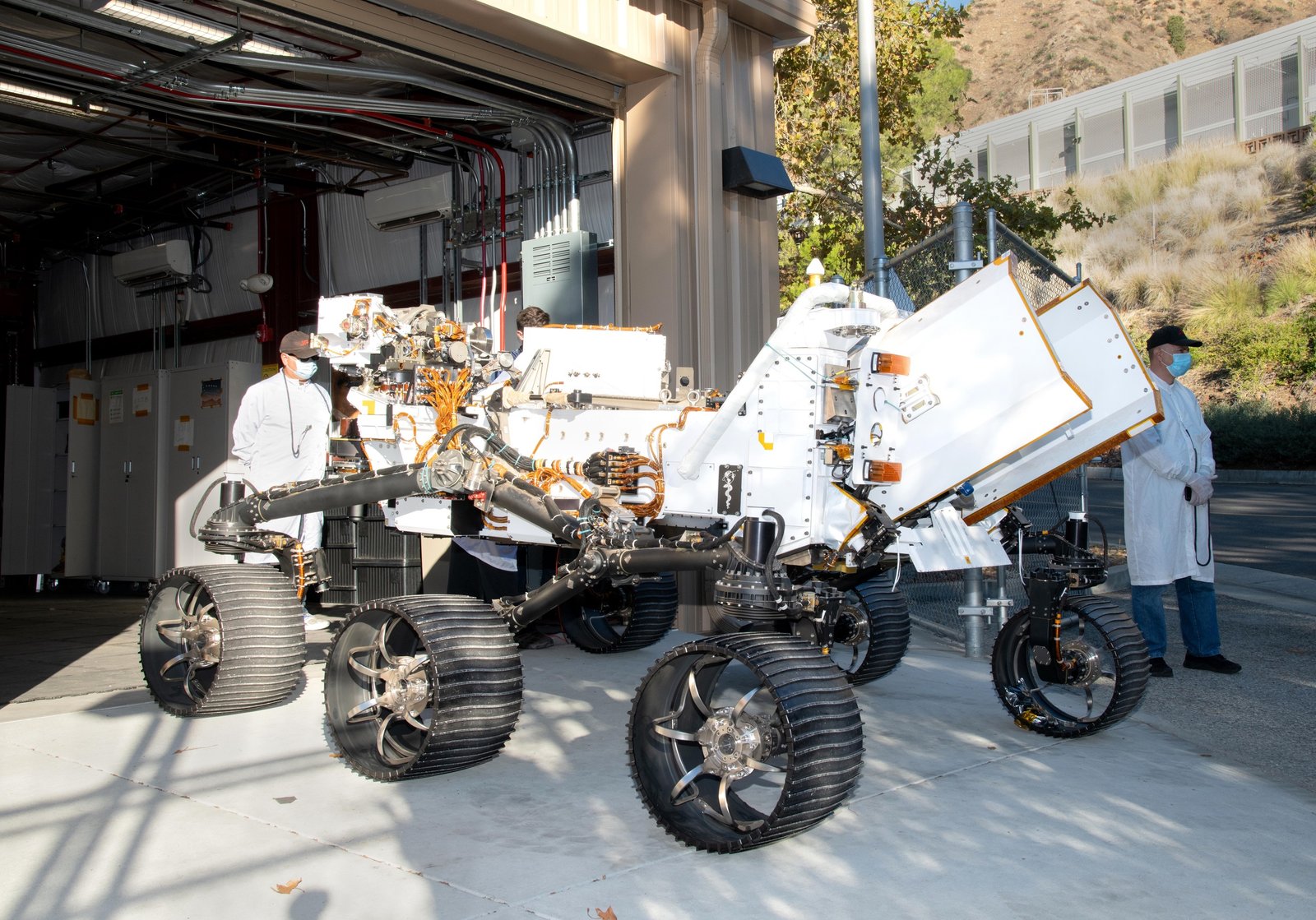
WASHINGTON — Converting an engineering model of a Mars rover into an actual lunar rover could cost NASA more than $1 billion, an estimate strongly rejected by the agency’s administrator.
NASA announced June 30 it was considering sending to the moon a rover it called PROMISE, or Polar Rover for Observation, Mapping and In-Situ Exploration. PROMISE would be based on engineering models of the Curiosity and Perseverance Mars rovers currently used on Earth to help plan rover operations and diagnose problems.
NASA Administrator Jared Isaacman said at the event where he announced PROMISE that the rover was part of efforts to “raid the pantry at every one of our centers for payloads” that could be used to support its lunar base efforts. “We are thinking very hard right now about sending PROMISE to the moon.”
“We’ve got the hardware, and this is exactly what we should be trying to do to put wins on the board, getting a capability like PROMISE to the surface of the moon,” he said. “I think we’ll probably make some adjustments to some of the instruments that are on it. It is going to bring an immense capability to the lunar south pole in short order.”
At the briefing, neither Isaacman nor Carlos García-Galán, NASA program executive for Moon Base, offered a price estimate for converting the Mars rover engineering model into PROMISE, but suggested it could be done relatively quickly and inexpensively because of the existing hardware.
However, an analysis by The Planetary Society published July 30 offered a different assessment. Based on historical cost data, requirements and other cost estimates, it concluded that PROMISE would cost between $723 million and $1.33 billion to develop and launch, including one year of operations on the moon. PROMISE likely would not be ready for launch until the early 2030s.
Casey Dreier, chief of space policy for The Planetary Society and author of the assessment, concluded that “it’s clear that this mission is far from a ‘freebie,’ and will consume significant resources that might otherwise be available to pursue established scientific priorities in NASA’s scientific portfolio.”
The assessment looked at what it would take to convert OPTIMISM, an engineering model of the Perseverance rover at the Jet Propulsion Laboratory, into PROMISE. Dreier noted that OPTIMISM lacks many of the space-rated components needed for a lunar mission, including a communications system. It also has no flight-ready instruments.
A major factor is the power supply. Perseverance uses a radioisotope thermoelectric generator, or RTG, for power. NASA currently has a single spare RTG that could be used for PROMISE, but that would still require significant work to approve its use on the rover as well as potential modifications to the lander that would carry PROMISE and certification of the launch vehicle that would launch it.
“There is no plausible version of this mission that is ‘free,’ and even the low-end cost is equivalent to a mid-size planetary exploration mission,” Dreier concluded.
There could be additional drawbacks to pursuing PROMISE, he added. It would deprive Curiosity and Perseverance of a testbed, increasing the risks for those missions. Using the spare RTG for PROMISE would also rule out pursuing a planetary science mission to the outer solar system for the foreseeable future.
In a social media post July 31, Isaacman pushed back against the cost estimates from The Planetary Society.
“Launch and landing costs are a reality for any mission, so setting those aside, if PROMISE costs even 20% of your low-end estimate, we simply will not fly it,” he stated.
He also defended the concept of trying to repurpose existing hardware to support the lunar base efforts. “That said, it would be crazy not to take advantage of hardware taxpayers have already invested hundreds of millions of dollars in, along with Pu-238 that continues to decay and lose roughly 2% of its potential each year,” he wrote, referring to the plutonium-238 fuel in the RTGs. “How much of this Pu-238 do you want to waste waiting for a mission that does not even exist?”
Uncertainty about the availability of that RTG, though, is one reason why an alternative mission does not exist. Budget issues forced NASA to postpone the call for proposals for its next New Frontiers planetary science mission, with current plans projecting that call to be released in fiscal year 2027. New Frontiers is a line of medium-class missions, some of which may require an RTG.
At a July 21 session of the NASA Exploration Science Forum, Louise Prockter, director of NASA’s planetary science division, said one factor in the delay of the release of the New Frontiers call is an ongoing assessment of the list of potential missions that will be considered in the call.
“We’re also looking at availability of nuclear power,” she added, citing reorganizations of nuclear programs within the agency. “We’re still working to understand the implications of that. Several missions on the list certainly would benefit from nuclear power.”
“We are investigating whether we will have nuclear power for that list” of candidate New Frontiers missions, she said later in the meeting. “That may make a difference to it, but we should have that information out fairly soon.”
Isaacman, in his social media post, broadly defended his approach to the agency’s lunar base proposals, including trying to move quickly and repurpose existing hardware and projects.
“I understand the community sometimes likes to take a long time to reach consensus, but under this administration, we can just do things and put wins on the board for the Moon Base and all the science and discovery it will enable,” he wrote. “In my humble opinion, less debate and more frequent wins make it easier to advocate for more resources to do more science.”
