


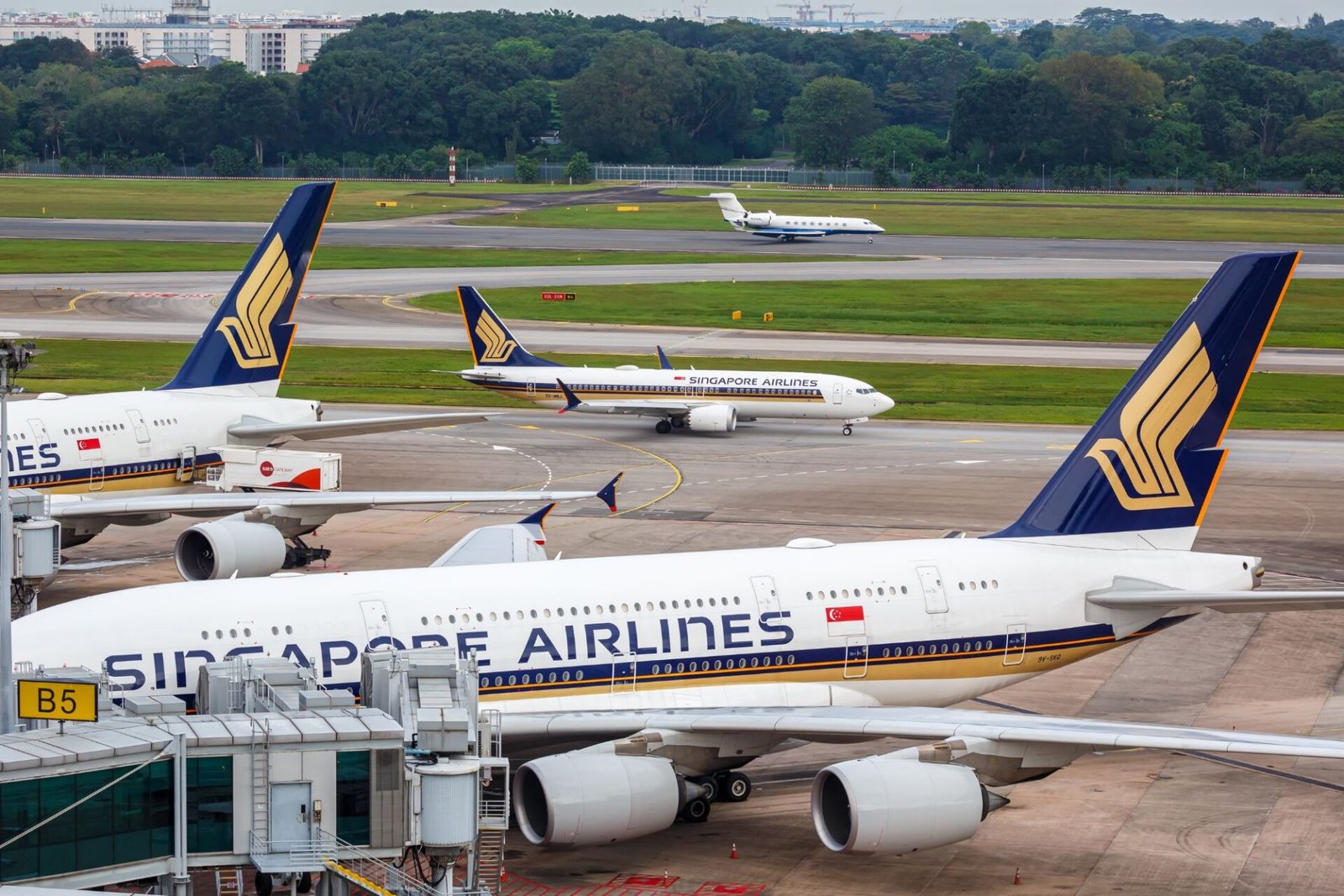
Singapore Airlines’ parent company posted a rare loss for the quarter ended June 30, 2026, even as the group brought in more revenue than ever before.
The SIA Group reported a net loss of S$76 million (US$59 million) for its first fiscal quarter, a sharp reversal from the S$186 million (US$143 million) profit it posted a year earlier, driven almost entirely by a spike in fuel costs tied to the conflict in the Middle East.
Record revenue, but fuel costs ate into it
Revenue for the quarter reached S$5.71 billion (US$4.40 billion), up 19.3% year-on-year and a new high for the group. Passenger revenue climbed 18.6% to S$4.58 billion (US$3.53 billion), helped by SIA and budget carrier Scoot carrying a combined 10.9 million passengers, up 6.3% from the previous year, along with a 12% rise in passenger yields.
Cargo revenue also grew, up 33.5% to S$708 million (US$545 million), supported by stronger cargo rates and slightly fuller planes.
However, none of that growth was enough to offset what happened on the cost side. Total group expenditure jumped 27.9% to S$5.61 billion (US$4.32 billion), almost entirely because of a S$991 million (US$763 million), or 78.5%, increase in net fuel costs.
That spike traces directly back to the Middle East conflict that began on February 28, 2026. Because jet fuel prices typically adjust with a delay, SIA said the group felt the impact of the conflict hit especially hard this quarter, with fuel costs before hedging more than doubling.
SIA did benefit from its fuel hedging, contracts that lock in fuel prices in advance, which turned a loss in 2025 into a gain this year. But even that wasn’t enough to offset how much more expensive fuel had become overall.
As a result, operating profit fell to S$106 million (US$82 million), down 73.8% from S$405 million (US$312 million) a year earlier. After accounting for a larger share of losses from Air India, in which SIA holds a 25.1% stake, and a smaller tax bill, the group ended the quarter S$76 million (US$59 million) in the red.
A strong balance sheet cushions the blow
Despite the loss, SIA’s finances remain solid.
The group closed the quarter with S$9.10 billion (US$7.01 billion) in cash and bank balances, up S$1.17 billion (US$901 million) from the previous quarter, along with another S$1.38 billion (US$1.06 billion) in longer-term fixed deposits and S$3.24 billion (US$2.50 billion) in undrawn credit lines.
Shareholders’ equity stood at S$16.59 billion (US$12.78 billion), down slightly from three months earlier, while the group’s debt-to-equity ratio ticked up to 0.65 from 0.62, partly due to a new five-year bond issued in Chinese yuan.
Growth continued despite the turbulence
Even with fuel prices working against it, SIA kept expanding its network during the quarter. Scoot launched new direct routes from Singapore to Belitung and Pontianak in Indonesia, while SIA began daily service to Hangzhou in mainland China. By the end of June, the group’s combined network covered 137 destinations across 36 countries and territories.
In Europe, SIA boosted frequencies to London Gatwick and Manchester over the summer travel season and announced a new five-times-weekly route to Madrid starting in October, its 15th destination in Europe. In Australia, the airline plans to add flights to Adelaide and launch daily service to the new Western Sydney International Airport later this year.
The Middle East conflict didn’t just raise fuel costs, it also disrupted parts of SIA’s own network. Scoot resumed flights to Jeddah in Saudi Arabia in June, only to suspend them again in mid-July as the conflict escalated. SIA’s services to Dubai remain suspended, and the planned launch of flights to Riyadh has been pushed back to December.
Navigating uncertainty ahead
SIA said demand for air travel remains strong heading into the rest of the year, and cargo demand is holding up as well, supported in part by semiconductor and data center-related shipments.
Still, the airline was clear-eyed about the risks ahead, noting that a prolonged Middle East conflict could keep fuel prices elevated and potentially disrupt broader supply chains and trade.
To manage that uncertainty, SIA said it plans to lean on its dual-brand structure, using Singapore Airlines and Scoot together to adjust capacity as demand shifts, while continuing to invest in new aircraft, airport lounges, and an updated in-flight experience set to roll out later this year.
