


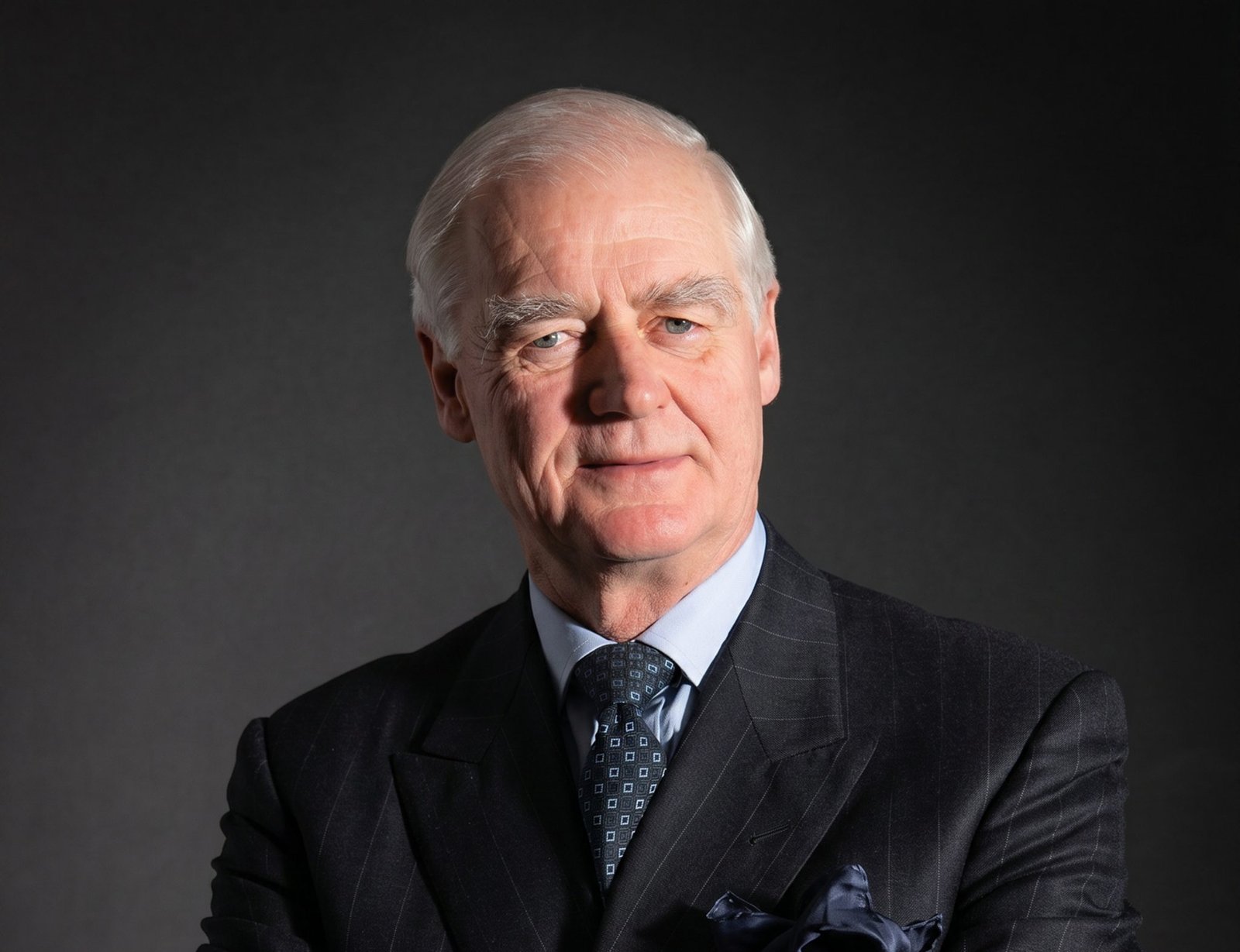
In a career with the UK manufacturer that spanned six decades, Robins introduced the Trent family and transformed a once-bankrupt business into a global propulsion powerhouse in commercial aviation.
To mark his retirement in 2002, Flight International presented Sir Ralph Robins with a commemorative cutaway poster of two Rolls-Royce engines: the Conway from the 1950s and the Trent 500 from 2000.
The drawings represented the span of a remarkable career with the UK propulsion company, which he joined as an engineering graduate apprentice in 1955 and departed as chairman (and Rolls-Royce’s longest-serving employee), having transformed the business into a global powerhouse in civil aerospace.
Robins, who has died aged 93, was a titan among British industrialists of the late 20th century. He is credited with transforming the fortunes of the once-bankrupt business after becoming commercial director in 1978 and managing director in 1984.
The key to that revival was the Trent family of high-bypass, widebody aircraft engines. The 1988 launch of the Trent 700 – which went into service on the Airbus A330 in 1995 – was followed by six major variants, including the Trent XWB for the Airbus A350 and the Boeing 787’s Trent 1000.
At the time Robins was beginning his ascent on the corporate ladder – he was promoted from programme management to head Rolls-Royce’s US business in the early 1970s – the UK’s propulsion champion, whose Merlin had helped win the Battle of Britain and Olympus (designed with Snecma) was powering commercial supersonic travel, was broke.
In 1971, the Heath government nationalised Rolls-Royce and de-merged the aerospace and luxury car operations. Like the British car industry, the engine maker looked like a lumbering, out-of-ideas behemoth unable to keep up with foreign competition, especially US giants Pratt & Whitney (P&W) and General Electric.
However, as commercial director, Robins played a huge role in securing contracts from the likes of Cathay Pacific and British Airways that helped secure the firm’s survival during a traumatic era for UK heavy industry.
As managing director, he led Rolls-Royce to a stock market flotation in 1987, followed by the launch of the Trent, with its distinctive three-shaft architecture, a product that would lead to the company becoming one of two dominant players in the widebody engine market in the 21st century.
The 1980s also saw Rolls-Royce form International Aero Engines with P&W and three other partners to develop the V2500, an engine that kept the company in the narrowbody segment, powering around 50% of the A320 family, until its withdrawal from the consortium in 2012.
In the 1990s, the acquisition of Indianapolis-based Allison and the setting up of Rolls-Royce Deutschland (originally a joint venture with BMW) gave Rolls-Royce a truly international footprint, including in the lucrative US defence market.
There were difficult times too. When he became chief executive and then chairman during the economic downturn of the early 1990s, and with breakeven on the Trent programme still at least a decade off, Robins led a painful cost-cutting programme that reduced the workforce from 36,500 to 22,200. However, the restructure, together with the beginnings of a move to treat the aftermarket as a major profit stream, again helped restore Rolls-Royce’s fortunes.
But Robins will most be remembered for bringing the Trent turbofan family to market. When the Trent 700 was unveiled 38 years ago, he remarked that he saw no reason why Rolls-Royce could not be manufacturing Trent engines in 40 years’ time. With more than 6,000 Trents produced to date – a number that has been growing by about 250 each year – that prediction appears unduly modest.
Subscribe to gain access to all news
Already have a subscription? Log in.
Choose your subscription
Considering a corporate subscription? Contact us to find out more.
