


US-based manufacturing company Skuld is leading a DARPA Rubble to Rockets (R2R) program effort to convert scrap metal into structural parts through advanced casting and AI-assisted analysis.
The company has filed a patent application covering its ability to cast wrought-grade aluminum alloys, including 6061 and 7075, directly from scrap feedstock. That detail reframes what might otherwise read as a materials science footnote. Producing wrought-equivalent mechanical properties through casting alone, without traditional mill processing, would remove one of the more persistent constraints in field manufacturing.
The primary source for this work is Skuld’s own program announcement, with collaborative research contributions from Worcester Polytechnic Institute (WPI), Foundry Casting Systems, and MatMicronia.
“Through the R2R effort, we are evaluating casting approaches, alloy behavior, and the use of AI tools that expand options for producing components in challenging environments,” said Sarah Jordan, CEO of Skuld LLC.
Overcoming Core Technical Challenges
The R2R program centers on three technical problems: identifying unknown scrap alloys quickly, predicting whether those alloys will perform adequately under load, and producing usable parts from them without conventional supply chains.
Skuld is addressing identification through AI-assisted spark testing, a technique that reads the light spectrum produced when metal is ground to estimate alloy composition. Microstructure and mechanical behavior prediction is led by WPI and MatMicronia.
On the production side, recent experiments eliminated cracking in complex geometries, a failure mode that had limited the range of parts castable from scrap. The results showed wrought-level strength achieved through casting and heat treatment alone, without the rolling or forging steps that typically produce that strength class in 6061 and 7075 aluminum.
Skuld’s process for producing those parts is called Additive Manufacturing Evaporative Casting (AMEC), which uses 3D printed patterns to create lost foam casting molds without hard tooling. That removes the lead time and capital cost associated with conventional tooling, relevant when sourcing is constrained or demand unpredictable.
The program also includes development of compact, portable casting systems. Those prototypes are intended for on-demand production in environments where conventional logistics pipelines are unavailable, a capability category the U.S. military has formally identified as a national security priority across its industrial base strategy.
What R2R is attempting is different in degree, not just in kind. Casting structural components from uncontrolled scrap feedstock, at wrought-equivalent strength, in portable equipment, involves solving three distinct engineering problems simultaneously. The fact that Skuld has filed a patent on the casting approach signals the company sees the method as commercially defensible ground.
Moving Beyond Controlled Metal Recycling
The scale of investment across the R2R program reflects how seriously DARPA is treating the problem. Last year, WPI received $6.3 million from DARPA to develop a machine learning process for manufacturing using scrap metal, with AI tools predicting how mixed material compositions behave before they are processed into parts.
In the R2R pipeline, that characterization capability has to work before Skuld’s casting capability can be applied. Whether the two can be made to function together at field scale is what the program is now testing.
A recent development in the UK underscores exactly why Skuld’s feedstock problem is so distinct. Defense technology company QinetiQ recently completed a flight test of a structural hinge component 3D printed from titanium recovered from a decommissioned aircraft, described by the company as a world first.
Now, titanium is a known classified alloy processed by a controlled recycling method. Skuld’s R2R work is attempting the harder version: casting structural parts from scrap of unverified composition, without the ability to pre-sort or certify the feedstock before it arrives.
3D Printing Industry is inviting speakers for its 2026 Additive Manufacturing Applications (AMA) series, covering Energy, Healthcare, Automotive and Mobility, Aerospace, Space and Defense, and Software. Each online event focuses on real production deployments, qualification, and supply chain integration. Practitioners interested in contributing can complete the call for speakers form here.
To stay up to date with the latest 3D printing news, don’t forget to subscribe to the 3D Printing Industry newsletter or follow us on LinkedIn.
Explore the full Future of 3D Printing and Executive Survey series from 3D Printing Industry, featuring perspectives from CEOs, engineers, and industry leaders on the industrialization of additive manufacturing, 3D printing industry trends 2026, qualification, supply chains, and additive manufacturing industry analysis.
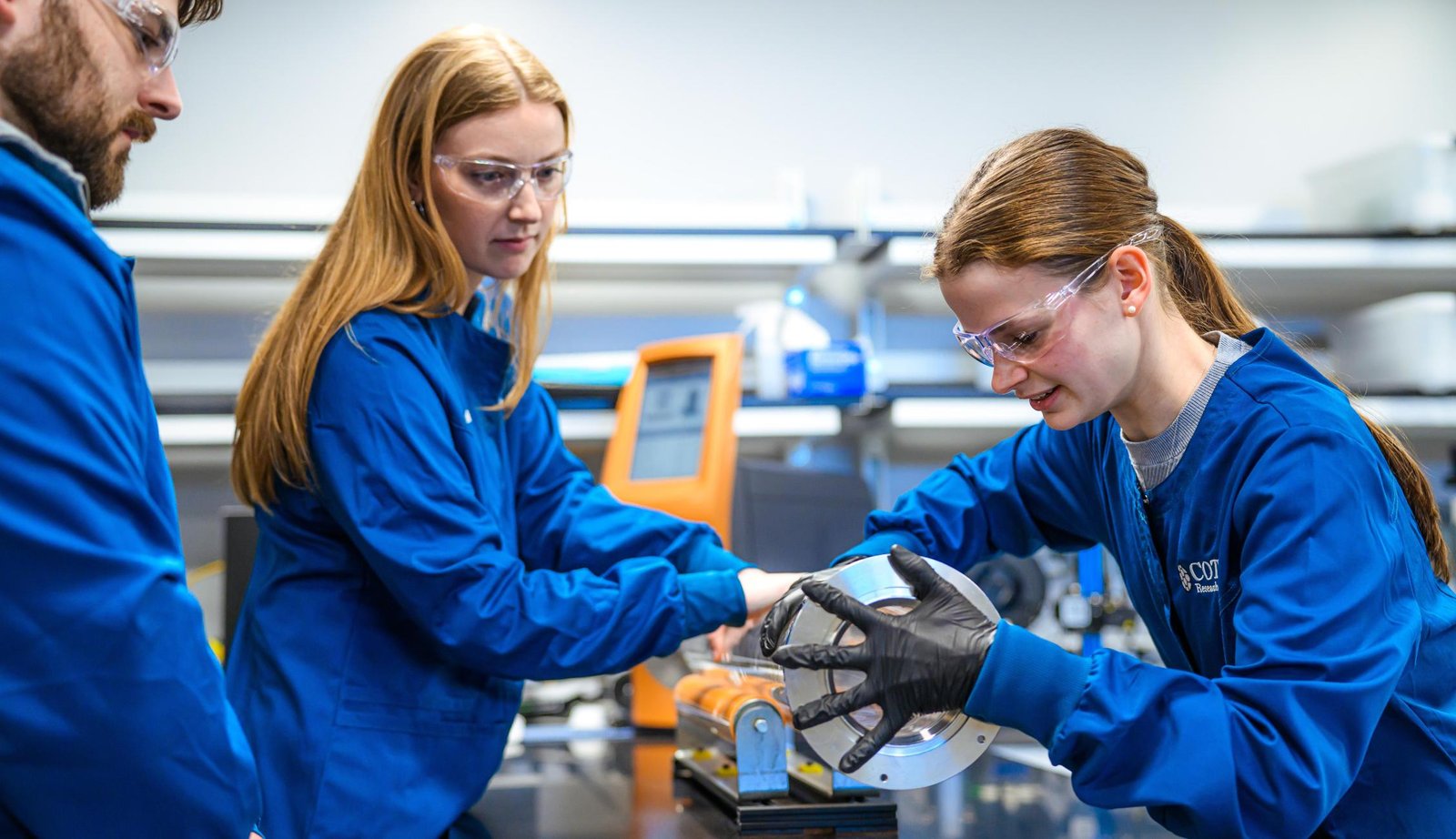
Featured image shows Worcester Polytechnic Institute working on the Rubble to Rockets project. Photo via Worcester Polytechnic Institute.
