


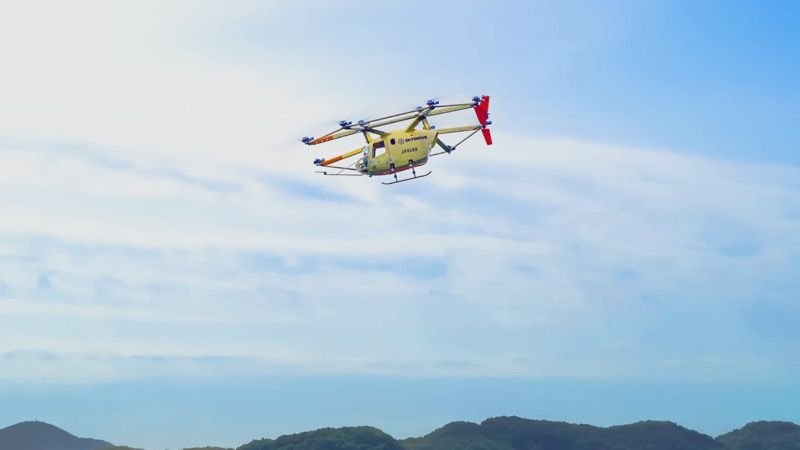
Japan’s SkyDrive has flown its SD-05 aircraft at 62mph (100km/h), a speed the developer considers viable for commercial short-hop inter-urban air mobility and a marker of progress toward type certification.
The high-speed test campaign verified the aircraft’s stability, controllability and maneuverability at speed, alongside the performance of its propulsion systems, flight control systems and on-board avionics. The data allows SkyDrive’s engineers to confirm the accuracy of the aircraft characteristics and dynamic behavior predicted through earlier design and analysis work.
The Japan-based company said high-speed flight is a critical stage of development because aerodynamic forces, vibrations, structural loads and flight control response all change and interact in complex ways. Flight testing is the only means of verifying whether design-phase predictions accurately describe in-flight behavior, and a divergence between predicted and observed data can require additional testing, design changes or revised development plans.
The SD-05 architecture uses 12 independent rotors under the control of a central flight control system. The recent tests confirmed that this configuration functions as designed in high-speed forward flight.
Skydrive said the results showed the observed flight characteristics matched expectations from the design and analysis phase, with the stability, controllability and structural integrity of the aircraft confirmed.
SkyDrive’s multicopter design is aimed at applications in urban airspace. The developer said the compact configuration allows greater flexibility in take-off and landing locations and keeps the aircraft structure and operations simple, reducing operational costs and improving maintainability.
Because the concept is distinct from conventional fixed-wing aircraft and helicopters, SkyDrive said it cannot rely on data collected from existing commercial aircraft, making flight-test verification of high-speed safety and the feasibility of the compact multicopter design particularly important.
The 62mph milestone comes after running simulations, wind tunnel testing, ground tests and standalone testing of batteries, motors and rotors. Aerodynamic performance testing was conducted in the wind tunnel at JAXA, the Japanese space agency, with development experience dating back to the company’s SD-03 prototype and several hundred subsequent test flights.
SkyDrive said engineers and pilots have used data from low- and mid-speed flights to decide at each stage whether to proceed with faster, expanded flight profiles. The company plans to continue high-speed testing to expand the flight envelope and gather the data required by regulatory authorities, with commercial operations planned to begin in 2028.
