


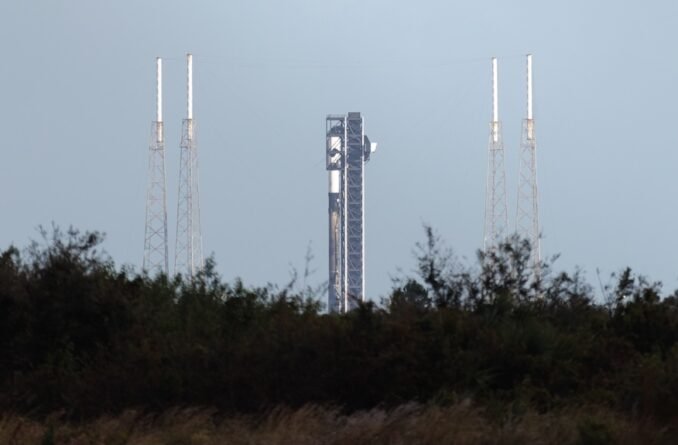
Update May 1, 12:21 p.m. EDT (1621 UTC): SpaceX pushed back the T-0 liftoff time.
SpaceX is kicking off the month of May by launching a batch of Starlink V2 Mini satellites into low Earth orbit. The Falcon 9 rocket will take off from Cape Canaveral Space Force Station Friday afternoon.
The Starlink 10-38 mission carries with it a batch of 29 broadband internet satellites, adding to the megaconstellation that currently consists of more than 10,000 spacecraft. This will be the 43rd mission of the year featuring Starlink satellites as the primary payload.
Liftoff from Space Launch Complex 40 is scheduled for 2:06:10 p.m. EDT (1806:10 UTC). The Falcon 9 rocket will fly on a north-easterly trajectory upon leaving the launch pad.
Spaceflight Now will have live coverage of the mission beginning about an hour prior to liftoff.
The 45th Weather Squadron forecast an 80 percent chance for favorable weather during liftoff. Meteorologists said they are watching for possible violations of the cumulus cloud and thick cloud layers rules.
“For the launch window on Friday, showers may develop along the sea breeze which will be pinned to the coastline due to offshore flow,” launch weather officers wrote. “The Cumulus Cloud Rule will be the primary concern with sea breeze development, with secondary Thick Cloud Layers Rule concerns due to the boundary proximity to the north.”
SpaceX will launch the mission using the Falcon 9 first stage booster with the tail number B1069. This will be its 31st flight following missions, like CRS-24, Eutelsat Hotbird 13F, and 26 batches of Starlink satellites.
Nearly 8.5 minutes after liftoff, B1069 will target a landing on the drone ship, ‘A Shortfall of Gravitas’, positioned in the Atlantic Ocean. If successful, this will be the 149th landing on this drone ship and the 607th booster landing to date for SpaceX.
The company recently retired its other East Coast drone ship, ‘Just Read the Instructions’, and is repurposing it as a transport vessel for its Starship rocket program.
