


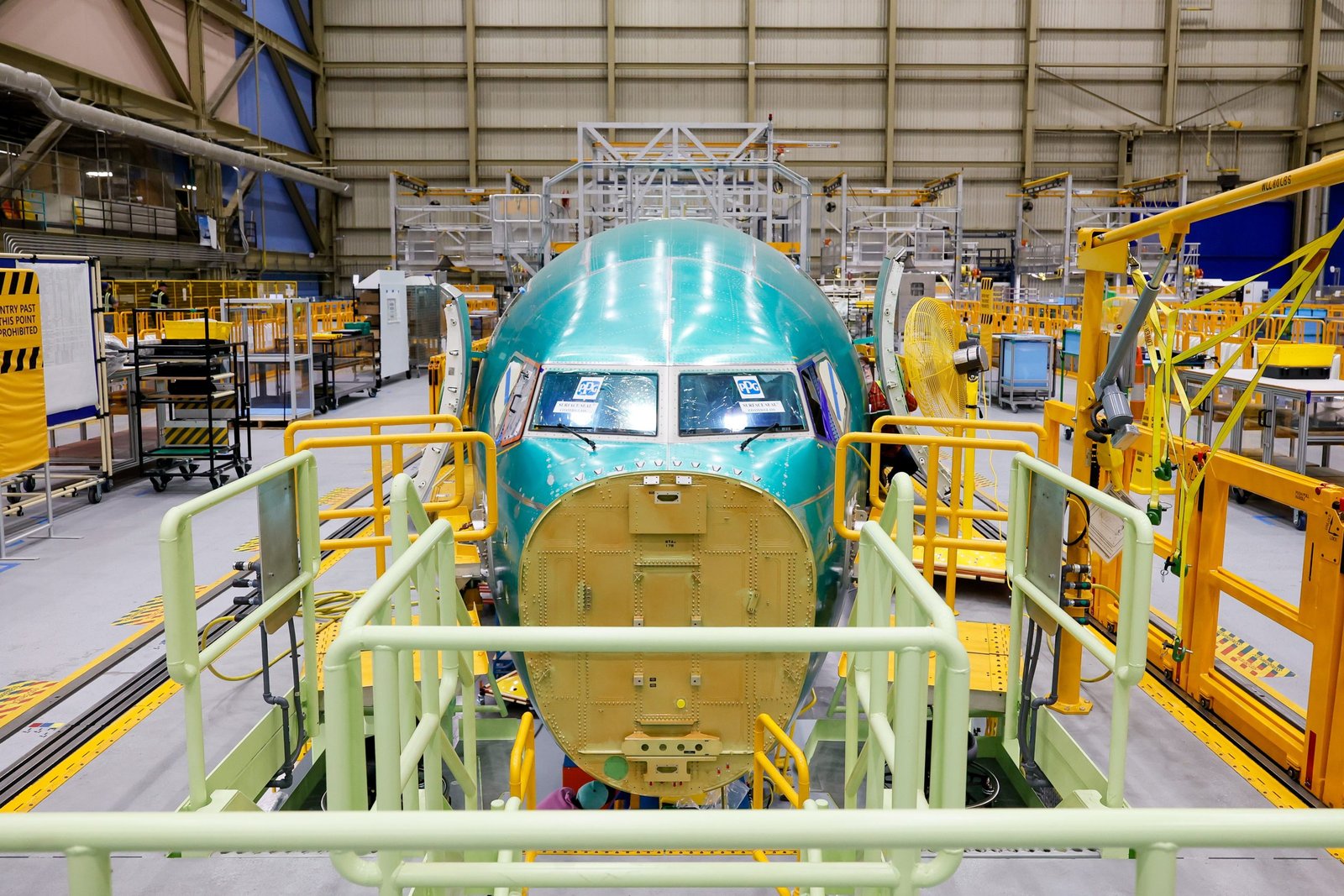
Airframer reveals a North Line layout it says will fuel production ramp while ensuring quality is maintained.
It was 11 years ago that Boeing opened a third 737 assembly line at its Renton site with the goal of increasing output from 42 to 52 jets monthly.
By 2018, the airframer had hit that 52-per-month target and was shooting for rate 57 the following year.
But the 2019 737 Max grounding prompted Boeing to haul back output and production never recovered amid the ensuing Covid-19 pandemic and a string of high-profile quality problems.
Fast forward to today and Boeing is working to hit rate-52 for the second time. But on this occasion it intends to do so not only using the three Renton lines but also with a newly opened fourth line 30 miles (48km) up the road in Everett.
The “North Line”, a $1 billion project, became operational on 6 July when workers started outfitting a 737 Max 10 fuselage destined for eventual delivery to Canadian carrier WestJet. The milestone marks the most significant 737 production change since Boeing began assembling the narrowbody in Renton in 1970.
“We’re going to be building the exact same way, so it is a collaboration of both sites,” Boeing North Line senior director Jennifer Boland-Masterson said on 8 July speaking on the Everett factory floor.
Located in a space where Boeing formerly built 787s (it has since consolidated Dreamliner production in South Carolina) the North Line represents more than an expansion in final assembly capacity. It reflects an effort by Boeing to increase production without sacrificing quality and without pushing Renton to its limits.
Boeing revealed its North Line plan in early 2023 while crawling back from the two 737 Max crashes and an emerging pattern of quality problems. Its troubles worsened in January 2024 when an Alaska Airlines 737 Max 9’s mid-cabin door-plug blew out in flight – the result of poor guidance and oversight by Boeing and of Renton workers failing to install four bolts, the National Transportation Safety Board found.
Public outcry and investigations followed, and the Federal Aviation Administration (FAA) capped 737 output at 38 jets monthly.
Boeing subsequently doubled down on a safety and quality overhaul. It replaced former chief executive David Calhoun with Kelly Ortberg, a longtime aerospace executive, and in 2024 acquired Spirit AeroSystems, the Wichita 737 fuselage supplier responsible for some of the quality lapses.
Boeing has since slowly ramped Renton’s 737 output, saying in May it is accelerating from 42 to 47 jets monthly, with a bump to 52 to follow.
That is where the North Line comes in: Ortberg says the Everett expansion will make rate 52 possible and enable production to soar even higher.
The company this week opened the North Line to reporters, detailing an assembly process closely matching Renton’s. And on 10 July it will host workers and local and national lawmakers at the North Line to mark the site becoming operational.

The North Line occupies the east side of Boeing’s sprawling Everett site, and like Renton contains 10 production stations.
Also like Renton, the North Line will receive 737 fuselages from Wichita by train – a spur off the rail line leading to Renton connects to Everett.
Boeing will not produce 737 wings in Everett. Renton will retain that work, shipping the wings – painted, sealed, tested and mated to wing-boxes – via road to Everett.
North Line workers receive the wings and fuselages through a massive north-side door.
They roll the wings on dollies to the WSI – wing system installation area – for outfitting with plumbing, electrical and other components, including some flaps.

Using a crane, they lift and lower newly arrived fuselages to position 1 at what Boeing calls the FSI (fuselage system integration) tool. It encompasses line positions 1-3 and includes four bays, each capable of accommodating one fuselage. Boeing reserves bay A for “contingency” work like repairing damage sustained during shipping.
Assembly starts in bay B – position 1, where workers install insulation, wiring and some electronics. Fuselages then move to FSI bays C (position 2) and D (position 3).
Next, Boeing moves fuselages out of the FSI to position 4, where workers mate the wings. From there, aircraft progress down the line though position 10, after which they undergo testing prior to customer handover at the Everett Delivery Center.

Production positions
1: Inspect fuselage; install dorsal fin, insulation and electronic, hydraulic and mechanical systems
2: Install wires, tubes, flight-control cables and wi-fi antenna
3: Connect wires and tubes to electric and hydraulic modules; test hydraulic system; install flight-deck panels and protective radome
4: Install wings, horizontal and vertical stabilisers and landing gear
5: Pressure-test fuel tanks; connect rigging to flight-control system; install electric systems and rear galley/lavatories (including water tanks)
6: Power up systems; introduce oil; complete air distribution systems; mechanical and electrical tests; install sidewalls, overhead bins and forward galley/lavs
7: Pump cabin with air, check leaks; inspect and clean fuel tank; check landing gear and flight-control systems
8: Install carpets and seats; check flight controls and hydraulics; inspect for defects and debris
9: Install engines; final inspections
10: Remaining installations, testing and inspections.
The North Line has 20% more space than the entire Renton site and can accommodate Max 10s, the largest variant of the narrowbody family, in each position. At Renton, by contrast, Boeing must position a shorter Max 8 after each Max 10.
The extra space also allows the North Line to accommodate four “slant positions” reserved for jets needing additional work, with two designated for complex lie-flat seat installations, says Boland-Masterson. At Renton, Boeing completes such work outside.
The North Line will primarily receive parts from a nearby warehouse, not from Renton’s stock. Boeing has already staffed the North Line with some 1,000 employees – half Renton veterans and half new hires trained in Renton.
Boeing intends to produce Max 8s and 9s on the new line, but not Max 7s, the smallest variant of the narrowbody.
Approvals outstanding
This week, the WestJet-bound Max 10 fuselage was the lone in-production jet on the line, sitting in position 1.
Boeing declines to say how quickly that aircraft will progress through assembly, but several hurdles remain before WestJet can take ownership.
For starters, neither the Max 10 nor 7 are certificated, though Boeing aims to gain both approvals this year. The Max 7’s certification could come in July, according to a 9 July Wall Street Journal report, with the Max 10’s clearance to follow.
Boeing also cannot deliver North Line-built jets until the FAA approves the site under the airframer’s existing “PC700” 737 production certificate.
When that sign-off might come remains unclear and Boeing declines to comment.
“The FAA will determine when we get that,” Boland-Masterson says. “They are auditing to ensure that we are building to our engineering drawings and following our quality management system.”
For now, Boeing is running the North Line at low-rate initial production – a slow pace during which it intends to perfect its processes with an eye on quality.
“We’re going to go a little slower to make sure that we’ve got everything that we need to build up speed,” Boland-Masterson says.
Subscribe to gain access to all news
Already have a subscription? Log in.
Choose your subscription
Considering a corporate subscription? Contact us to find out more.
