


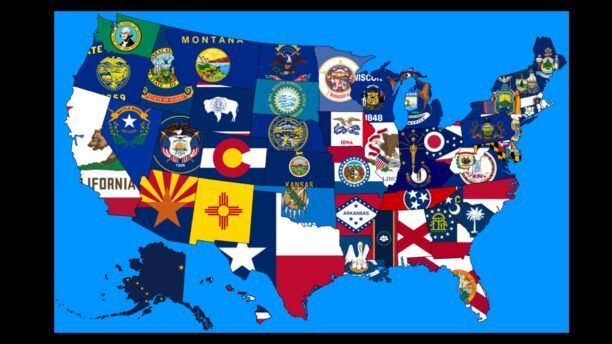
New restrictions in California, Arizona, and Alabama highlight differences in state regulations and raise questions about federal airspace authority.
By DRONELIFE Features Editor Jim Magill
As states and local municipalities push to impose regulations to protect event venues from unwanted UAV incursions, drone operators and industry advocates are concerned that the new rules are creating a patchwork of laws and ordinances, many of which eventually could be pre-empted by federal airspace regulations.
California, Arizona and Alabama have all recently passed state laws that seek to limit drone overflights of venues during events such as concerts and monster truck rallies. Marshall White, founder of airspace intelligence platform UAShield, said laws such as these could prove to be problematic for operators who fly drones as part of their business operations, as well as for recreational UAV pilots.
“Until fairly recently, following ‘the rules’ generally meant abiding by FAA regulations. In contrast to state and local laws, these are fairly easy to identify and monitor, as federal law is generally standardized in its delivery and availability. That is not at all the case with state and local regulations,” White said in an email statement.
Although the new laws in the three states — California’s AB 2113, Arizona’s SB 1160 and Alabama’s HB 429 — are similar, they differ in some significant respects.
“One notable exception is that California clearly outlines venue capacity (1,000 or more people), while Arizona does not. This puts additional burden on operators that have to verify precise seat counts at venues prior to flying,” White said.
Another aspect in which the laws differ is in the area of restricted airspace surrounding an event venue. The California and Alabama laws prohibit drone flights within 400 feet of a venue, while the Arizona law sets off an area within a one-mile of the site.
All three new laws contain exemptions for drone operators, such as obtaining written consent from a person with legal authority over the ticketed entertainment event, or acting as an employee of a regulated utility performing official business duties.
In addition, California’s AB 2113 creates an exemption for operators: holding an FAA certificate who are authorized to conduct commercial BVLOS operations; and who are operating in compliance with all applicable federal regulations. The Alabama law provides drone flight exemptions if “the operator is authorized by federal regulations to operate an unmanned aircraft system and is operating the system in a lawful manner consistent with federal regulations.”
White said the type of exemptions each statute offers provides a major contrast among the different laws.
“California exempts venue consent (often impractical), utility and emergency personnel (a small minority of commercial operators), and FAA-authorized commercial BVLOS, but a routine Part 107 flight isn’t exempt on its own. Arizona appears to exempt all FAA-compliant flights,” he said.
“This difference in the fine print only serves to create additional confusion for otherwise law-abiding operators.”
Another difference among the three states’ laws is the severity of the fine. California and Alabama’s laws carry a $500 fine for violations compared with the Arizona law’s much more stringent penalties of up to six months in jail and a $2,500 fine.
White said he believes several of the drone laws passed by individual states could face challenges under the federal pre-emption doctrine, which gives the regulation of the U.S. airspace to the FAA.
“I believe that state regulations like this set a confusing (and dangerous) precedent. I believe this is true of Arizona’s version of the law in particular,” he said. “While a 400-foot bubble (California’s version) is one thing, Arizona’s 1-mile bubble is another thing entirely.”
In addition, by creating a “patchwork” of rules regarding drone operations the states are creating unnecessary burdens on drone operators who already have too many tasks to juggle.
“This patchwork either needs to be woven into a single, seamless tapestry and standardized across states and venues with a centralized notification system (which sounds like what the FAA already has), or states should stick solely to enforcing the act of launch and recovery from the ground.”
Challenging Alabama’s ticketed-event law
Some of the newly enacted state laws already are getting pushback from commercial drone operators. For example, in Alabama Kevin Henderson, owner of drone photography company SkyBama, recently spoke out against a move by the Birmingham City Council to consider adding a $500 first-offense fine for violations of Alabama’s law restricting drone over ticketed events, which went into effect October 1.
Henderson, whose business includes capturing newsworthy drone-captured images for publication, said the state law and the city-imposed fine could interfere with his livelihood.
“I cover a lot for news and events,” he said in an interview. “Let’s say a musical artist is coming to Birmingham and they haven’t been here in 20-something years and it’s a massive concert.” He said he should be able to launch his drone, snap a photo, and then land, as long as he’s following all FAA regulations.
“What they passed in Alabama, in my opinion, doesn’t hold any weight in court, especially with First Amendment issues,” he said. “But it does give police a reason to hand you a $500 fine, possibly confiscate your equipment, and could cause you to lose your shot even if you’re following all FAA regulations.”
He added that the state law is poorly written in how it delineates the 400-foot boundary within which drone flight is prohibited. “So, how are they going to define 400 feet? Does it start from the stage? Does it start from a property line, a fence, a road?” he asked. “And once they determine that, how is an officer going to know if you were 380 feet away from something or 450 feet away from something?”
Henderson said the new regulations would put the onus for deciding what constituted a violation on the local police, who are not trained in the enforcement of aviation rules. “Are they just going to say, ‘Okay, I see you flying a drone. You’re near the event. Here’s your ticket. We’ll see you in court,’ or will they confiscate your equipment or arrest you?”
In the past Alabama’s drone industry advocates had successfully managed to thwart legislative efforts to pass bills that would create new restrictions.
“The state has tried to create several drone bills over the past, I guess maybe eight years or so, and we’ve pushed back really hard. And I was honestly very surprised that this ticketed event one made it through, but somehow it did,” Henderson said.
He said that while some state regulation of the industry – such as restrictions on flying above critical infrastructure sites – might make sense, others – such as the ticketed-venue law – would prove to be too onerous for the drone-flying community.
“You just don’t want to interfere with legal operations of people that are doing their work or enjoying their hobby and not doing anything unsafe and just enjoying the day. It’s a big balancing act between state officials and the regular drone operator,” he said.
Read more:

Jim Magill is a Houston-based writer with almost a quarter-century of experience covering technical and economic developments in the oil and gas industry. After retiring in December 2019 as a senior editor with S&P Global Platts, Jim began writing about emerging technologies, such as artificial intelligence, robots and drones, and the ways in which they’re contributing to our society. In addition to DroneLife, Jim is a contributor to Forbes.com and his work has appeared in the Houston Chronicle, U.S. News & World Report, and Unmanned Systems, a publication of the Association for Unmanned Vehicle Systems International
