

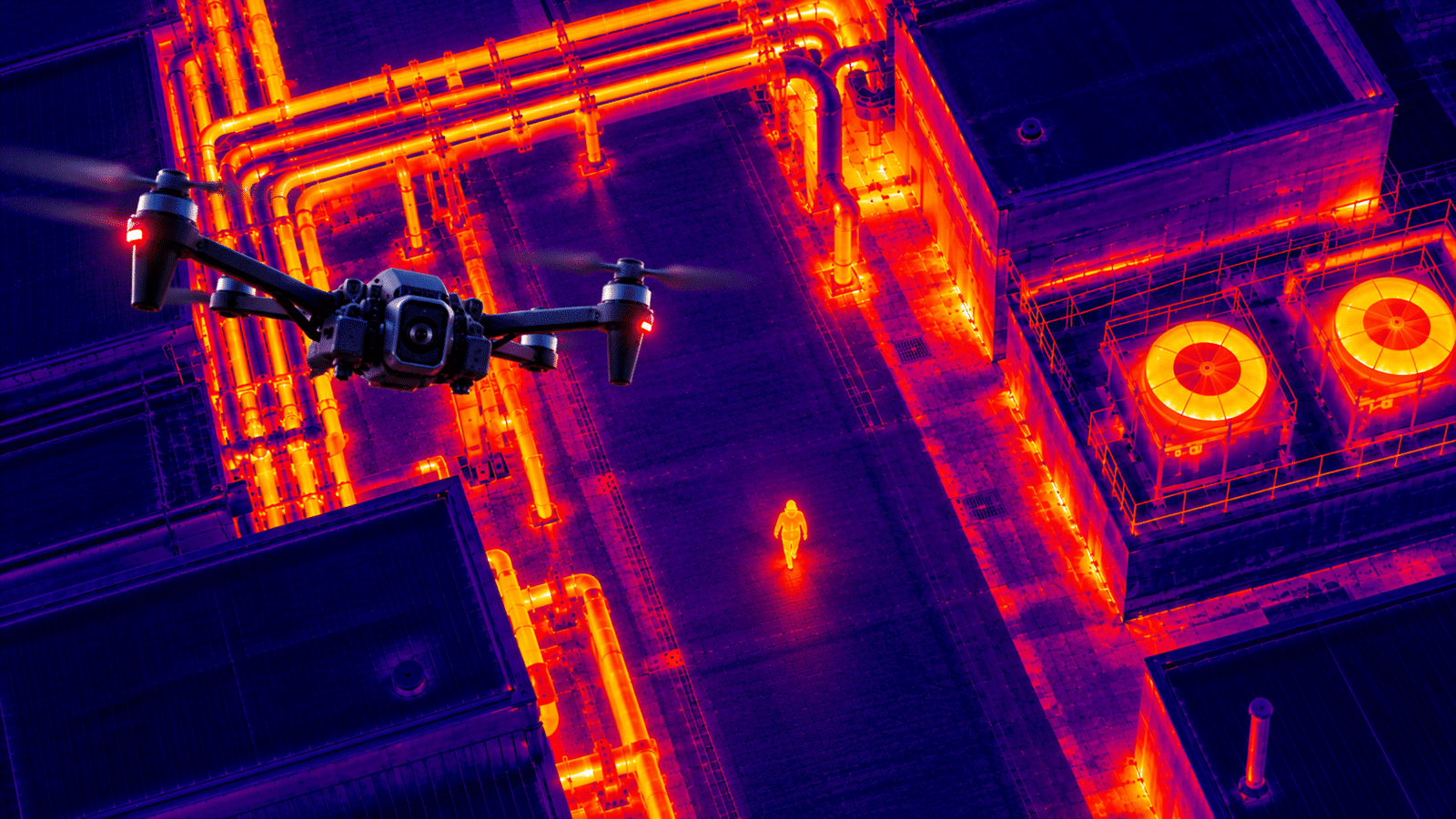
SunTek Thermal’s IR-1 NX platform helps UAV and counter-UAS manufacturers reduce development time by simplifying thermal imaging and onboard AI integration.
The push to expand U.S. drone manufacturing is placing new demands on aircraft developers. Manufacturers must bring new systems to market quickly while adding capabilities such as thermal imaging, onboard artificial intelligence, and advanced sensors.
Increasing production capacity is only part of the challenge. Before manufacturers can build drones at scale, they must integrate complex technologies into reliable, flight-ready systems.
For many engineering teams, that integration process can become a significant bottleneck.
“Integration is usually where the schedule slips,” according to the team at SunTek Thermal, a thermal imaging technology developer and authorized Teledyne FLIR OEM partner.
SunTek estimates that integrating cameras, processors, and supporting software can take six to twelve months, depending on the project. The work includes developing camera drivers, coordinating thermal and visible imagery, and validating the complete system on flight hardware.
As demand grows for more capable drones, reducing that development time can help manufacturers respond more quickly to customer requirements.
The Challenge of Integrating Thermal Imaging and AI
Thermal imaging plays an important role in drone applications ranging from public safety and infrastructure inspection to military reconnaissance and counter-UAS operations. Combined with onboard AI processing, thermal and visible-light cameras can support applications such as object detection, tracking, and sensor fusion.
However, connecting these technologies requires specialized engineering.
“Drone teams are usually excellent at airframes, autonomy and flight software. Kernel-level camera bring-up is a different specialty.”
One particular challenge involves MIPI CSI-2, an interface that allows cameras to transmit image data directly to embedded processors. It can provide a low-latency connection suitable for applications involving multiple sensors.
Making that connection work requires developers to configure hardware, integrate drivers into the operating system, and resolve timing issues between camera streams.
These tasks can consume engineering resources that manufacturers would otherwise devote to developing their aircraft and applications.
SunTek’s Approach: Reducing Integration Work
SunTek Thermal developed its IR-1 NX platform to simplify this process.
The platform combines NVIDIA Jetson Orin AI computing with pre-integrated support for Teledyne FLIR Boson+ thermal cameras and the Hadron 640R dual thermal and visible-light camera module.
Rather than requiring developers to build camera interfaces from scratch, SunTek provides a system image with the necessary drivers already installed.
The Boson+ MIPI CSI-2 driver is integrated into the Jetson software environment, allowing the camera to appear as a standard V4L2 video device when the system first starts.
This allows engineering teams to begin developing applications involving image processing, sensor fusion, detection, and tracking without first completing the underlying camera integration.
The platform offers four NVIDIA Jetson Orin NX and Orin Nano configurations, allowing manufacturers to select computing capabilities based on their application requirements.
From Prototype to Production
SunTek also designed the IR-1 NX platform to address another common challenge: moving from a working prototype to hardware suitable for production.
The company offers two versions of the platform.
The IR-1 NX Development Board provides standard connectors for laboratory testing and engineering work. Developers can connect cameras, test applications, and refine their designs.
The IR-1 NX Deployment Board uses production-grade wire-to-board connectors designed for integration into finished systems.
Both boards share the same computing options, carrier architecture, and validated software environment.
“Moving to production changes the connectors, not the software, so the camera driver stack doesn’t have to be ported again during the transition.”
Both versions arrive assembled, pre-flashed, and functionally tested. According to SunTek, this approach eliminates the need for initial board bring-up and custom camera driver development while reducing repeated integration work.
SunTek also draws on its experience developing thermal imaging systems and manufacturing payload components. The company says its in-house capabilities allow it to support customers through design changes and production runs ranging from hundreds to several thousand units annually.
Supporting Faster Drone Development
The importance of development speed is particularly clear in the defense drone market, where manufacturers face pressure to deliver new capabilities and respond to changing operational requirements.
The U.S. Drone Dominance Program illustrates the scale of that demand. The Department of War has outlined plans to acquire tens of thousands of drones through a competitive process designed to accelerate the delivery of capable systems.
For manufacturers developing aircraft that require thermal imaging, nighttime operation, or onboard image processing, reducing the time needed to integrate sensors and computing hardware can help shorten the path to deployment.
SunTek says it is already supporting several U.S. customers through product launches and production ramp-up, including expedited development and manufacturing of electro-optical and infrared payloads.
The company sees this as part of a broader shift toward pre-integrated technologies that allow drone manufacturers to concentrate their engineering resources on the capabilities that distinguish their products.
As U.S. drone manufacturers work to increase production and deliver more advanced systems, solutions that simplify technology integration may become an increasingly important part of the development process.
For companies building thermal-enabled drones, the ability to move from a working prototype to a production-ready design without repeating complex camera integration work offers a practical way to accelerate development.
Read more:
