


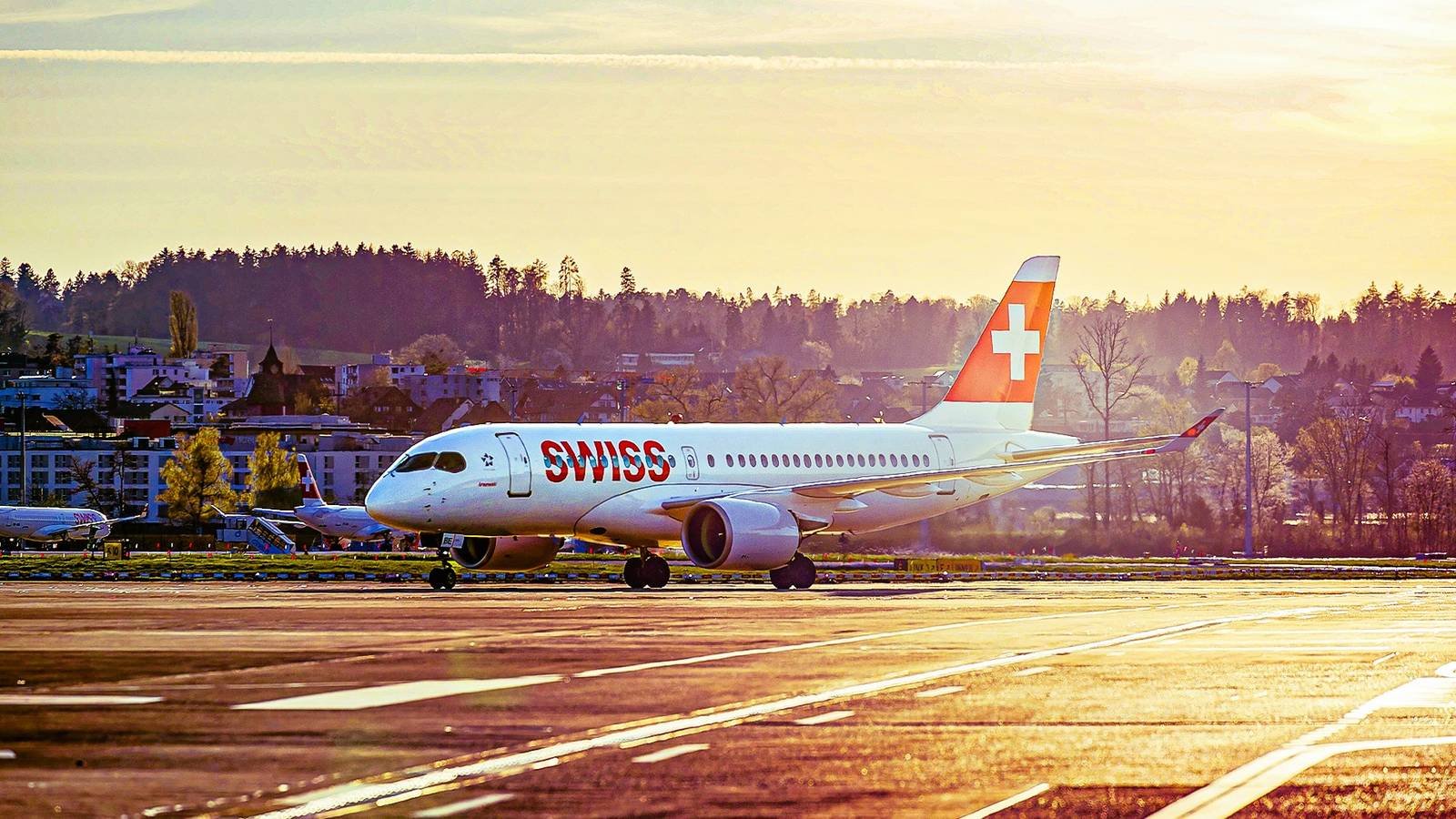
SWISS is preparing to withdraw the aircraft that introduced the Bombardier CSeries — and ultimately the Airbus A220 — to commercial service. Only four of the airline’s original nine Airbus A220-100s remain operational, but all are expected to leave service by the end of 2027. Two of the aircraft are already being parted out, meaning the launch customer is moving toward operating without the smaller A220 variant barely a decade after its historic first flight.
The decision does not represent a retreat from the A220 family. Instead, SWISS is sacrificing its smaller 125-seat aircraft to protect the availability of its 21 larger, 145-seat Airbus A220-300s. What began as a temporary response to engine shortages caused by the Pratt & Whitney geared turbofan debacle has evolved into a permanent fleet strategy. Now the airline that launched the A220 has concluded that its limited engines, components and maintenance resources generate more value when directed toward the larger variant.
SWISS Has Set An End Date For The A220-100
SWISS originally operated nine A220-100s, but the sub-fleet has already been reduced substantially. While four remain in limited service, three have been placed into long-term storage, and two — HB-JBC and HB-JBD — are being dismantled. The four active aircraft are expected to be withdrawn by the end of 2027 and stored, leaving SWISS planning its medium- and long-term operation without the variant.
Current Status Of SWISS’ A220-100 Fleet | |
|---|---|
A220-100 status | Aircraft |
Remaining in service | 4 |
Already stored | 3 |
Being dismantled | 2 |
Originally operated | 9 |
The two aircraft being dismantled are particularly significant because both are less than 10 years old. They had been stored at Toulouse-Francazal, but SWISS concluded that their Pratt & Whitney PW1500G engines and other usable components would be more valuable supporting the A220-300 fleet than preserving the aircraft for a possible return to service. The airline says the move should improve the availability and operational reliability of the larger variant.
That represents a clear progression from SWISS’s position earlier in 2026. When the part-out plan first emerged in May, the airline said it had not decided whether its other parked A220-100s would be retired or returned to service once the engine situation improved. The end-of-2027 withdrawal plan effectively answers that question: rather than rebuilding the smaller sub-fleet, SWISS is preparing to consolidate around the A220-300.
Why The Larger Airbus A220-300 Won

The catalyst was the continuing disruption surrounding Pratt & Whitney’s geared turbofan engines. The Lufthansa Group 2025 Annual Report said that between four and six SWISS A220s had been unavailable at any given time during the year while their engines underwent early inspections and overhauls to replace affected components. With the situation expected to continue into 2026, SWISS decided to assign its available engines to the A220-300 and park the A220-100s.
The choice is easier to understand when the two variants are placed side by side. SWISS configures the A220-100 with 125 seats and the A220-300 with 145, allowing the larger aircraft to carry 20 more passengers, or 16% more capacity. Both belong to the same aircraft family and use variants of the PW1500G engine, so every engine and maintenance slot committed to a -300 can restore more seats to the airline’s schedule.
SWISS A220-100 vs A220-300 | ||
|---|---|---|
Measure | A220-100 | A220-300 |
Aircraft originally acquired | 9 | 21 |
SWISS seating capacity | 125 | 145 |
Additional seats per aircraft | — | 20 |
Capacity advantage | — | 16% |
Long-term status | Being withdrawn | Retained |
Sub-fleet size strengthens that calculation. SWISS has more than twice as many A220-300s as A220-100s, while the smaller fleet has already been reduced to only four operational aircraft. Maintaining a tiny sub-fleet requires continued scheduling, spare parts and technical support, even as it becomes less flexible and more vulnerable whenever another aircraft is unavailable. By dismantling two -100s and redirecting their components, SWISS can use the smaller variant to improve the reliability of the aircraft it has chosen to retain.
The Airline That Introduced The A220 To The World

The A220-100’s departure will nevertheless carry considerable historical weight. In March 2009, SWISS and Lufthansa Group committed to 30 Bombardier CSeries aircraft, becoming the new program’s launch customer. Twenty were initially intended to replace SWISS’s four-engined Avro RJ100s, while ten additional aircraft would support further growth in its European network.
At the time, the CSeries promised a substantial generational improvement. SWISS projected that the new aircraft would consume more than 25% less fuel than the Avro RJ100, cut annual carbon dioxide emissions by approximately 90,000 tons, and offer per-seat costs that were more than 10% lower. The aircraft was also expected to be substantially quieter, helping SWISS address the noise constraints surrounding airports such as Zurich Airport (ZRH) and London City Airport (LCY).
The defining moment came on July 15, 2016, when CS100 HB-JBA operated flight LX638 from Zurich to  Paris Charles De Gaulle Airport (CDG). It was the first commercial flight by any Bombardier CSeries aircraft, with then-chief commercial officer, Markus Binkert, describing the aircraft as a new benchmark for regional flights:
“The Bombardier CS100 is a class act in every respect: comfort, economics and environmental credentials.”
The airline initially planned to acquire 15 CS100s and 15 larger CS300s, although the final fleet evolved into nine of what became the A220-100 and 21 A220-300s. The A220-100 therefore accomplished the central task SWISS had assigned to it. It replaced an aging, inefficient regional fleet, introduced quieter and more economical technology, and helped establish an aircraft program that survived Bombardier’s financial difficulties before being taken over and renamed by Airbus.
Its unusually early departure does not erase that contribution; it shows how quickly fleet economics can change when engine availability becomes constrained and a larger variant offers more capacity from the same basic platform. While the -100 introduced the aircraft family to the world, when SWISS was forced to choose between the two variants, the -300 proved to be the version it needed most.
