


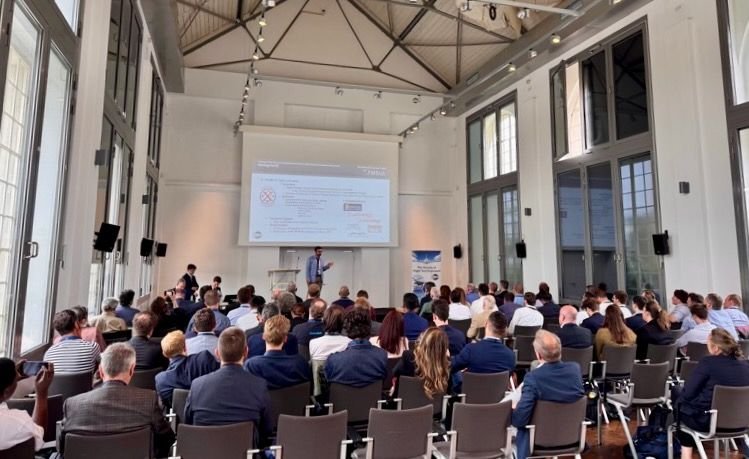
The 2026 Society of Flight Test Engineers (SFTE) European conference was held in Berlin on June 8-9, just before the ILA Berlin Airshow. The conference featured more than 20 presentations about flight testing, a selection of which is outlined below.
The conference neatly showcased how the flight test community is dealing with the demands being placed upon it during a transformative time for aerospace, without compromising on the unwavering requirements of safety and certification.
Presentations by flight test professionals from around the world covered topics such as technical efficiency, rapid military integration, digital transformation and the ethical management of institutional drift.
Novel digital tools
On day one Ata Esfahani, flight test engineer, Gulfstream, describes his company’s approach to innovation and three tools that it has developed. The business jet maker used its AI-enabled flight planner Aiden in fuel efficiency test campaigns for its G400 and G800 aircraft. By using jet stream forecasts to identify parallel wind locks, the tool reduced test-repeat rates from 32% to just 5%, saving the company more than US$1m.
Meanwhile representatives from DLR presented its progress toward a paperless future for flight test – the TwinSight and TwinSash platforms. They aim to create an end-to-end digital ecosystem, traceable with reports produced within minutes.
Rapid integration and portable tracking
Several presentations during the SFTE conference focused on defense applications. For example, the RAF’s MQ-9 Bravo project demonstrated “rapid first of type” integration of the Brimstone weapon under a six-week directive and no budget. UK airspace and weather constraints necessitated a simulator-heavy, incremental build-up to prove the kinetic chain, to meet the tight deadlines.
Meanwhile, Jesus Javier Fernandez Orio and Alonso Pardo from INTA (the National Institute for Aerospace Technology, Spain) provide the latest updates from the EXAELIA (Experimental Aircraft for European Leadership in Aviation) program. As part of the program engineers in Spain have developed SPOTS (Small Portable Optical Tracking System).
SPOTS can be transported in a van to remote ranges for trajectory tracking where permanent infrastructure is impractical. The system can be set up in approximately one hour and offers a low-cost alternative for tracking UAVs and verifying control algorithms.
Institutional drift
Despite these advancements, there was also lively discussion of the challenges flight test professionals can experience, and how to deal with them.
On day one Jaime Hale warns of “institutional drift,” where pressures from elsewhere in the organization gradually shift the definition of acceptable risk. This friction was evident in her Volocopter case study, where she says EASA initially imposed a “five-minute” limit on the first crewed VoloCity flight because it “felt appropriate,” despite data supporting longer durations.
Hale proposes three “inoculations” against drift: independent safety reporting, experienced aviation leadership and documenting dissent registration.
Meanwhile on day two Nick Caccavaco and Becky Read from Airbus’s MAP (Mise au Point) department, the team responsible for resolving technical issues during final assembly and flight testing, highlight the pressures experienced to achieve end-of-year delivery targets for aircraft. They present a case study of snags such as the Trent 7000 fire detection issues, which technical analysis revealed were caused by potting compound expansion due to moisture during storage.
They conclude that resolving major snags depends on seamless teamwork across departments. This involves coordinating between the flight test department, final assembly lines, design offices and external suppliers such as Rolls-Royce.
Power and endurance
On day two, the focus of talks shifted to how innovation and operational constraints intersect, first with Boris Boing from NLR’s presentation on evaluating electric propulsion and ground-based realities.
Boing describes how modern certification is grappling with the challenges of preserving battery health in electric aviation via research on the Pipistrel Velis Electro, which compared the effects of reduced-power take-offs versus conventional full-power take-offs on the batteries.
Initial results from the flight test program show that battery stress is most severe at low temperatures, particularly when the battery is fully charged. He notes that the worst thing an operator could do is take a cold, fully charged aircraft out of a hangar and immediately apply full power for the first take-off.
This “reality” of electric flight was contrasted by a presentation from Turkish Aerospace Industries about the T-625 helicopter program’s endurance campaign, which substituted 20 months of flight for 76 days of high-workload “tie-down” ground testing.
Both presentations underscored that even ground-based testing requires full flight-test rigor to manage the mechanical limits of the airframe. Ultimately, the presenters conclude that successful testing depends on the careful integration of engineering, safety and human factors, viewing the pilot not just as an operator but as essential for managing unexpected situations.
Boundary layers and flutter analysis
In the general aviation sector, high-fidelity data acquisition must often be achieved through “good enough” instrumentation. Chris Martens from NLR details the use of infrared (IR) thermography for non-intrusive boundary layer transition measurements.
The “hard reality” here is directional emissivity: temperature signals drop drastically at camera viewing angles below 20°. Martens’ solution uses bench-test calibration to ensure research-grade data even when camera placement is restricted by airframe geometry.
Conversely, Lyssandre Ramos, head of flight test engineering at Aircraft Design Certification (ADC), a Germany-based, manufacturer-independent design organization, sets out how to test for flutter properly without expensive instrumentation.
Under EASA’s risk-based proportionality, lower-category aircraft (CS-LSA) use simplified standards. However, as Ramos notes, “an airplane that breaks apart in flight is bad, no matter how big it is.” The tool should be proportionate to the risk: sometimes high-end IR is required, at other times “sophisticated sandbags” are sufficient.
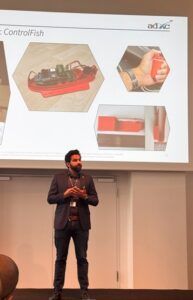
As well as sandbags the team at ADC uses an in-house device called the control fish to measure flutter in aircraft such as the Bristell B 23 and Lightning AC4. The fish allows for the identification of aerodynamically excitable modes without the cost of high-end wind tunnel modeling.
A versatile platform designed to take various sensors, it can include strain gauges for measuring stick forces and potentiometers for tracking stick positions, pressure ports for speed and altitude data, an IMU (inertial measurement unit) for accelerations and orientations, and GPS for positioning.
Considering the human element
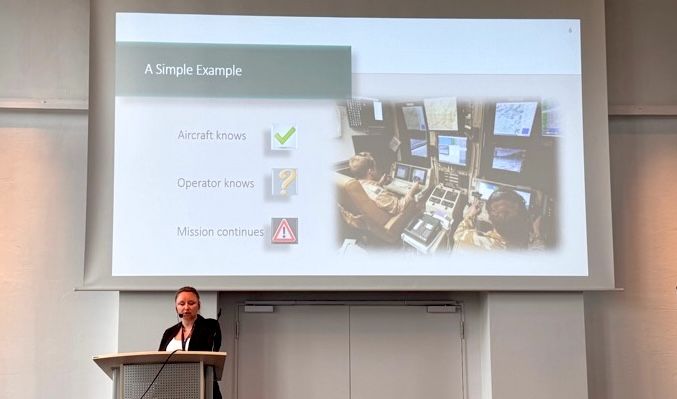
Discussion around risk also moved to consider human factors and the increase of autonomy in aircraft. Magdalena Gryzbek, Typhoon flight test engineer at BAE Systems, highlights how autonomy does not remove complexity but relocates it through a UAV case study where software performed “correctly” by switching modes after a sensor disagreement. However, because the display did not communicate the why, the operator lost confidence.
Her conclusion was perhaps a familiar one for engineers: that “the earlier safety is involved, the easier it is to influence the design.”
Meanwhile also on day two, Mike Bromfield from Myriad’s presentation explored how VR-based upset prevention and recovery training (UPRT) can mitigate the “startle and surprise” response experienced by pilots in loss of control situations while flying. By integrating motion for feedback, VR can address the physiological “freeze” response during incipient spins.
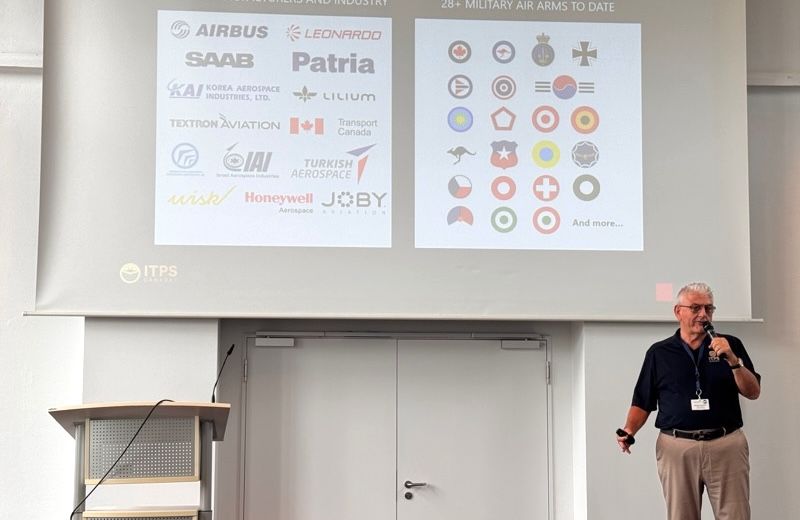
Finally, Giorgio Clementi from the International Test Pilots School (ITPS) talks about how training the next generation of pilots for 5th-generation platforms such as the F-35 can be achieved with modified aircraft such as an L-39 equipped with large-area displays, augmented fly-by-wire flight control systems and variable stability components to simulate high-performance aircraft behavior affordably.
Flight test discipline and integrity
Over the course of two days the conference established several imperatives for the flight test community along its stated theme of how flight test is where dreams meet reality.
Among those lessons were how safety teams must be embedded in the design phase of development to avoid the cost of post-hoc redesigns and how immersive VR is increasingly being seen as a useful training tool. The conference also heard how flight test needs to be pragmatic with equipment, instrumentation and data, especially in the general aviation and electric sectors, where successful certification relies on “good enough” instrumentation backed by rigorous calibration.
So, although commercial pressures, AI and equipment such as SPOTS can increase operational tempo, flight test integrity relies on data being verified, and this represents the core of the profession. Ultimately, the transmission of discipline between engineers remains the industry’s most critical asset.
More information on the SFTE European Chapter can be found here.
