


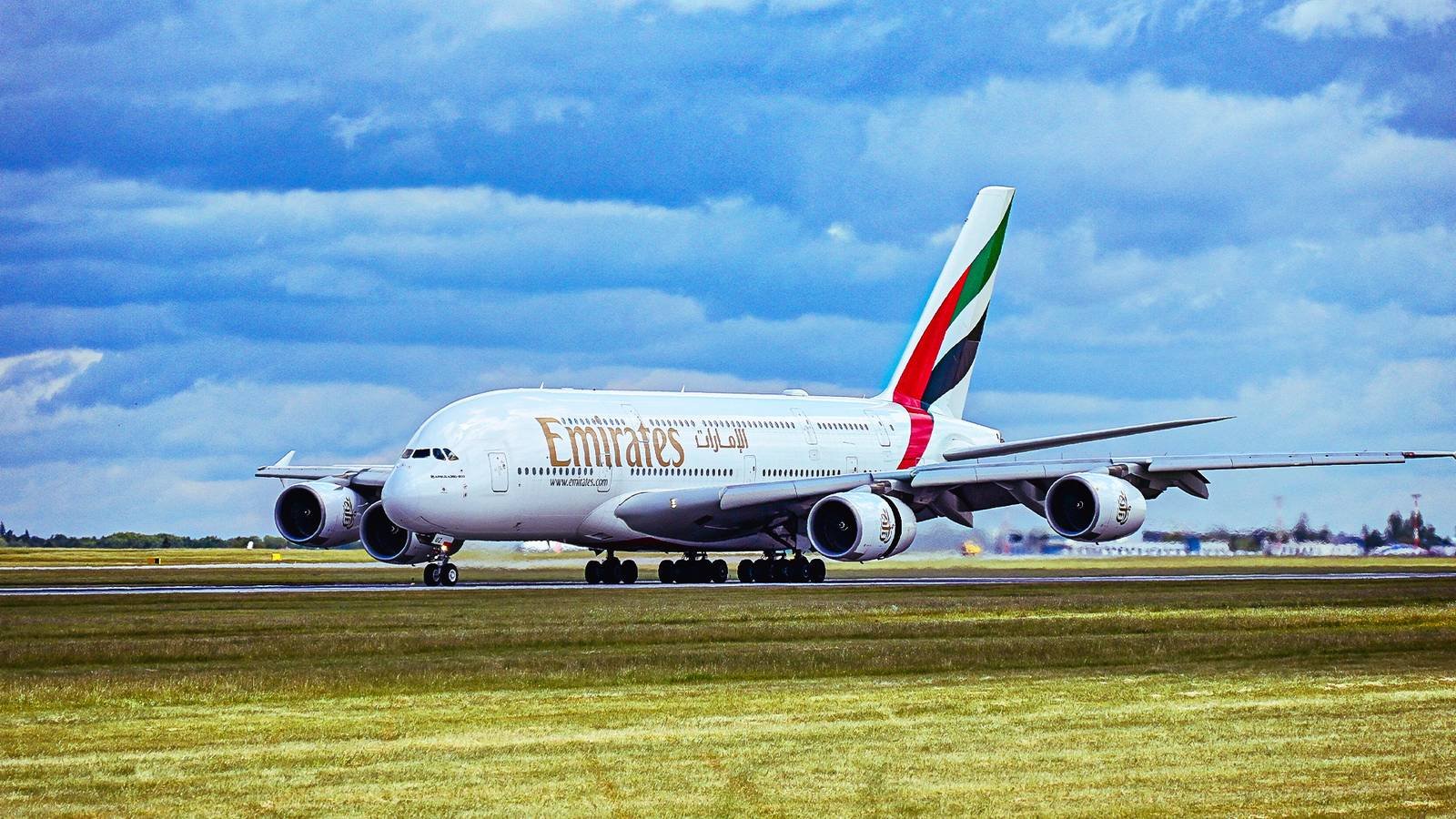
The Airbus A380, the world’s largest passenger aircraft, has four engines, but thrustreversers are fitted only to the two inboard engines (numbers 2 and 3). Unlike most four-engine airliners, the outer engines do not produce reverse thrust after landing. The reason is largely linked to their position beneath the aircraft’s enormous 80-meter wingspan. Located close to the runway edge, the outboard engines would be far more likely to disturb and ingest gravel, dirt and other debris from unpaved margins, increasing the risk of Foreign Object Damage (FOD) to the engines, wings and fuselage.
There are other important reasons behind Airbus’ decision. Each thrust reverser adds significant weight, structural complexity and maintenance requirements, so omitting two of them reduces both aircraft weight and loads on the wing. More importantly, reverse thrust is not required to stop the aircraft safely. The A380 is certified to land using its brakes and spoilers alone, with the two inboard reversers primarily providing additional braking on wet or slippery runways to reduce the risk of aquaplaning. This article takes a closer look at why Airbus chose this configuration and why, for the A380, two thrust reversers provide almost all of the operational benefit of four.
Why The Airbus A380 Only Has Two Thrust Reversers
The Airbus A380 is quite unlike any other commercial airliner. As the world’s largest passenger aircraft, it was designed with engineering solutions that differ significantly from smaller twin-engine aircraft. One of the most noticeable is that, despite having four Rolls-Royce Trent 900 or Engine Alliance GP7200 engines, only the two inboard engines (numbers 2 and 3) have thrust reversers. At first glance, this seems unusual, especially considering that many four-engine aircraft, such as the Boeing 747, have reversers on all four engines. However, Airbus intentionally departed from that convention after extensive aerodynamic, structural, and operational analysis.
Many passengers might think that thrust reversers are one of the most important parts of landing. The loud roar heard immediately after touchdown often creates the impression that reverse thrust is doing most of the work in stopping the aircraft. In reality, this is not the case. Airliners rely primarily on wheel brakes, aerodynamic spoilers, and sophisticated anti-skid systems. Reverse thrust is considered supplementary, helping reduce brake wear and improving stopping performance on contaminated runways rather than serving as the primary braking system.
Understanding why Airbus equipped only half of the A380’s engines with reversers requires looking beyond braking performance alone. Runway geometry, engine placement, certification requirements, aircraft weight, and maintenance considerations influenced the decision. Together, these factors made omitting two reversers not a compromise, but a carefully engineered solution that improved both efficiency and operational reliability.
The Challenge Created By The A380’s Massive Wingspan

One of the biggest reasons behind Airbus’ decision lies in the A380’s enormous size. With a wingspan of 79.75 meters (261 feet), it occupies almost the full span permitted under ICAO Code F airport standards. While the large wing provides the lift needed for an aircraft weighing more than 575 tonnes at maximum take-off weight, it also places the outer engines much farther from the aircraft’s centerline than on smaller airliners.
Catch what other flight trackers miss
Emergency squawks, holds, NOTAMs — live signals, no signup.
Open tracker
Catch what other flight trackers miss
Emergency squawks, holds, NOTAMs — live signals, no signup.
Open tracker
The A380 was designed to operate from Code F airports, which specify a runway width of 60 meters (200 feet). However, many major international airports were originally built to Code E standards, with 45-meter-wide runways designed for aircraft such as the Boeing 747-400. Before the A380 entered service, airports including London Heathrow and Frankfurt invested hundreds of millions of pounds upgrading taxiways, runways and gates to accommodate the superjumbo.
Even on compliant runways, engines 1 and 4 sit much closer to the runway edge than the inboard engines. At airports that were upgraded rather than purpose-built for the A380, the outboard engines can be positioned only a few meters from the pavement edge, placing them close to grass, gravel, or other unpaved surfaces. This positioning became a major consideration when Airbus designed the aircraft’s thrust reverser system.
Protection Against Foreign Object Damage

Foreign object damage, commonly referred to as FOD, is one of aviation’s most persistent maintenance concerns. Even relatively small objects can cause expensive damage when ingested into a high-bypass turbofan engine traveling at high rotational speeds. Compressor blades, fan blades and even the engine core can suffer serious damage from debris, while objects ricocheting from reverse thrust can also strike the wings, landing gear or fuselage. The threat posed by foreign object damage is taken so seriously that many airports and military bases run dedicated FOD prevention initiatives, such as the US Air Force’s “Golden Bolt” program, which rewards personnel for identifying potential FOD hazards on the airfield.
When reverse thrust is deployed, large blocker doors redirect the engine’s fan airflow forwards rather than backward. Although the aircraft continues moving forwards, this redirected airflow creates a braking force by producing thrust opposite to the direction of travel. The powerful airflow also spreads outward across the runway surface, lifting loose material into the air. The closer an engine is to the runway edge, the greater the likelihood that this airflow will interact with unpaved surfaces rather than clean asphalt or concrete.
By restricting reversers to engines 2 and 3, Airbus ensured that the strongest reverse airflow remains concentrated well within the runway boundaries. These engines are positioned safely over the paved center section, reducing the likelihood of disturbing gravel or soil. The result is lower engine wear, fewer maintenance issues, and improved long-term reliability without sacrificing meaningful stopping performance.
Structural Benefits Of Two Thrust Reversers

The absence of reversers on the outboard engines also provides significant structural benefits. A thrust reverser is far more than a pair of moving doors. Each system includes actuators, blocker doors, hydraulic mechanisms, electronic controls, locking devices, structural reinforcements, and extensive nacelle modifications. Together, these components add hundreds of kilograms to each engine installation.
Industry estimates suggest that each large-engine thrust reverser system weighs approximately 500 kilograms or more. Removing two complete systems therefore saves around one tonne from the aircraft. While this represents just 0.17% of the A380’s 575-tonne maximum take-off weight, its location makes the saving far more significant than the figure alone suggests. Because the outboard engines sit farthest from the fuselage, any additional weight acts through a longer lever arm, increasing wing bending moments and structural loads. Removing that mass therefore delivers greater structural benefits than an equivalent weight reduction closer to the aircraft’s centerline.
Weight saved | ~1000 Kg |
|---|---|
Maximum take-off weight | 575,000 Kg |
Weight saving as % of MTOW | ~17% |
The benefits extend beyond simple weight reduction. Every kilogram removed reduces fuel burn over the aircraft’s operational life, producing meaningful savings across thousands of long-haul flights. At the same time, eliminating two complete thrust reverser systems reduces the number of moving parts requiring inspection and maintenance, improving reliability while lowering lifecycle costs. Airbus therefore achieved multiple engineering advantages by removing equipment that wasn’t essential for the aircraft’s certified landing performance.
Why The A380 Doesn’t Actually Need Four Thrust Reversers

Perhaps the biggest misconception surrounding reverse thrust is that it is required to stop an aircraft safely. In reality, certification rules take a conservative approach and do not rely on reverse thrust to demonstrate compliance with landing-distance requirements on a dry runway. Manufacturers must demonstrate that an aircraft can stop safely using wheel brakes, spoilers, and tire friction alone, even if all thrust reversers fail to deploy.
Immediately after touchdown, the A380 deploys its large spoilers across the wings, destroying lift and transferring almost the aircraft’s full weight onto the landing gear. This dramatically increases the effectiveness of the carbon brakes, which anti-skid systems manage to extract maximum braking performance without locking the wheels. Together, these systems provide the majority of the aircraft’s stopping capability.
The two inboard thrust reversers therefore serve mainly as an additional safety margin rather than a necessity. On wet, snow-covered, or contaminated runways, they help slow the aircraft while reducing reliance on wheel brakes, lowering brake temperatures and decreasing the likelihood of aquaplaning. In normal dry conditions, however, the difference in stopping distance between using two reversers and four would be relatively small.
An Engineering Trade-Off That Makes Perfect Sense

The A380 demonstrates that successful aircraft design often involves finding the optimum solution rather than simply maximizing capability. While fitting thrust reversers to all four engines might appear advantageous, Airbus concluded that the additional braking performance would be outweighed by increased weight, higher maintenance requirements, and a greater risk of foreign object damage to the exposed outboard engines. Instead, the manufacturer achieved almost all of the available braking benefit using only the two inboard engines, which remain safely positioned over the runway surface.
This was not the only structural optimization Airbus engineers employed. For example, Airbus used mathematical optimization to redesign fuselage panels and other structural components, saving more than 700 kg while maintaining the aircraft’s strength and durability. Similar programs were applied across the airframe to improve efficiency and reduce operating costs.
The A380’s two-thrust-reverser configuration is therefore one example of Airbus’ wider design philosophy: every system was carefully evaluated to determine whether its benefits justified its weight and complexity. Rather than adding capability for its own sake, Airbus focused on delivering the greatest operational value with the simplest effective solution.
