


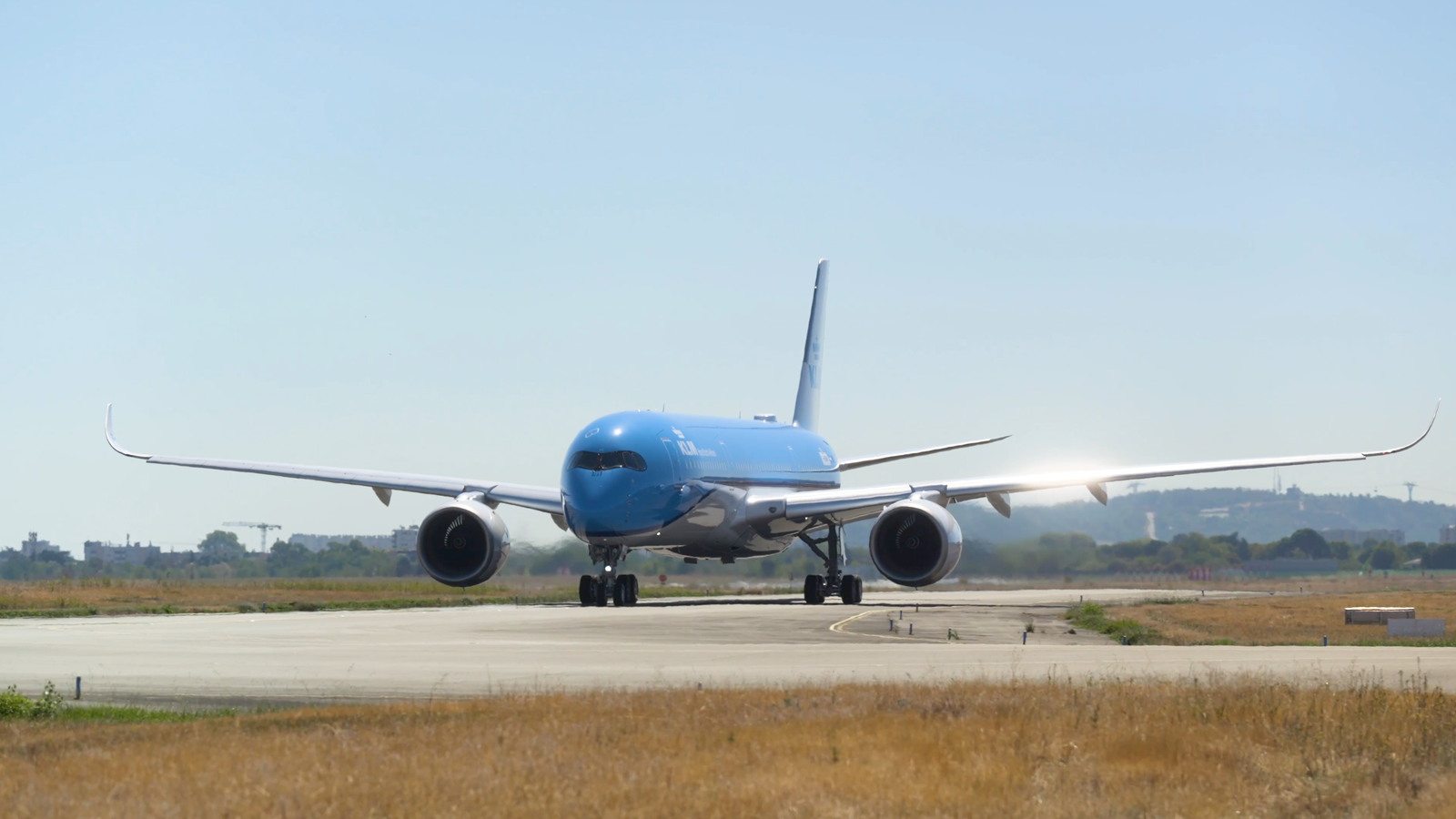
Seven years ago, Air France-KLM deliberately removed the Airbus A350 from KLM’s future. Seven Airbus A350-900s originally intended for the Dutch carrier were reallocated to Air France, while six Boeing 787s moved in the opposite direction, concentrating the group’s Dreamliners at Amsterdam Schiphol Airport. Today, that strategy looks very different. Following Air France-KLM’s 2023 order for 50 A350-900s and Airbus A350-1000s, alongside 40 additional purchase rights, KLM is preparing to operate 22 A350-900s of its own.
The first of those aircraft, PH-ZNA, completed its maiden flight from Toulouse on September 4, 2026. Named The Night Watch as part of KLM’s new Dutch Masterpieces naming theme, the aircraft is expected to enter commercial service between Amsterdam and Toronto on October 30, before expanding to Montreal and destinations in East Africa. Over time, the A350s will progressively replace KLM’s aging Airbus A330s and Boeing 777-200ERss. But KLM’s return to the A350 is more than a conventional fleet renewal. So what changed between 2019 and 2026 to turn an aircraft KLM deliberately walked away from into a cornerstone of its future long-haul fleet?
Why Did KLM Give Up The Airbus A350 In The First Place

To understand why KLM walked away from the A350, it helps to look at what Air France-KLM was trying to achieve in 2019. That June, the group reorganized the widebody orders of its two main airlines in an effort to simplify their long-haul fleets. Seven A350-900s originally destined for KLM were transferred to Air France, while six Boeing 787s moved in the opposite direction. The logic was straightforward: concentrate the A350 fleet at Paris Charles de Gaulle and the 787 fleet at Amsterdam Schiphol. Air France-KLM CEO Benjamin Smith described the move at the time as the “first step towards harmonizing and simplifying” the fleets of the group’s two largest airlines. Under the strategy, KLM’s future long-haul fleet was expected to center on the Boeing 777 and 787.
There were good reasons for that division. Operating fewer aircraft families reduces complexity in pilot and crew training, maintenance, engineering, spare parts, and day-to-day fleet scheduling. KLM was already well established as a Dreamliner operator, having introduced the 787-9 in 2015, while the larger 787-10 joined its fleet in 2019. Air France, meanwhile, was preparing to build up its own A350 operation. Rather than having both airlines operate relatively small fleets of both types, concentrating each new-generation widebody around one hub offered the group a cleaner and potentially more efficient fleet structure.
The problem was that the strategy depended on the operating environment remaining broadly compatible with the assumptions made in 2019. Fleet decisions stretch decades into the future, leaving airlines exposed when networks, regulation, aircraft availability or operating economics change faster than expected. Within just four years, several of those conditions had shifted significantly enough for Air France-KLM to reconsider its long-term widebody strategy. So what changed between the 2019 fleet swap and the group’s major A350 order in 2023 to make that once-logical division between Paris and Amsterdam increasingly difficult to maintain?
The World KLM Designed Its 2019 Fleet For No Longer Exists

The biggest external change came with Russia’s invasion of Ukraine in 2022. More than 40 countries closed their airspace to Russian carriers, and Russia, in turn, closed its airspace to European airlines. This particularly affected Europe-Asia routes, forcing airlines to take longer paths around Russia. The result was longer flight times, higher fuel consumption, greater crew costs, and increased aircraft utilization. Fuel prices also climbed sharply after the conflict began. By March 21, 2022, jet fuel had reached around $150 per barrel, up 39% in a month and 121% year-over-year. Even now, in September 2026, 4 years later, the fuel crisis persists. In this environment, the economics of operating newer and more efficient aircraft have become increasingly important. The A350, for example, can burn about 25% less fuel than older-generation aircraft like the Boeing 777-200ER it is intended to replace. This is also important because of the war’s impact on the climate.
Hence, Air France-KLM concluded that the disruption was unlikely to disappear quickly. When announcing the A350 order in 2023, CEO Benjamin Smith said the group was working on the assumption that the ban on Russian overflights would remain in place for “at least the mid-term.” The A350 therefore offered the group an efficient replacement for aging A330s and 777s while providing the range needed for a long-haul network operating under very different conditions from those assumed in 2019.
Moreover, there was another problem. A natural next step in long-haul fleet renewal could have involved Boeing’s new 777X, but repeated certification and production delays pushed its entry into service years behind the original schedule. Air France-KLM could not base its replacement strategy on new-generation Boeing capacity arriving as originally expected. In September 2023, the group instead placed an order for 50 Airbus A350-900s and A350-1000s, alongside purchase rights for another 40 aircraft. The jets are intended to progressively replace older A330s and Boeing 777s across the group. Geopolitics and aircraft availability helped overturn the logic of 2019, but another reason the A350 was becoming particularly valuable to KLM was the increasingly tight operating constraints at its Amsterdam Schiphol hub.
Schiphol Has Made Every Aircraft Movement More Valuable

Aerovista Luchtfotografie | Shutterstock
The A350 is particularly important for KLM because of the growing environmental and operational restrictions at its Amsterdam Schiphol hub. Under the Dutch government’s Balanced Approach, the airport has been limited to478,000 annual aircraft movements since November 2025, including a maximum of 27,000 nighttime movements. With fewer opportunities to increase flight frequencies, KLM must focus on making better use of its existing slots. This means carrying more passengers per movement while reducing the environmental impact of its operations.
Catch what other flight trackers miss
Emergency squawks, holds, NOTAMs — live signals, no signup.
Open tracker
Catch what other flight trackers miss
Emergency squawks, holds, NOTAMs — live signals, no signup.
Open tracker
The A350 offers advantages in both areas. According to KLM, the aircraft (powered by two Rolls-Royce Trent XWB-84 engines) burns approximately 25% less fuel and has a 40% smaller noise footprint than the Boeing 777-200ER it will replace. These improvements are particularly valuable at Schiphol, where noise performance is becoming increasingly important. During the first half of 2026, 38% of aircraft operating at the airport belonged to its two quietest categories, up from 29% a year earlier. With 331 seats, the A350 also allows KLM to maintain substantial long-haul capacity while operating a quieter, more fuel-efficient aircraft.
The benefits could extend beyond immediate operating costs. The Dutch government has indicated that once it achieves its 20% noise-reduction target, it could share additional noise capacity created through measures such as fleet modernization between the aviation sector and surrounding communities. For KLM, investing in quieter aircraft could therefore help protect its long-term operating flexibility at Schiphol. But if every aircraft movement must deliver greater value, where will KLM deploy its new A350s first?
Toronto Reveals How KLM Intends To Use The A350

KLM’s first A350-900, registered PH-ZNA, completed its maiden flight from Toulouse on September 4, 2026, under the test registration F-WZNM. The flight lasted approximately 90 minutes and was followed by further testing before delivery. Named The Night Watch after Rembrandt’s famous painting, the aircraft is part of KLM’s new Dutch Masterpieces naming theme. Its first commercial service is planned for the end of October between Amsterdam Schiphol and Toronto Pearson, with five weekly A350 flights replacing existing Boeing 787 operations on selected departures.
Toronto is only the beginning. KLM plans to introduce the A350 on services to Montreal from November 30, followed by Kilimanjaro, Dar es Salaam, and Zanzibar in December. Nairobi is expected to join the network in January 2027. The choice of destinations is significant. Canadian routes offer established long-haul demand, while East African services demonstrate the aircraft’s flexibility across different markets and operating conditions.
These initial routes are part of a much larger fleet renewal program. KLM is expected to receive 22 A350-900s, gradually replacing its aging Airbus A330s and Boeing 777-200ERs. The new aircraft will help the airline modernize its long-haul network, improve fuel efficiency, and reduce noise. However, introducing a new aircraft type is not always straightforward, and KLM’s first A350s already face an unexpected complication.
KLM’s Newest Aircraft May Enter Service With An Empty Business Class

Despite the excitement surrounding its arrival, KLM’s first A350s face an unexpected setback. The airline has confirmed that the World Business Class seats on its first two aircraft have not yet received regulatory certification. According to KLM, the delay follows a revised interpretation of seat installation requirements by aviation authorities. As a result, all 34 Business Class suites will remain unavailable when the aircraft enter service. This presents a commercial challenge, as premium cabins typically generate significantly higher revenue per passenger than Economy Class.
The A350 will still operate with its remaining 297 seats available, including 26 in Premium Comfort and 271 in Economy Class. KLM says the seat manufacturer is working to complete certification as quickly as possible. However, operating without Business Class means the airline will initially lose access to one of its most valuable sources of passenger revenue. This is particularly significant at Schiphol, where capacity restrictions make maximizing revenue from each aircraft movement increasingly important.
The setback highlights the challenges of introducing an entirely new aircraft type, even after years of planning. While the certification issue is expected to be temporary, KLM’s wider A350 program will unfold over several years. The bigger question is whether the new fleet can deliver the long-term operational and environmental benefits the airline needs at its increasingly constrained Amsterdam hub.
Can KLM Grow Without Adding Flights?

KLM’s A350 introduction reflects a broader shift in how airlines can grow at capacity-constrained airports. With Schiphol facing strict limits on aircraft movements and noise, adding more flights is no longer a straightforward option. Instead, KLM must focus on improving efficiency, carrying more passengers where demand supports it, and reducing the environmental impact of each departure. The airline plans to invest €7 billion in fleet renewal, including new A350s, A350 freighters, Boeing 787s, Airbus A321neos, and Embraer E195-E2s.
The arrival of 22 A350-900s through 2030 will be an important part of that strategy. As older A330s and 777-200ERs are retired, KLM will have an opportunity to reduce fuel consumption and noise while maintaining its long-haul network. However, the A350 will operate alongside the Boeing 787 rather than replace it. This suggests that KLM’s reversal is less about choosing one aircraft over another and more about building a flexible fleet suited to changing operational demands.
Seven years after KLM redirected its original A350S to Paris, The Night Watch marks the start of a different fleet strategy. The question now is whether 22 A350s will be enough to support KLM’s long-term ambitions at an airport where additional flights can no longer be taken for granted.
