


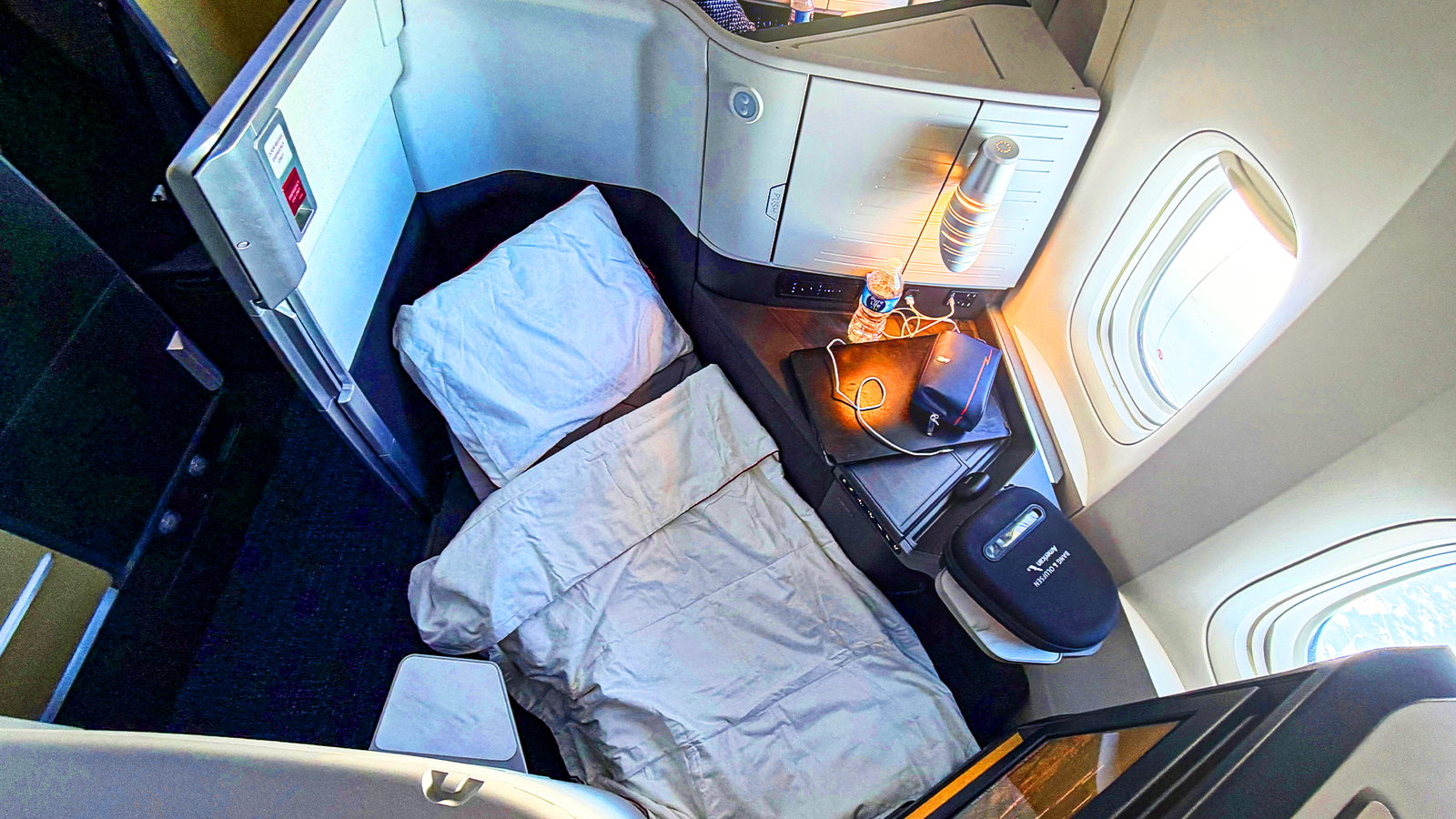
American Airlines and  United Airlines spent the past two years building the most expensive business class cabins either carrier has ever flown, marketing them as distinct flagship products, and placing them head-to-head on the same transatlantic routes. Both selected the same seat from the same manufacturer to do it. The Adient Elevate Ascent sits at the center of American’s Flagship Suite and United’s Polaris Studio, which means the differences passengers notice are not differences in hardware at all.
What separates the two cabins is how each airline chose to deploy that hardware. American spread it across all 51 business seats on its  Boeing 787-9P. United concentrated it into eight Polaris Studio suites and fitted a different seat behind them, building a two-tier cabin with a 27-inch (68.6 cm) screen at the front against American’s 17.5 inches (44.45 cm) throughout. One carrier built a better cabin. The other built a better seat and charged for it.
Why Do Both Airlines’ Flagship Seats Come From The Same Supplier?

American selected the Elevate Ascent for the Flagship Suite installed on its Boeing 787-9P subfleet, with retrofits planned for the 777-300ER and 777-200ER. United Airlines selected the same seat for Polaris Studio, the premium tier of its Elevated 787-9 interior. Two carriers competing directly on transatlantic routes went to the same product for the seat each is marketing as its most exclusive onboard offering.
The divergence begins with how each airline positions it. American uses the Elevate Ascent across its widebody business cabin, covering both the eight Flagship Suite Preferred positions and the 43 standard suites behind them. United reserved the Elevate Ascent for its eight Polaris Studio suites at the front of a 64-seat business cabin. American applied the product broadly. United concentrated it into a front-row tier it sells separately.
Layout geometry differs as well. American installs its suites in a reverse herringbone arrangement, the configuration that has become standard across most long-haul business products. Simple Flying reported that half of the center suites on United’s incoming 787s will be installed in a straight herringbone orientation instead, which changes how passengers sit relative to the aisle. American’s A321XLR breaks the pattern entirely, carrying 20 Collins Aurora suites rather than the Elevate Ascent, a different seat from a different supplier. The two airlines bought the same product and built different cabins from it, which raises the more consequential question of how many of each seat they decided to install.
How Many Of Each Suite Does Each Carrier Actually Install?

United’s Elevated Boeing 787-9 carries 64 Polaris business suites, of which eight are Polaris Studio, alongside 35 Premium Plus seats in a 222-seat aircraft. American’s 787-9P carries 51 business seats, comprising eight Flagship Suite Preferred and 43 standard Flagship Suites. United installs 13 more business seats on the same airframe type, and both carriers arrive at an identical number of top-tier suites at eight each.
What United gave up is visible against its own previous layout. The outgoing United 787-9 configuration held 48 Polaris seats, 21 Premium Plus, and what Simple Flying described as a much larger economy cabin. The Elevated version adds 16 business seats and 14 Premium Plus while trimming economy, which Simple Flying characterized as trading volume for cabin yield. American’s 787-9P reflects a parallel decision, with the carrier stating that premium seating across its long-haul fleet will grow by more than 45% by 2026.
The 777-300ER shows how differently American treats its top tier across the fleet. Only four Flagship Suite Preferred seats are installed on that aircraft, located in the first two rows, against eight on the 787-9P. The Preferred bed measures 81 inches (205 cm) against 80 inches (203 cm) in the standard Flagship Suite, a difference of one inch. United’s Studio is roughly 25% larger than its standard Polaris suite, a far wider gap between tiers than American built into its own cabin. That difference leads directly to the technology each installed, where the gap is wider still.
What Does United Buy With A 27-Inch Screen?

United’s Polaris Studio carries a 27-inch (68.6 cm) 4K OLED display, which the airline describes as the largest screen offered by any US carrier. American’s Flagship Suite and Flagship Suite Preferred both use 17.5-inch (44.5 cm) 4K displays, identical between the two tiers. The gap is nearly 10 inches (25.4 cm), and it falls entirely on the top-tier product. United’s 56 standard Polaris seats carry 19-inch (48.2 cm) 4K OLED touchscreens with Bluetooth connectivity, which still exceeds what American installs anywhere on the 787-9P.
United Airlines — Live Flights
The Studio adds more than a display. United’s own announcement lists an extra ottoman seat, exclusive entrée options, and an Ossetra caviar service alongside the 25% size increase over standard Polaris. From The Tray Table reported that two of the eight Studio seats, 1D and 1F, do not include proper companion seats with seatbelts, meaning six of the eight function as two-person spaces. United built a product tier that is physically and functionally distinct rather than a better version of the same seat.
American made the opposite choice deliberately. Flagship Suite Preferred differs from standard Flagship Suite by one inch of bed length on the 777-300ER and by position in the cabin, with identical screens. The airline spread its investment across all 51 business seats rather than concentrating it into eight. Both approaches are defensible. United created a reason to pay more for a specific seat. American created a reason to choose the airline regardless of which row you book. What neither carrier anticipated was that the privacy doors defining both products would reach service unable to close.
Why Did Both Airlines Launch Suites With Doors That Could Not Close?

United debuted its new Polaris suites on the 787-9 with the privacy doors unavailable. The hardware was installed and visible, but passengers could not use it. United’s own March 2026 announcement carried an asterisk against the privacy doors noting they were temporarily unavailable. Simple Flying reported the issue as echoing a problem American Airlines had already encountered on its own rollout, meaning both carriers delivered their flagship business products with the feature most central to the marketing out of service.
Neither airline has published a detailed explanation of what held up approval. What is clear is that the obstacle was certification rather than manufacturing, since the hardware reached the aircraft and was physically in place. The pattern repeating across two carriers using related seat products suggests the delay sits with the door design and its approval pathway rather than with anything specific to either airline’s installation.
Both carriers flew the aircraft anyway rather than hold deliveries. That decision makes commercial sense, since an aircraft generating revenue with an unusable door earns more than one parked awaiting paperwork. It also indicates how compressed both rollout schedules are. American has installed Flagship Suite on every 787-9P delivered since the third quarter of 2024, and United intends to fit the Elevated interior to all future 787 deliveries. The pace of those programs raises the question of which routes receive the new cabins first, and what each airline charges for them.
Which Routes Get These Cabins, And Who Pays Extra?

United launched the Elevated 787-9 on international service with UA1 from San Francisco International Airport (SFO) to Singapore Changi (SIN) on April 22, 2026, followed by UA901 from San Francisco to London Heathrow (LHR) on April 30. Tickets went on sale March 19. Both routes concentrate the premium demand a 99-seat premium cabin requires, and United has since expanded the aircraft to all three daily San Francisco to London rotations. American has highlighted Chicago O’Hare (ORD) to London as an early route for Flagship Suite, placing both carriers’ flagship cabins on the same corridor.
Fleet availability determines how quickly either product spreads. American had roughly 14 787-9P frames in service as of May 2026, with Flagship Suite installed on every 787-9P delivered since the third quarter of 2024 plus a small number of retrofitted 787-9s. United has stated that all future Boeing 787 deliveries will receive the Elevated interior and Polaris Studio suites. American’s product also reaches aircraft that United’s does not, with 20 Flagship Suites on the A321XLR opening thinner long-haul markets, and retrofits planned for the 777-300ER and 777-200ER.
Pricing is where the strategies have not converged. United sells Polaris Studio through an additional seat selection fee on top of a Polaris booking, which is the commercial justification for a tier 25% larger with a 27-inch (68.6 cm) screen and caviar service. Simple Flying reported that American is expected to eventually introduce a surcharge for Preferred suites as the rollout completes, moving closer to United’s model. Whether American can command a premium for a seat that differs from the one behind it by one inch of bed length is the question the next year of bookings will answer.
