


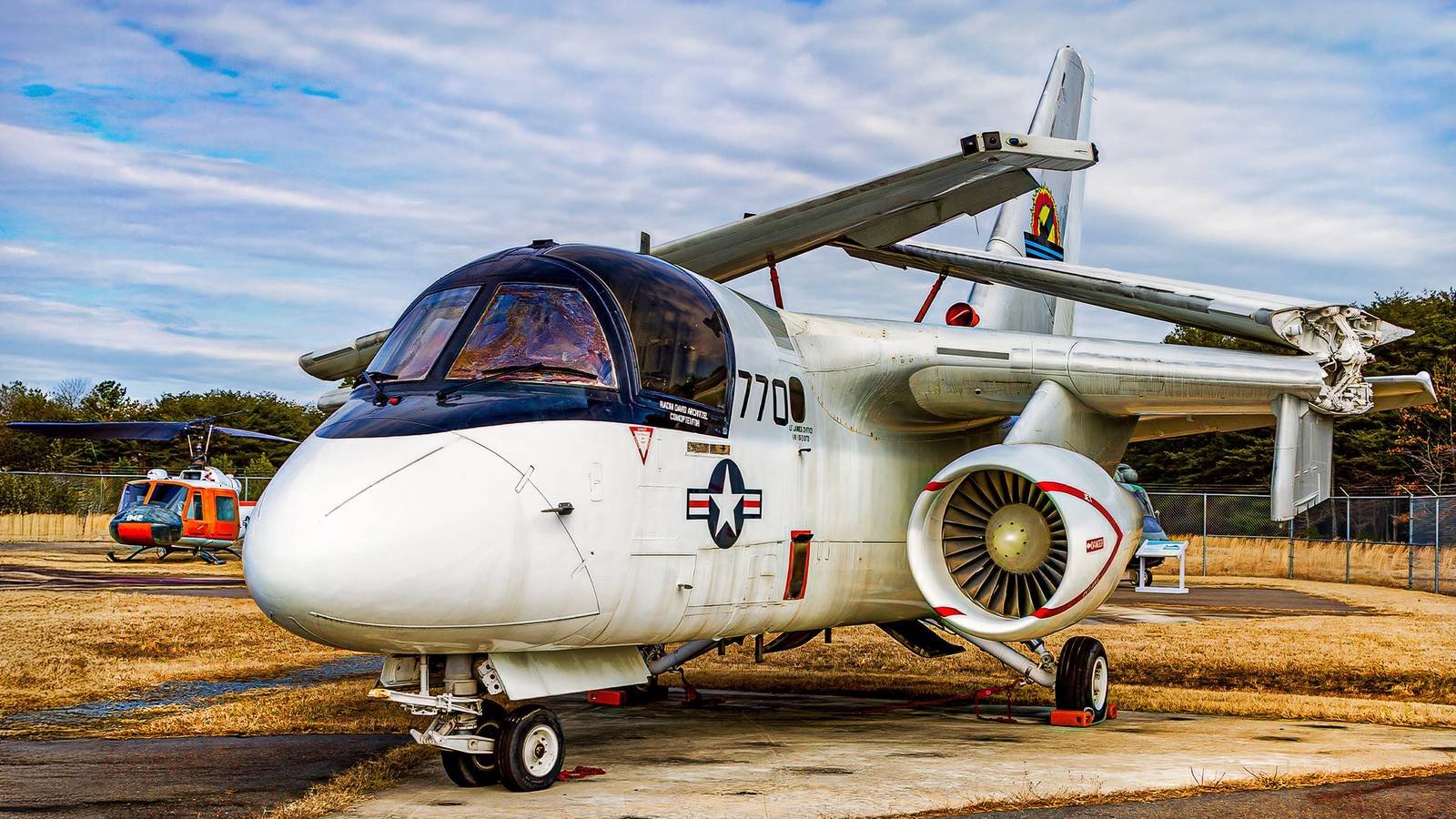
During the intense years of the Cold War, the Soviet Union was expanding its fleet of nuclear-powered submarines, presenting a threat to US Navy (USN) carrier strike groups. In response, the S-3 Viking was designed and produced to take on this subsea challenge. The aircraft not only met the requirements, but it also excelled as an incredibly versatile aircraft that served for decades.
However, with the fall of the Soviet Union in the 1990s, the large-scale submarine challenge abated. As such, the Viking was not only retired, but it was not replaced with another dedicated sub-hunter, and its functions were transferred to other aircraft. This move left a gap in carrier-based anti-submarine warfare (ASW) capabilities. The latter has been seen as shortsighted, particularly now, as both Russia and China continue to expand their submarine inventory.
The Cold War World And Why The USN Needed the Viking
Since World War II (WWII), the aircraft carrier has been the premier power projection asset in the United States arsenal. Since that time, these vessels have greatly grown in tonnage and capabilities. For example, the Essex-class carrier (the most widely produced in WWII) had a full-load displacement of 36,382 long tons (36,966 tonnes). The early to mid-Cold War period saw the production of the Forrestal and Kitty Hawk Classes, America’s first true supercarriers (commissioned between 1955 and 1968), with a full-load displacement range of 76,000 to 84,914 long tons (77,220 to 86,276 tonnes). And the Soviet military was always developing improved methods to transform these large vessels into artificial reefs on the ocean bottom.
To this point, by the 1960s and 1970s, a growing concern for US Military planners was the growing threat posed by Soviet nuclear attack submarines, designed to locate and destroy US carrier groups at extended ranges. The submarines of particular concern were Project 659 Echo I, Project 675 Echo II, Project 670 Charlie I and the Project 670M Charlie II classes.
Moreover, these submarines were becoming faster, quieter, and capable of operating at longer ranges, while being armed with increasingly advanced torpedoes and anti-ship cruise missiles. In addition, Soviet doctrine envisioned the coordinated use of multiple platforms—aircraft, surface vessels, and submarines—to target a US carrier strike group. The aim was to saturate its defenses and overwhelm the carrier’s protective “bubble,” ultimately enabling its destruction.
Catch what other flight trackers miss
Emergency squawks, holds, NOTAMs — live signals, no signup.
Open tracker
Catch what other flight trackers miss
Emergency squawks, holds, NOTAMs — live signals, no signup.
Open tracker
Thus, by 1968, the U.S. Navy issued the VSX requirement for a new carrier-based anti-submarine warfare aircraft to replace the Grumman Aircraft Engineering Corporation S-2 Tracker. In August 1969, Lockheed’s design was selected, effectively marking the beginning of full-scale development of the Viking. The aircraft was first introduced to the fleet in 1974 and deployed in 1975, with its first operational cruise aboard the USS John F. Kennedy. By the end of the 1970s, around 186 airframes had been manufactured.
The US Navy’s Most Powerful Aircraft Carriers Ranked
Ranking the five most powerful US Navy aircraft carriers ever built, from the Midway class to the advanced Gerald R. Ford class supercarriers.
The Capabilities of the Viking

The Viking provided US carrier strike groups operating around the world with top-tier organic anti-submarine warfare capabilities for over 40 years. This aircraft, equipped with two powerful General Electric jet engines, had a range of over 2,300 nautical miles (4,260 km), allowing the Viking to operate far ahead of any carrier it was attached to and seek out potential Soviet submarines. In addition to its great range, its engines earned the S-3 the nickname “Hoover” due to their distinctive sound.
The aircraft was operated by a crew of four: the pilot, co-pilot, sensor-operator, and navigator. Initial deliveries of the aircraft were equipped with a sensor suite that was highly advanced for the 1970s. This equipment consisted of the AN/APS-116 surface search radar, AN/ALR-47 electronic support measures (ESM), and the AN/ASQ-81 Magnetic Anomaly Detection system (MAD).
S-3 Viking Specifications | Related Data |
|---|---|
Contractor | Lockheed |
Crew | Four |
Wing span | 69 feet (21 m) |
Length | 53 feet (16.2 m) |
Height | 23 feet (7.0 m) |
Weight | Empty: 26,500 pounds (12,021 kg) Maximum takeoff: 52,539 pounds (23,840 kg) |
Power plant | Two GE TF34-GE-2 turbofan engines |
Speed | 518 mph (834 km/h) |
Range | More than 2,300 nautical miles (4,260 km) |
Ceiling | 40,000 feet (12,200 m) |
The Viking’s radar could rapidly scan broad areas of the ocean for contacts, while deployed sonobuoy fields provided acoustic tracking of submerged submarines across large patrol grids. The MAD system allowed for close-range localization of contacts, and the ESM suite provided passive detection of enemy emissions, improving the crew’s situational awareness. In the event that the S-3 had to make an attack on a submarine, they could be armed with the Mark 46 torpedo, Mark 50 torpedo, and depth charges. If an attack on a surface vessel was to be undertaken, the Viking could be armed with the AGM-84 Harpoon (this was available with the S-3B variant).
For a carrier group, the versatility of the S-3 meant it served as an organic, tailor-made submarine hunting platform. This reduced reliance on destroyers alone and extended the fleet’s defensive anti-submarine warfare screen far beyond the task force itself, creating a layered airborne detection and prosecution capability that significantly enhanced maritime control.
By the time the Viking was retired from active service on January 30, 2009, the aircraft had been adapted for a variety of roles, including signals intelligence, aerial refueling, transport, and surface warfare, earning a reputation as the “Swiss Army knife of naval aviation.” Because of this versatility, its retirement left a gap that required several different aircraft types to perform the missions the Viking had previously carried out on its own.

Why The E-3 Sentry’s Rotating Radar Dome Will Be Nearly Impossible To Replace
The eye in the sky the USAF is saying goodbye to.
Without The Viking, The USN Parceled Out its ASW Mission

Following the end of the Cold War in 1991 and the dissolution of the Soviet Union, the USN believed that the original mission of the Viking—carrier-based anti-submarine warfare against large Soviet submarine fleets—had greatly diminished. Accordingly, the Russian International Affairs Council states:
“At the end of the 1980s, the Soviet Navy had over 300 submarines, including 64 nuclear-powered and 15 diesel-powered submarines with ballistic missiles of various ranges; 79 cruise-missile carriers (including 63 nuclear-powered vessels); and about 80 nuclear-powered and roughly the same number of diesel-powered attack submarines.”
Due to drastically reduced budgets, by the mid-1990s, the Russian submarine force had decreased by about half, and by 2013, there were roughly 60 remaining, a mere shadow of its former self. During this time, the US military refocused on low-intensity warfare, whether in policing or peacekeeping actions in the 1990s or in its mission in the “War on Terror” beginning in the 2000s. The need for a specialized sub-hunter began to fade as the Russian navy did.
The Navy retired the Viking in stages between 2005 and 2009, with the last squadron, VS-22 “Checkmates,” standing down in January 2009. At the time, the Navy argued that the aging S-3 inventory was becoming increasingly expensive to maintain. Supporting a relatively small and specialized aircraft type required its own training pipeline, logistics network, spare-parts inventory, and depot maintenance infrastructure, resources that Navy leaders believed could be better allocated elsewhere.
With the Viking retired, its core mission areas were distributed to other naval aircraft. The role of ASW was given to the land-based  Boeing P-8A Poseidon and organic ASW capabilities were to be provided by Sikorsky SH-60 Seahawk helicopters. While the tactical airborne tanker mission was absorbed by the buddy-store-equipped McDonnell Douglas F/A-18E/F Super Hornets. Finally, fleet airborne logistical duties were transferred to the Greyhound and later the CMV-22B Osprey.
Critics have opined about the loss of the Viking, given that the fleet lost its only true sub-hunter. While the Navy could plausibly save or reallocate funding, the Poseidon requires land basing, and it is entirely possible that a deployed task force may not benefit from its system attributes on short notice. The SH-60s, on the other hand, are carrier-based and possess the technology to locate and attack submarines, but they lack the range and speed of a purpose-built ASW aircraft. In this regard, the Seahawks can provide only localized ASW coverage of around 380 nautical miles (704 km).
Why Does The US Navy Still Rely On The F/A-18 Super Hornet?
The F/A-18 has been able to carry out most of the Navy’s requirements while being affordable, although it is increasingly struggling.
The Urgent Need For Dedicated, Long-Range ASW

As we have seen, the USN retired its dedicated sub-hunter and never fully replaced it. The logic was sound for the time: with the Soviet Union gone, the United States entered a historic, global unipolar moment. Given that the submarine threat had largely subsided, the Viking was retired. As is the case in so many instances, hindsight is 20/20—the aircraft’s retirement now appears shortsighted, particularly since no replacement was developed. However, the Navy does not possess a crystal ball, and its view 25 years ago was that dedicated ASW was not a priority.
Fast-forward to the post “War On Terror” world, and the USN needs to enhance its ASW capabilities now. The reason behind this is the continued growth of the Chinese Navy (PLAN), including its submarine force, both attack and ballistic missile variants. In terms of hull count, according to the Congressional Research Service, the PLAN is forecast to approach or exceed approximately 430 vessels by 2030, depending on counting methodology. In addition to its surface fleet, its submarine force continues to grow as well.
The International Institute for Strategic Studies reports continued expansion in Chinese naval assets in recent years, with sustained growth in submarine construction and tonnage. Most significantly, China has emerged as the primary driver of global submarine production growth. Additional SSBN production is believed to be ongoing, alongside development of next-generation designs intended to supplement or eventually replace the Type 094 class.
Between Russia and China, submarine production remains active at a steady pace, with China being the larger contributor.
Can the Navy reactivate the S-3 Viking? Theoretically, it could; the airframes are generally well-maintained, and limited reactivation is technically feasible. However, getting these aircraft into modern condition would take time and would be expensive. Additionally, reconstructing the ecosystem surrounding the aircraft is also a glaring issue. There is no training cadre, no training infrastructure of any kind; the S-3 maintainers are effectively gone, and rebuilding the supporting manufacturing base to produce spare parts would also be required.
The idea has been floated to press the Boeing MQ-25 Stingray into service as a fleet ASW aircraft. This is possible, as the airframe is large enough to be equipped with radar systems, electronic intelligence sensors, sonobuoy dispensers, and networking and command-and-control equipment. However, this would require substantial redesign and major expansion of mission systems beyond its current role as a carrier-based refueling UAV.
