


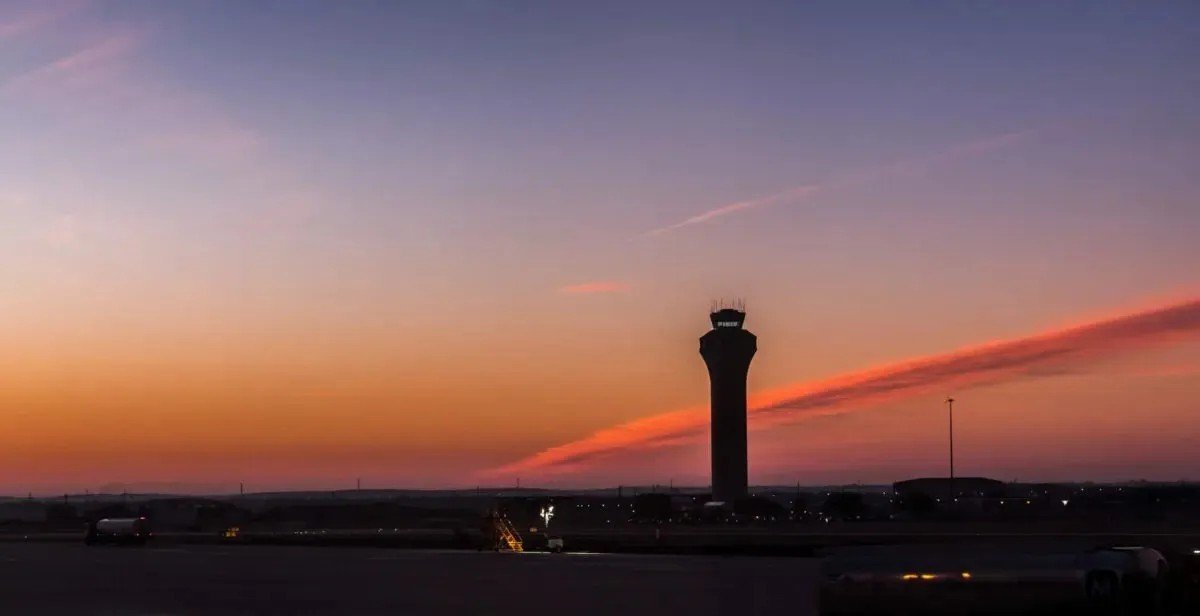
Federal officials on Tuesday formally asked Congress for more than $50 billion to support improvements to the nation’s aging air traffic control (ATC) system, which they have blamed for Friday’s nationwide ground stop that disrupted thousands of flights.
U.S. Transportation Secretary Sean Duffy, FAA Administrator Bryan Bedford, and Russell Vought, director of the White House’s Office of Management and Budget (OMB), wrote a letter to congressional appropriators requesting funds to build a “truly world-class air traffic control network.”
Duffy on Friday raised his ask to $50 billion after he, Bedford, and a coalition of aviation groups in September backed legislation that would allocate $30 billion toward ATC and airport improvements.
“Last week, we urged Congress to act swiftly and provide vital funding for the modern, resilient aviation system the American people deserve,” Duffy, Bedford, and Vought wrote. “Less than 24 hours later, the urgent need for this investment became undeniable when outdated, legacy equipment disrupted aircraft communications and radar feeds.”
Among the projects described in the $50 billion request, and not included in officials’ previous $30 billion ask, is the construction of five new air route traffic control centers (ARTCCs) for $10 billion. The funds would cover the design, site selection, land acquisition, and construction of the new centers. The facilities would consolidate the FAA’s 22 existing ARTCCs, which the officials described as deteriorating and “beyond their service life.”
Unstable aircraft radar and communication feeds at 17 ARTCCs prompted Friday’s ground stop, which was only the second nationwide halt of departures since the 9/11 attacks. The centers manage en-route aircraft flying at high altitudes.
Duffy on Friday said he “didn’t anticipate that we’d have an outage like this” but that there will be “more of these unless the American people and the Congress tell us to build.”
What the $50 Billion Would Cover
The officials’ request also includes $10 billion for the construction, replacement, and improvement of up to 140 FAA-owned ATC towers, which handle ground operations and arrivals and departures at airports. The DOT said many of these facilities are “decaying and in an unacceptable state of disrepair.”
The rest of the funds would largely cover the same projects that officials outlined in September.
About $10.1 billion would support modernizing ATC systems, including $7.2 million for a common automation platform (CAP) to unify the FAA’s STARS and ERAM platforms. Another $2 billion would fund cloud computing and telecommunications. Officials in September said this would specifically support the FAA Enterprise Network Services (FENS), which is designed to provide communications and information-management services across roughly 4,500 facilities.
Of the remaining $900,000, about one-third would cover the consolidation of terminal ATC facilities. The rest would fund “strategic air traffic flow management technologies,” which officials in September specified includes the AI-powered Strategic Management of Airspace, Routes and Trajectories (SMART) platform.
Officials are also seeking $20 billion for airport improvements. Half would fund a Terminal Pilot Program to modernize or rebuild aging terminals at airports that service between 5 million and 25 million passengers annually. The package also includes $5 billion for Airport Terminal Program (ATP) discretionary grants and $5 billion for Airport Improvement Program (AIP) grants, which is $2 billion more than what was requested in September.
ATC Funding Request Faces Pushback
Lawmakers on both sides of the aisle have questioned the new $50 billion request, contending that the DOT has not spent much of the $12.5 billion that Congress allocated toward ATC modernization in 2025. That funding was intended to support the first phase of the agency’s Brand New ATC System (BNATCS) project, which aims to modernize communication, surveillance, weather, and other systems.
Duffy in response said that Congress placed parameters on the $12.5 billion that explicitly outline how the money can be spent, preventing the DOT from shifting funds from one workstream to another.
The construction of new ATC facilities has been planned since BNATCS began. According to a request for solutions published after the DOT’s selection of Peraton as the project’s prime integrator, it would take place during Phase 2 of the multiyear effort. The Government Accountability Office in September said the FAA does not yet have a timeline for when Phase 2 will begin or conclude.
The GAO further found that the FAA lacks a lifecycle cost estimate or master schedule for BNATCS. It predicted that the project could go the way of the agency’s previous NextGen effort, which it found delivered only 16 percent of its promised benefits after 20 years and $36 billion spent.
Bedford disputed the GAO’s findings. But lawmakers have asked for greater transparency on how existing BNATCS funding is being spent before they award billions of dollars more.
