


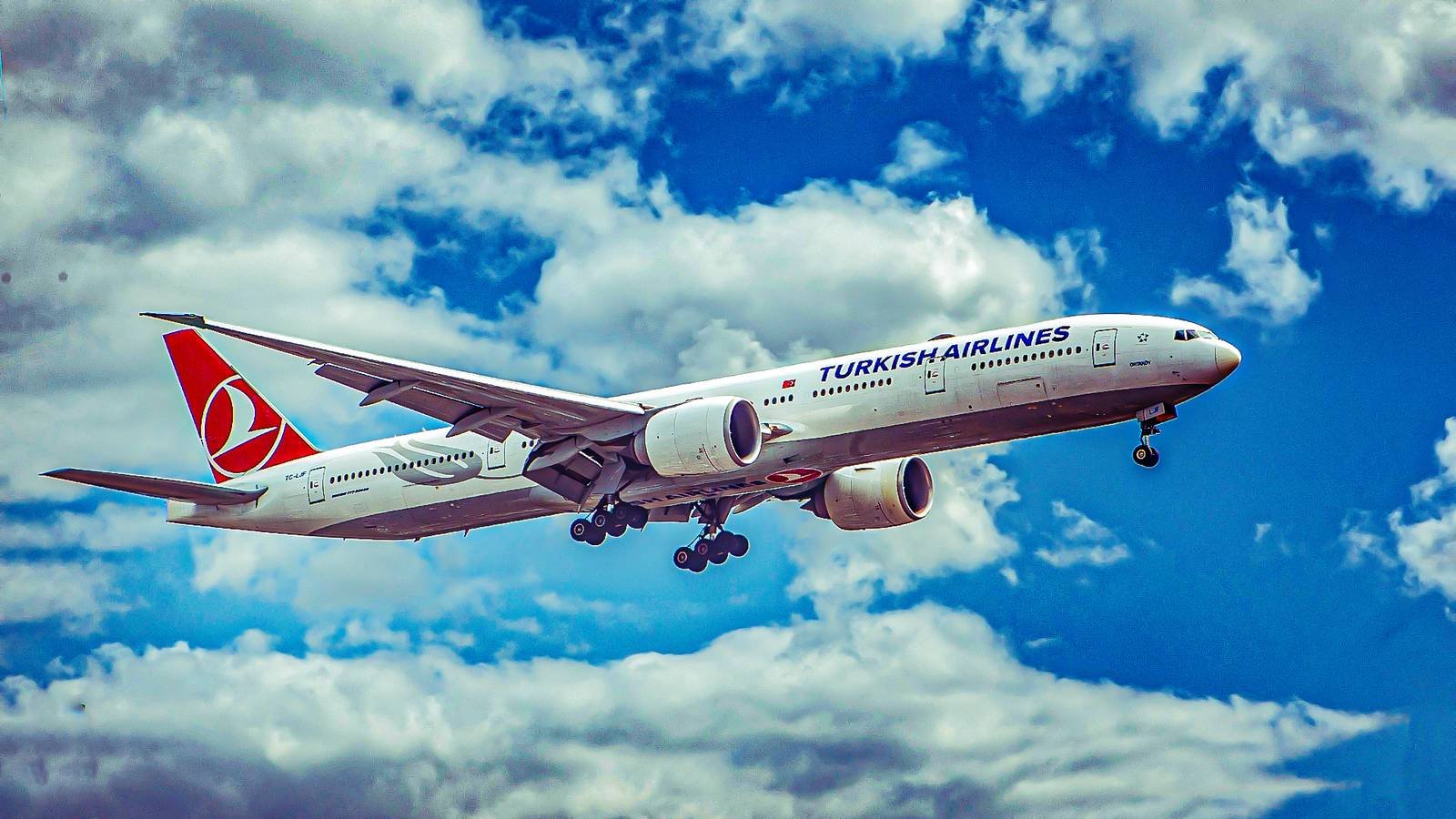
Passengers on a Turkish Airlines flight from  Istanbul Airport (IST) experienced a rough taxi ride after a smooth landing at Antalya International Airport (AYT) around 8:00 PM local time on Thursday, June 11. The Boeing 777-300ER, operating flight TK2430, struck a radar antenna mast that penetrated the fuselage and caused injuries to at least one passenger and potentially as many as three, although current reports are conflicting.
The radar antenna also damaged the plane’s right wing and dislodged an overhead bin after punching through the jet’s skin, and caused the oxygen mask to deploy. The 267 passengers on board the widebody jet were safely evacuated by the aircrew and emergency personnel at the airfield with no life-threatening injuries, according to Haberler.
Trouble In Antalya For Turkish Airlines

The big Boeing ‘triple seven’ was maneuvering to a parking position after a normal and safe landing when it hit the antenna pole. No details have been released as to why this ground mishap happened, but the airline has announced that it is beginning a technical investigation. Similarly, it is presently unclear if the injuries sustained by passengers occurred as a result of hitting the mast or from disorder during the evacuation.
The aircraft that was damaged is tail number TC-LKD, a 17-year-old airframe that has served several operators under lease deals, according to Planespotters.net data. The plane had just been returned from a three-year lease to  IndiGo recently, and Turkish had not yet repainted it into their standard corporate livery. It was still seen flying in a modified livery when the pole collapsed on the plane.
The flight was a regularly scheduled, short-haul domestic route between Turkish’s main base at IST and the seaside tourist hub of AYT. The Ministry of Transport released this statement regarding the incident:
“[Aircraft TC-LKD] entered the taxiway from the wrong lane after landing on our airport’s runway and collided with a ground radar mast on apron-1… After the passengers were evacuated and necessary checks were carried out, the aircraft was towed to the apron parking area.”
Catch what other flight trackers miss
Emergency squawks, holds, NOTAMs — live signals, no signup.
Open tracker
Catch what other flight trackers miss
Emergency squawks, holds, NOTAMs — live signals, no signup.
Open tracker
How Did Turkish’s Big Jet Get There?

According to the Aviation Safety Network report, the aircraft was navigating a taxiway where the distance between the painted centerline and the base of the radar pole was only about 95.1 feet (29 m). The Boeing 777-300ER has a massive wingspan of 212.6 feet (64.80 m), meaning it extends exactly 106.3 feet (32.40 m) out from the centerline of its taxi path.
The widebody jetliner appears to have turned onto a restricted taxi route. An aircraft as massive as a Boeing 777-300ER being directed onto a taxiway too narrow for its wingspan usually stems from a breakdown in ground protocols or communication errors. The investigation has only just begun, so the cause remains open to speculation, but there are a couple of scenarios that are most probable.
It is very difficult for pilots to accurately judge whether their outer wingtip will clear a distant object purely by looking out the window. The crew may have missed a turn or mistaken an incorrect entrance for the approved one, causing them to inadvertently steer the giant plane into a bottleneck. Another explanation could be that the ground controller managing the airport’s taxi traffic may have inadvertently issued a routing clearance meant for a smaller aircraft.
288 Evacuated After Turkish Airlines Airbus A330 Catches Fire
The emergency evacuation of a Turkish Airlines Airbus A330 in Kathmandu highlighted the critical importance of rigorous safety training.
Triple Seven Out Of Action: Fixing A Widebody

The repair timeline will likely take at least several weeks, but depending on the extent of the damage to the jet, it could also take as long as a few months before TC-LKD is flying again. Along with the repairs to the skin and airframe structure, the wing and fuselage will need to be inspected and evaluated for additional problems with internal systems.
The cabin fuselage will need to have the torn sections cut out and cleanly replaced with new material in order to restore pressurization. The overhead bin, wiring and oxygen mask modules will need to be replaced as well. The wing will require extensive assessment since it contains fuel and its aerostructures, like spars, must be carefully monitored for fatigue to prevent a catastrophic failure in the future.
