


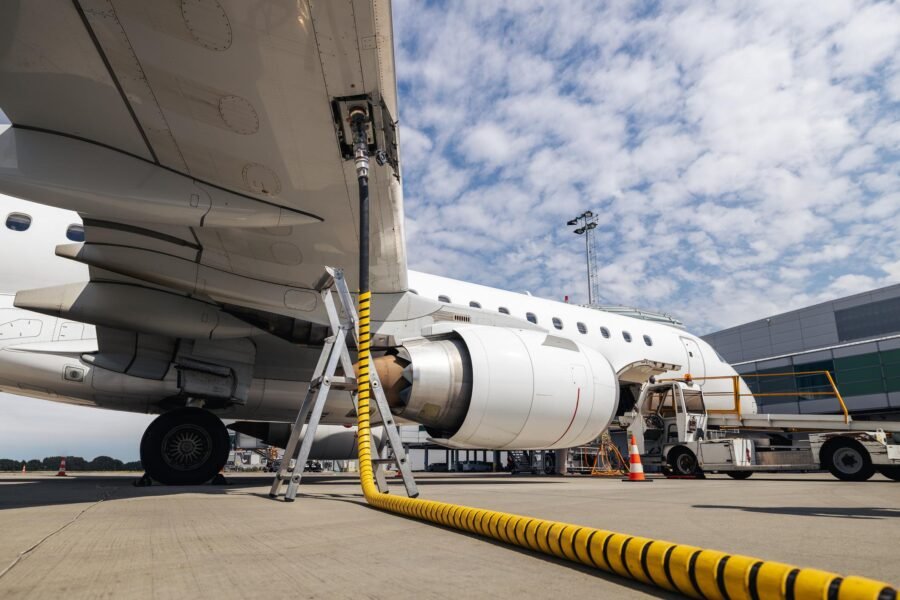
U.S. airlines saw jet fuel spending surge sharply following the outbreak of conflict involving Iran, highlighting the industry’s vulnerability to geopolitical shocks. According to data released by the U.S. Department of Transportation, carriers spent more than $5 billion on fuel in March, a dramatic increase compared to the previous month.
Total jet fuel expenditure reached $5.06 billion in March, up 56.4% from $3.23 billion in February. The figure also represents a 30% increase compared to March 2025, underscoring the scale of the cost spike. The surge followed U.S.-Israel strikes on Iran, which disrupted global energy markets and effectively led to the closure of the Strait of Hormuz, a critical corridor for global oil supply.
Fuel is the second-largest expense for airlines after labor, and the rapid increase has forced carriers to reassess their financial outlook. Several U.S. airlines have lowered or withdrawn their 2026 guidance altogether, citing uncertainty around fuel prices and broader economic conditions. In response, some carriers have also scaled back capacity growth plans to avoid oversupply in a high-cost environment.

The most complete publicly available daily data comes from the Argus US Jet Fuel Index, which tracks simple‑average spot prices across Chicago, Houston, Los Angeles, and New York. On May 6, 2026, the index price was $3.90 per gallon.
The pressure intensified into April, when jet fuel prices exceeded $4 per gallon in some markets as the conflict continued. The sustained increase has already had tangible consequences across the industry. Spirit Airlines’ recent collapse was partly attributed to rising fuel costs, which disrupted its restructuring strategy and weakened its financial position.
Despite the cost pressures, airlines expect to gradually pass higher fuel expenses on to customers through increased fares. Industry executives have indicated that pricing adjustments could begin to offset costs by late 2026 or early 2027, depending on demand trends and market conditions.
So far, consumer demand has remained resilient. Data from the Airlines Reporting Corporation shows that travel agency ticket sales rose 12% year-over-year in March to $10.4 billion. Domestic trips increased by 5%, while international travel grew by 1%, suggesting that higher fares have not yet significantly dampened demand.
The sharp rise in fuel costs illustrates how quickly external factors can reshape the airline industry’s financial landscape. As geopolitical tensions continue to influence energy markets, airlines are balancing cost control, pricing strategies, and capacity management to navigate an increasingly volatile operating environment.
Related News:
Sources: AirGuide Business airguide.info, bing.com, cnbc.com, wsj.com
