


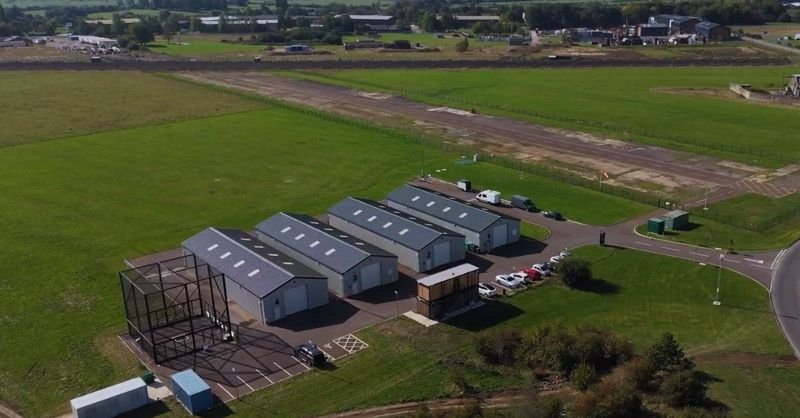
The UK is expanding its national drone testing facility at Westcott with new rigs for assessing navigation resilience, wind response, communications and remote operations under controlled, repeatable conditions.
The Satellite Applications Catapult is building the National Autonomy and Drone Innovation Centre (NADIC), expanding its existing Drone Test and Development Centre at Westcott Venture Park in Buckinghamshire.
The centre will add position, navigation and timing (PNT) testing facilities, letting companies assess how systems perform when satellite navigation signals are unavailable, disrupted or manipulated. A Satellite Communications Integration and Test Lab will validate drone and autonomous systems across satellite, terrestrial and hybrid networks to support beyond-visual-line-of-sight (BVLOS) operations.
A Windshaper system will generate precise, repeatable indoor wind conditions so technologies can be tested consistently without weather disruption, while a robotic arm will enable automated, repeatable testing with less manual handling. A motion platform will recreate operations on moving vessels, vehicles and uneven terrain, letting companies test systems against challenging real-world scenarios.
A Remote Operations Control Centre will let operators train, simulate missions and validate remote command-and-control procedures under realistic conditions. The robotic arm, motion platform and control room are expected to be operational in the coming months, with the full facility anticipated in the second half of 2027.
NADIC is aimed primarily at small and medium-sized companies and component builders developing the navigation, sensing, communications and autonomy systems the wider sector depends on, and which must prove their equipment is safe before operators will design it in.
Flying BVLOS depends on satellite communications that do not drop out and on PNT data that can be trusted, particularly where terrestrial coverage is limited. NADIC will sit alongside the Catapult’s Future Networks Development Centre at Westcott, which works on resilient communications combining satellite and terrestrial networks.
John Abbott, CEO of the Satellite Applications Catapult, said, “A company should be able to arrive with a system, establish its operational limits under controlled conditions, and leave with data that goes straight into a regulatory application. This facility offers a serious step forward for the sector.”
Almost every commercial drone flight in the UK remains individually authorized and time-limited, requiring operators to prove with evidence that a specific operation is safe. Access to facilities that can produce that evidence to a standard regulators recognise has been limited, particularly for smaller companies.
The Civil Aviation Authority acknowledged the challenge in its Airspace Architecture Concept of Operations, published in July, which said today’s bespoke approvals “are not designed to support the volume of operations needed for widespread commercial use”.
The investment includes £2.25 million (US$3 million) from Buckinghamshire Council. The UK government has set a target of establishing routine BVLOS drone flight by 2027, and forecasts the value of the UK drone economy to be up to £45 billion (US$60 billion) by 2030.
