


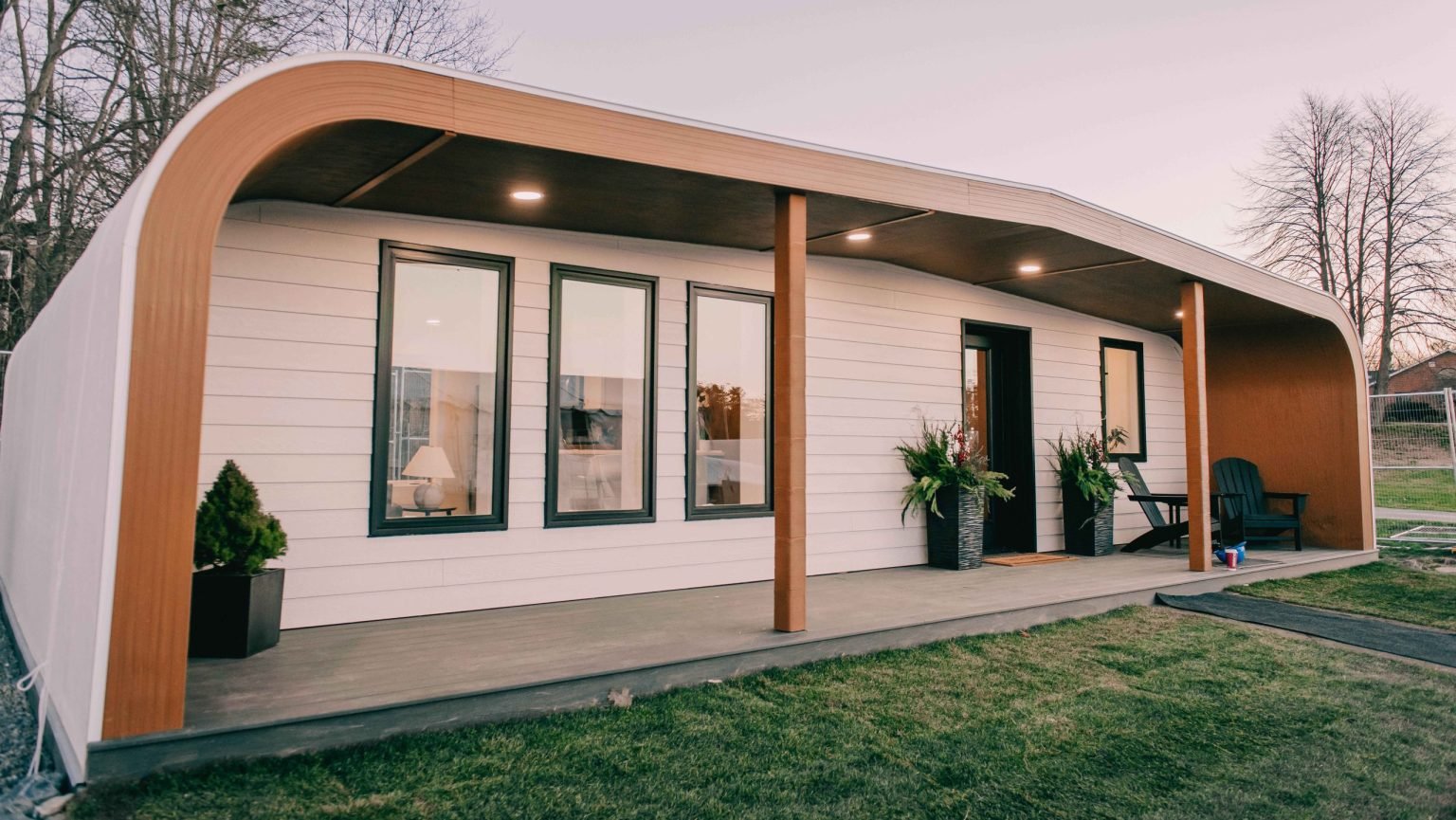
The University of Maine’s Advanced Structures and Composites Center (UMaine ASCC) is partnering with Maine nonprofit Penquis to produce up to nine 3D printed homes in the Greater Bangor area, marking the university’s first move from a single demonstration house toward a repeatable housing manufacturing system. The project, announced August 26, 2026, comes four years after UMaine unveiled the world’s first fully bio-based 3D printed house.
The homes will be built in three stages, giving researchers the chance to test each round, make adjustments, and carry those lessons into the next. The work will take place inside the Factory of the Future, part of UMaine’s new GEM facility, which gives the team capacity to test higher production speeds and more automated processes than were available when the original BioHome3D was built. Funding comes from $4 million in Congressionally Directed Spending secured by U.S. Senator Susan Collins.
From One House to a Repeatable System
ASCC Executive Director Habib Dagher described the long-term goal as a “Ford factory of homes,” a highly automated system capable of producing housing faster, more efficiently, and in much greater volume. “We’ve already demonstrated that we can build the house,” he said. “Now the challenge is how do we scale this technology so we can manufacture homes faster, more efficiently and in much greater numbers.”
That scaling challenge is measurable in raw output. When BioHome3D development began, UMaine’s printing system deposited material at roughly 100 pounds per hour. The university’s newer large-scale printer operates at about 500 pounds per hour, and future equipment is expected to reach around 1,000 pounds per hour. The Factory of the Future lets researchers put that expanded capacity to the test under real production conditions.
The push toward automation carries particular weight in Maine, where a housing shortage is compounded by a limited construction workforce. Shifting more of the building process into an automated manufacturing environment could allow more homes to be produced without a matching increase in on-site labor. Dagher framed the nine-home project as a step toward that larger system rather than an end in itself: “Those homes give us an opportunity to validate and improve the manufacturing system we would need to ultimately produce housing at a much larger scale.”
Meeting the Bar for Broader Use
Moving beyond a research setting brings its own requirements. Dagher said safety has to be built into the technology as it scales, which means developing fire-resistant materials and completing further testing to show the homes can meet the standards required for wider deployment. Each group of homes built under the Penquis partnership will give researchers another evaluation opportunity, with results feeding into the next stage of production.
Dagher tied the project to both the university’s manufacturing progress and its regional impact. “This marks a major milestone for UMaine’s BioHome3D technology,” he said. “By combining local sawmill waste with cutting-edge additive manufacturing, we are demonstrating how code-compliant, sustainable housing can be produced faster and more efficiently.”
Testing the Ground for Scale
The original BioHome3D prototype, unveiled in November 2022, offered proof that the approach could work. The 600-square-foot house had its floors, walls and roof 3D printed from a material made of wood fiber and bio-resins, giving residual wood from Maine sawmills a new use. It was manufactured in three six-sided modules, transported to the site, and secured on its foundation in about half a day.
The house has since gone through three Maine winters, with researchers continuing to monitor its durability and long-term performance. The technology also carries an environmental case: BioHome3D absorbs an estimated 46 tons of carbon dioxide per unit as a carbon sink, a figure cited against the construction industry’s outsized share of global emissions.
The manufacturing leap behind this next phase followed: the April 2024 unveiling of Factory of the Future 1.0, a printer four times larger than UMaine’s 2019 record-holder, positioned from the outset as the engine behind BioHome3D’s push toward commercialization and cheaper, sustainable housing at scale.

From One-Off Prototype to Repeatable Housing Manufacturing
UMaine’s strategy hinges on treating BioHome3D as infrastructure rather than a finished product. The 2022 house proved the material and process worked; the Penquis partnership exists to prove the same process can be repeated, adjusted, and produced in volume without losing quality, the actual gap standing between a research demonstration and a viable housing manufacturer.
Others in the sector have already moved further down that path. ICON’s Vulcan printer underpins a 100-home community built with homebuilder Lennar outside Austin, where the printer handles the first floor and conventional wood framing finishes the rest, a hybrid model built explicitly around repeatability at community scale. In Houston, HiveASMBLD began construction on Zuri Gardens, a 13-acre affordable housing development combining 3D printed ground floors with panelized upper levels, aimed at a full build-out within 18 months.
Each approach solves the repeatability problem differently, hybrid construction, panelization, phased rollout, but the target is the same one UMaine is now chasing: turning a single successful print into a manufacturing line.
3D Printing Industry is inviting speakers for its 2026 Additive Manufacturing Applications (AMA) series, covering Energy, Healthcare, Automotive and Mobility, Aerospace, Space and Defense, and Software. Each online event focuses on real production deployments, qualification, and supply chain integration. Practitioners interested in contributing can complete the call for speakers form here.
To stay up to date with the latest 3D printing news, don’t forget to subscribe to the 3D Printing Industry newsletter or follow us on LinkedIn.
Explore the full Future of 3D Printing and Executive Survey series from 3D Printing Industry, featuring perspectives from CEOs, engineers, and industry leaders on the industrialization of additive manufacturing, 3D printing industry trends 2026, qualification, supply chains, and additive manufacturing industry analysis.
Featured image shows 3D printed house. Photo via University of Maine.
