


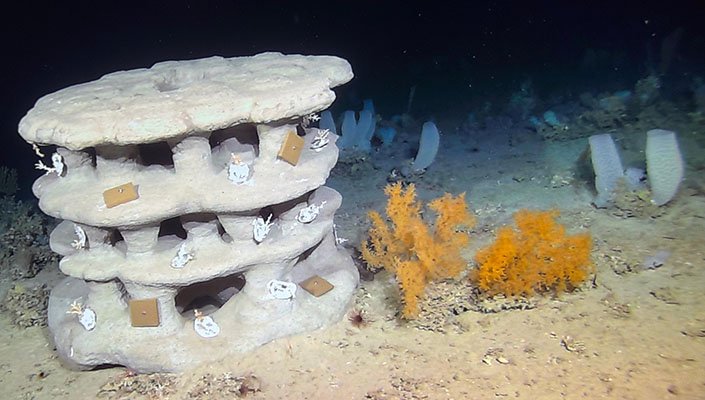
Twenty-three 3D printed artificial reefs now sit on the Atlantic seabed at depths of up to 1,100 metres, placed there by a Franco-Irish research team testing whether additive manufacturing can speed the recovery of cold-water coral habitats damaged by bottom trawling. The structures were deployed in August from L’Atalante, a research vessel of the French Oceanographic Fleet, at two protected sites: the south-west Porcupine Bank off the west coast of Ireland, and the Guilvinec Canyon in France’s Bay of Biscay.
The deployment is the latest campaign of REDECOR (REstauration DEs CORaux d’eau froide), a three-year mission run by researchers from University of Galway, the French ocean research institute Ifremer, and Sorbonne University. It feeds into REDRESS (Restoration of deep-sea habitats to rebuild European Seas), a Horizon Europe project that brings together 27 partners from 15 countries.
Printed Concrete Built for the Deep
Each reef is an eco-designed, 3D printed cylinder made from low-carbon concrete that incorporates volcanic material. The modules measure roughly 80 centimetres tall and 100 centimetres across, and each weighs about 600 kilograms. Printing allowed the team to build complex internal geometry into every unit, including tunnels, ledges, and overhangs that create sheltered microhabitats and surfaces for corals and other organisms to colonise.
Rather than being joined into one continuous structure, the modules were set down individually, spread across an area of roughly half a hectare. On the Porcupine Bank they were placed between 900 and 1,100 metres below the surface, with the installed reef pictured at around 950 metres.
The researchers are testing two ways of seeding the structures. Some modules carry oyster shells, ceramic plates, and tiles intended to encourage free-swimming coral larvae to settle on their own. Others were fitted with “nubbins,” small fragments of living coral. To prepare these, the team collected coral from around 950 metres, kept the colonies in seawater tanks set up to mimic deep-sea conditions, then cut small branches, attached them to oyster shells, and anchored them to the printed reefs.
The work focuses on the two main reef-building cold-water species, Lophelia pertusa and Madrepora oculata. The goal is to find out whether transplanted fragments can survive and form new colonies, and whether they make the artificial reefs more attractive to settling larvae.
Early Signs From the 2025 Reefs
The August voyage also revisited modules installed in the Guilvinec Canyon during the 2025 campaign. Coral nubbins placed on those reefs a year earlier were found to be still alive, and the structures had drawn a range of marine life, including sea urchins, fish, crabs, and crinoids.
Dr Anthony Grehan, a deep-sea ecologist at University of Galway who co-led the Porcupine Bank mission, said: “With this project, we are testing whether we can actively accelerate that recovery by creating new starter structures for corals to grow on which also mimic reef structure to help re-establish functioning reef habitats. The early results are very encouraging, and if we can show that these approaches work, it could open up new possibilities to scale up the restoration of damaged coral reefs elsewhere in the Atlantic and beyond.”
Over the coming years, the team will track both sites using photography, video, and 3D mapping to follow how coral and other species develop on and around the reefs. Monitoring of the Irish and French sites is planned for next year aboard an Irish research vessel. The programme will also measure seawater conditions, sediment, and chemical contaminants, to better understand what healthy coral growth requires and how climate change and ocean acidification might affect restoration.
Why Waiting Is Not an Option
Cold-water corals are less familiar than tropical reefs, but they support deep-sea biodiversity, including fish populations. They are also fragile and easily destroyed by bottom trawling. Because they grow only a few millimetres a year, a damaged reef can take decades or even centuries to recover naturally.
Both REDECOR sites are now closed to trawling. The Porcupine Bank site falls under the EU Common Fisheries Policy, which bans trawling below 800 metres, and the Guilvinec Canyon is a Natura 2000 site where trawling is also prohibited. For the researchers, however, protection alone does not go far enough.
Marie-Claire Fabri, a research engineer in deep-sea benthic ecology at Ifremer who co-led the Bay of Biscay expedition, said: “Preserving these areas alone is not enough; the active restoration of cold-water corals is urgently needed.”
The same printed reef modules have also been installed by REDRESS partners in the UK, Iceland, and Italy, at sites in the Atlantic and the Mediterranean. That gives the project a Europe-wide view of whether standardised 3D printed structures can reliably support coral restoration across different environments.
The findings are expected to help guide implementation of the new European Nature Restoration Law, which sets targets for restoring damaged sponge, coral, and coralligenous algae habitats. Funding comes from the European Union through REDRESS, along with the French Oceanographic Fleet, Ifremer, and Sorbonne University.
From Tropical Lagoons to the Deep Atlantic
REDECOR’s strategy targets a gap that trawling bans alone cannot close. Protection stops new damage, but cold-water corals grow only a few millimetres a year, so a destroyed reef may take decades or centuries to come back on its own. The team’s answer is to give recovery a physical head start: 3D printed low-carbon concrete modules with tunnels, ledges and overhangs that mimic reef structure, some fitted with settlement surfaces and others seeded with living coral fragments.
What sets the project apart is where it operates. Most printed-reef work to date, from 3D printed concrete reefs in the Gulf of Mexico to 3D printed terracotta tiles in Hong Kong, has focused on shallow waters. REDECOR installs its modules at 900 to 1,100 metres. Because partners in the UK, Iceland and Italy are using the same design, the project can also test whether one standardised printed unit works across very different European seabeds.
In June 2026, Anantara Dhigu Maldives Resort and Swiss company rrreefs placed 13 flower-shaped reef structures on the resort’s lagoon floor. The project was covered as 3D printed reef structures installed in the Maldives. The modules are 3D printed from fired terracotta clay and designed to help coral larvae settle, with part of the funding coming from Edelweiss Air and help alliance, both Lufthansa Group companies.

In Jordan, the Aqaba Development Corporation, Voyacy Regen and Sperra deployed 3D printed concrete reef structures, a project showcased at the 2025 UN Ocean Conference in Nice. It was reported as the latest 3D printed coral reef restoration effort in Aqaba. Separately, the Environment Agency of Abu Dhabi signed an MoU with Archireef to restore Abu Dhabi’s coral reefs using 3D printing with structures made from natural materials.
3D printing is now a proven tool for reef restoration in shallow waters. REDECOR takes it into the deep sea, where recovery is slowest.
Register now for AMA: Software 2026. Join 3D Printing Industry on 22 October for expert presentations, panel discussions and live audience Q&A exploring the software shaping additive manufacturing. [Register here.]
To stay up to date with the latest 3D printing news, don’t forget to subscribe to the 3D Printing Industry newsletter or follow us on LinkedIn.
Explore the full Future of 3D Printing and Executive Survey series from 3D Printing Industry, featuring perspectives from CEOs, engineers, and industry leaders on the industrialization of additive manufacturing, 3D printing industry trends 2026, qualification, supply chains, and additive manufacturing industry analysis.
Featured image shows Installed Artificial Reef in 950m of water off the Porcupine Bank. Photo via Ifremer/University of Galway.
