


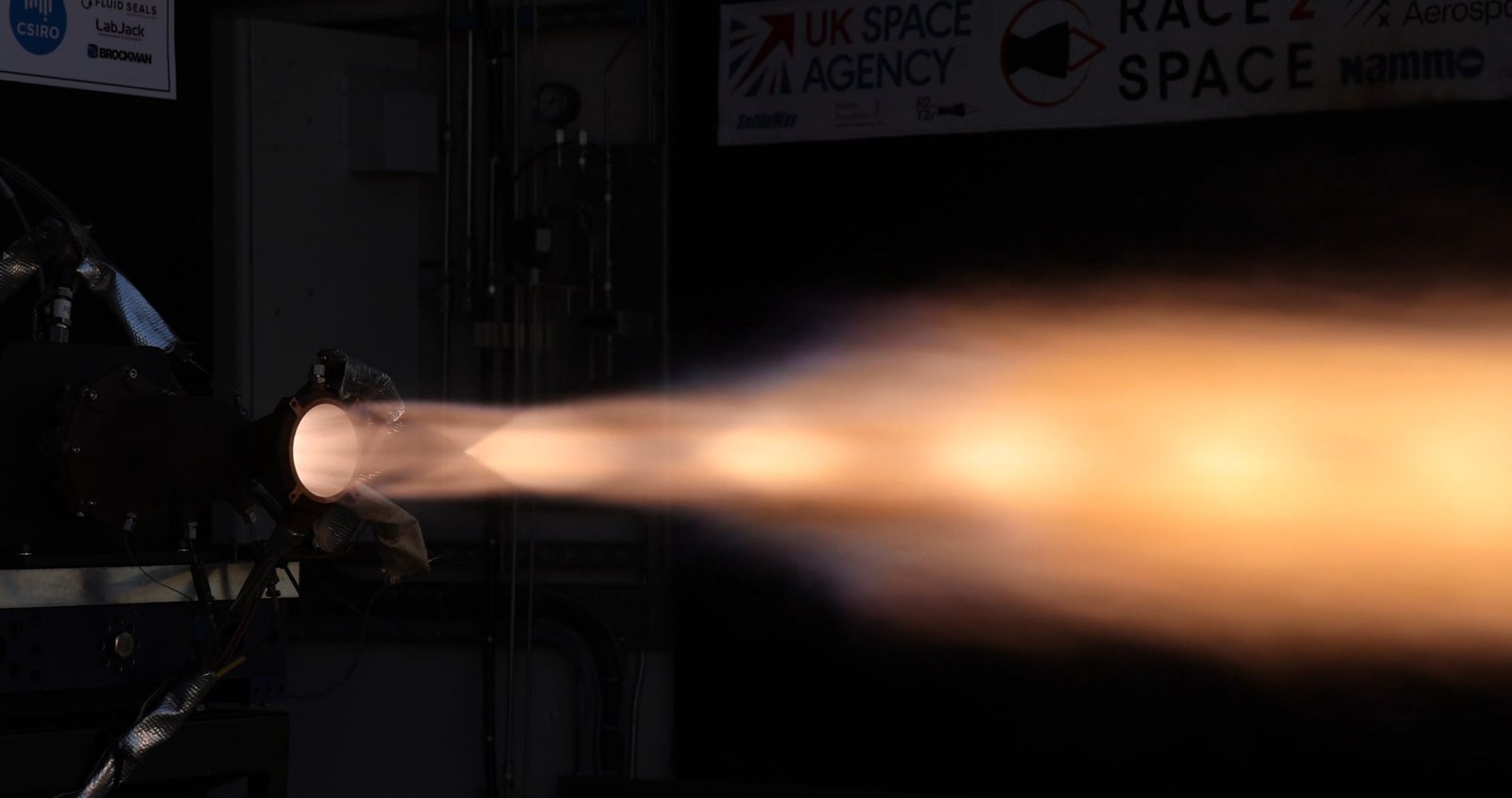
A three-person student team from the University of Melbourne has hot-fired a 3D printed regeneratively cooled liquid bipropellant rocket engine at Race2Space in the UK, taking first place in the competition’s liquid oxygen (LOX) bipropellant category. CSIRO, which supported the build through its Lab 22 additive manufacturing center, says it is the first regeneratively cooled liquid rocket engine an Australian student team has successfully fired at the event.
The engine, nicknamed Slinky, weighs roughly 6 kg and is about the size of a large pineapple. It completed five clean, stable hot fires in a single day, including throttling runs, and reached a maximum thrust of 5.4 kilonewtons, output comparable to a small lunar lander engine.
Slinky was built as an Aerospace and Rocket Engineering Society (ARES) capstone project by aerospace and mechanical engineering master’s students Jack Gardiner, Brooke Doolan, and Stuart Davis, working with scientists and engineers at Lab 22.
Cooling channels inside the chamber wall
Regenerative cooling routes one of the two liquid propellants through passages in the wall of the combustion chamber, pulling heat out of the structure before that propellant is injected and burned. It is standard practice in professional liquid propulsion and rare in student projects, because the plumbing is difficult to build.
That is the constraint additive manufacturing lifts. “Now using 3D printing, we can build channels inside the combustion chamber wall,” said Dr. Cherry Chen, senior research scientist and team leader at CSIRO, contrasting the approach with the complex arrangements of pipes and tubes traditionally wrapped around the chamber. Moving the coolant path inside the wall improves cooling efficiency and removes an assembly problem.
Lab 22 printed the engine on a Nikon SLM Solutions 280 2MA laser powder bed fusion system at Clayton, Victoria, supported by the iLAuNCH Trailblazer Program. The material is a copper alloy, selected for thermal conductivity and its tolerance of high heat flux environments. Chen said Lab 22 advised the students on material selection, mechanical behavior, design for additive manufacturing, and post-processing of the printed parts.
The finished hardware is a fully integrated engine with micro cooling channels embedded in the chamber wall, mounted for testing on a welded steel thrust structure built to interface with Airborne Engineering’s facilities.
Concept to test, compressed
Richard Sandberg, Chair and Professor of Computational Mechanics at the University of Melbourne, supervised the capstone and framed the result as evidence of what pairing computational design with additive manufacturing can do in a student timeframe. He argued the same concept-to-test speed will shorten engineering development cycles more broadly and bring costs down.
Davis said the team was thrilled to be working at the leading edge of computational engineering and to have shown what its integration can deliver. Doolan called the outcome a big step for ARES Rocketry, opening the way to more complex propulsion design and manufacturing, with the team hoping to fly Slinky in a future rocket.
The line between student project and professional hardware just moved
Regenerative cooling isn’t new. What kept it out of student hands was construction: tube bundles brazed one by one, jackets machined and joined, each seam a place to fail and a skill to hire for. Printing the channels into the wall replaces that labor with geometry, which is why a three-person capstone team could attempt a design normally reserved for professional programs, and get five clean fires on the first campaign.
Other student teams are arriving at the same threshold. In March 2026, Ireland’s ULAS HiPR team announced Lúin of Celtchar, described as the first additively manufactured liquid rocket engine in the Republic of Ireland, a 2 kN engine burning IPA and nitrous oxide, developed with the University of Limerick and Irish Manufacturing Research and entered in the same Race2Space 2026 competition. A decade ago the comparable student milestone was UCSD’s SEDS team flying Vulcan-1 on a printed engine, with no regenerative cooling at all.
What these teams still need is someone else’s equipment. Copper alloys are standard for these components because of their thermal conductivity and remain difficult to process by laser powder bed fusion, the reason NMIS engineers demonstrated a cold spray pathway for copper rocket nozzles earlier this year. Slinky was printed on Lab 22’s system, with CSIRO advising on material selection, design for additive manufacturing, and post-processing.
Regenerative cooling is an established practice in professional propulsion. What’s new is a three-person capstone team firing one, which took a national lab standing behind them.
3D Printing Industry is inviting speakers for its 2026 Additive Manufacturing Applications (AMA) series, covering Energy, Healthcare, Automotive and Mobility, Aerospace, Space and Defense, and Software. Each online event focuses on real production deployments, qualification, and supply chain integration. Practitioners interested in contributing can complete the call for speakers form here.
To stay up to date with the latest 3D printing news, don’t forget to subscribe to the 3D Printing Industry newsletter or follow us on LinkedIn.
Explore the full Future of 3D Printing and Executive Survey series from 3D Printing Industry, featuring perspectives from CEOs, engineers, and industry leaders on the industrialization of additive manufacturing, 3D printing industry trends 2026, qualification, supply chains, and additive manufacturing industry analysis.
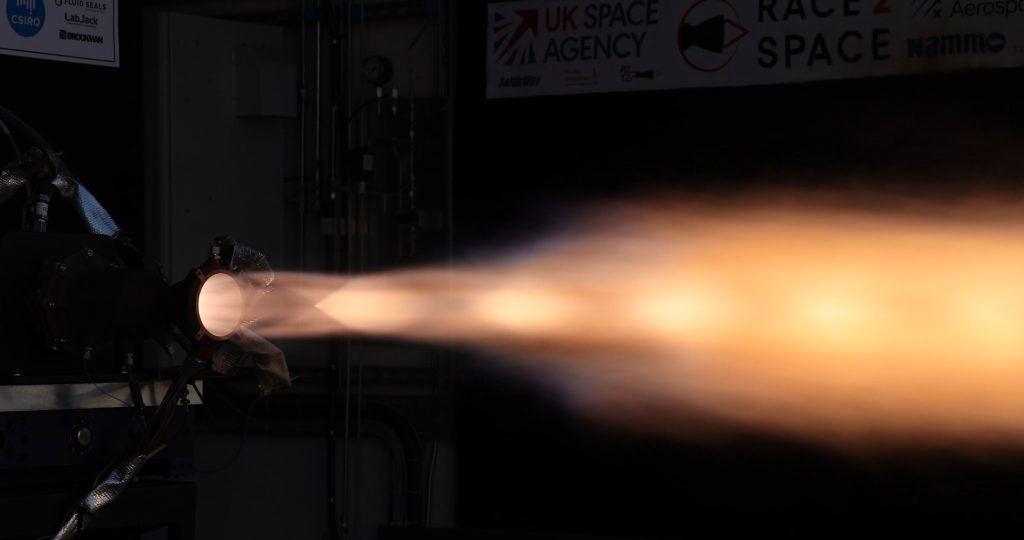
Featured image shows Slinky, the 3D printed rocket engine, under hot firing test. Photo via CSIRO
