


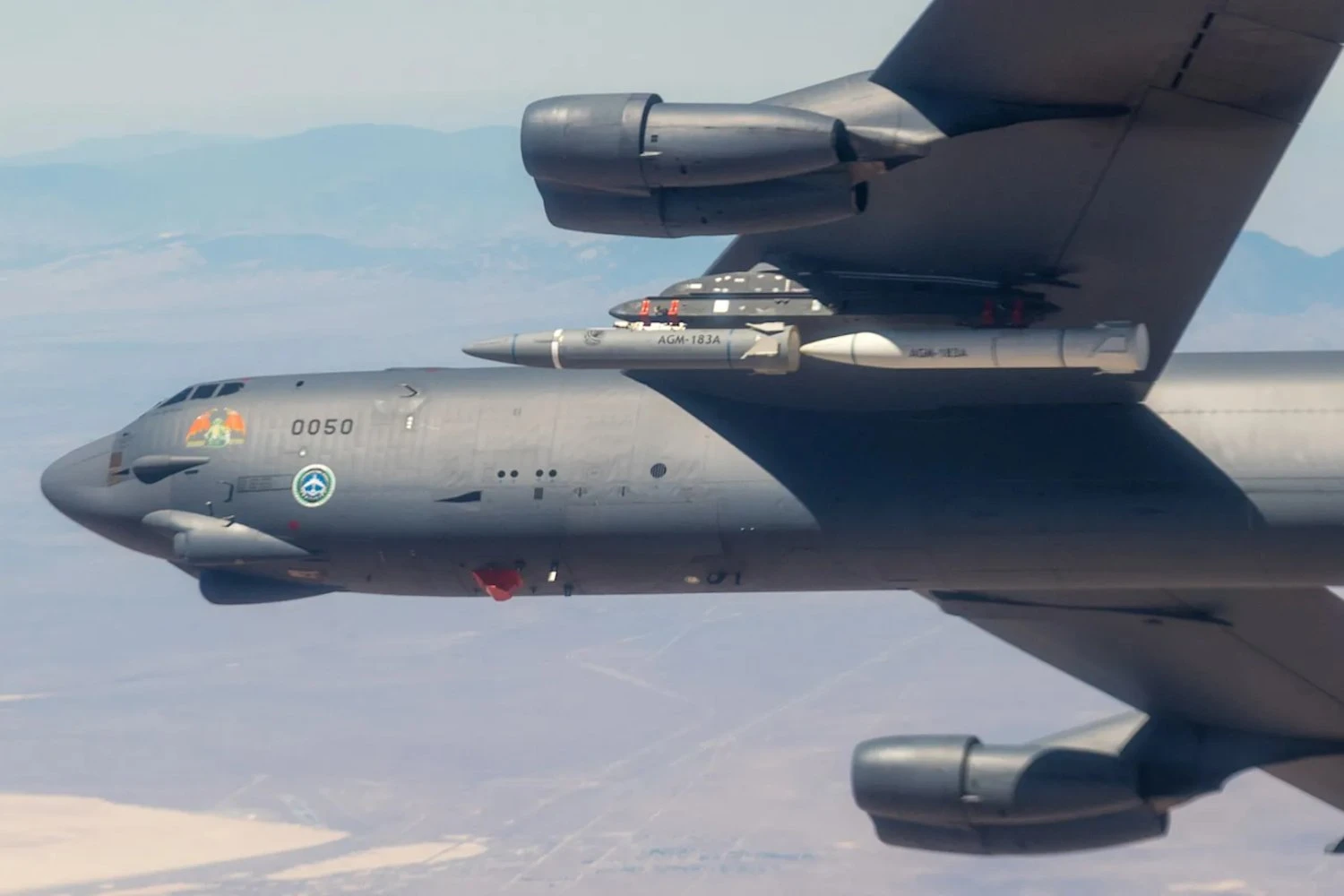
The U.S. Air Force has awarded Lockheed Martin a US$694 million contract to produce and field the AGM-183A Air-Launched Rapid Response Weapon (ARRW), reviving a hypersonic missile that the service had decided not to buy just three years ago.
The contract was signed on September 29 but disclosed by the Air Force on October 26. The service said the agreement formally moves ARRW from prototyping and flight testing into production.
The Air Force did not disclose how many missiles will be manufactured or when deliveries will begin, citing operational security.
ARRW is a boost-glide weapon designed for long-range strikes against high-value and time-sensitive targets protected by advanced air defenses. A solid-fuel rocket accelerates the missile beyond Mach 5 before releasing an unpowered hypersonic glide vehicle that can maneuver toward its target.
Follow Air Data News: WhatsApp | Instagram | LinkedIn | Twitter | Facebook
The B-52H Stratofortress, which has been extensively used during the ARRW test program, will be the weapon’s initial operational platform. The Air Force has also worked on integrating the missile with the B-1B Lancer.
From cancellation to production
The production contract completes an unusual reversal for a program that appeared to be approaching its end in 2023.
Lockheed Martin began developing ARRW for the Air Force in 2018, and captive-carry testing with the B-52H followed in 2019. The program subsequently suffered a series of test failures, including three unsuccessful launch attempts in 2021.
The first successful booster test came in May 2022, when an ARRW released from a B-52H separated successfully, ignited its rocket motor and exceeded Mach 5.
A complete missile was successfully tested for the first time in December 2022. Another all-up-round test in March 2023 encountered problems, prompting renewed questions about the future of the program.
Later that month, then-Air Force acquisition chief Andrew Hunter told lawmakers that the service did not intend to proceed with ARRW procurement. The remaining tests would be completed to collect data, while investment shifted toward the Hypersonic Attack Cruise Missile (HACM).
ARRW nevertheless continued flying. Additional testing provided the Air Force with more data on the complete weapon, including a March 2024 launch from a B-52H that demonstrated its ability to engage a land target.
By 2025, the position had changed. Then-Air Force Chief of Staff Gen. David Allvin told Congress that the service intended to purchase ARRW, and the fiscal year 2026 budget subsequently provided US$362 million to restart production and begin procurement.
The fiscal year 2027 budget request adds another US$452 million for ARRW procurement. Air Force planning documents project annual spending of between US$556 million and US$621 million from 2028 through 2031, although the number of weapons associated with those amounts has not been made public.
ARRW reaches production before HACM
The decision creates an unusual outcome for the Air Force’s two major air-launched hypersonic weapon programs.
HACM became the service’s priority when ARRW procurement was abandoned in 2023, but the Raytheon-developed weapon is still in flight testing. ARRW has now become the first U.S. Air Force hypersonic weapon to enter production.
The two missiles use different approaches to hypersonic flight. ARRW uses a rocket booster and an unpowered glide vehicle, while HACM is a smaller air-breathing cruise missile powered by a scramjet engine.
Their intended employment also differs. ARRW’s size favors bombers such as the B-52 and B-1, while HACM is being developed as a more compact weapon that can be carried by tactical aircraft.
A second ARRW is already planned
The Air Force is also funding development of an improved version of the weapon rather than treating the current AGM-183A as the end of the program.
Its fiscal year 2027 research budget requests US$296 million for ARRW Increment 2, including development of a terminal seeker and data link as well as hardware changes and initiatives intended to reduce production costs.
Those additions would give the weapon a capability absent from the original ARRW: the ability to receive targeting information and locate a target during the final portion of its flight.
That could allow Increment 2 to engage moving targets rather than only predetermined locations, opening the possibility of using the hypersonic weapon against targets such as warships.
