


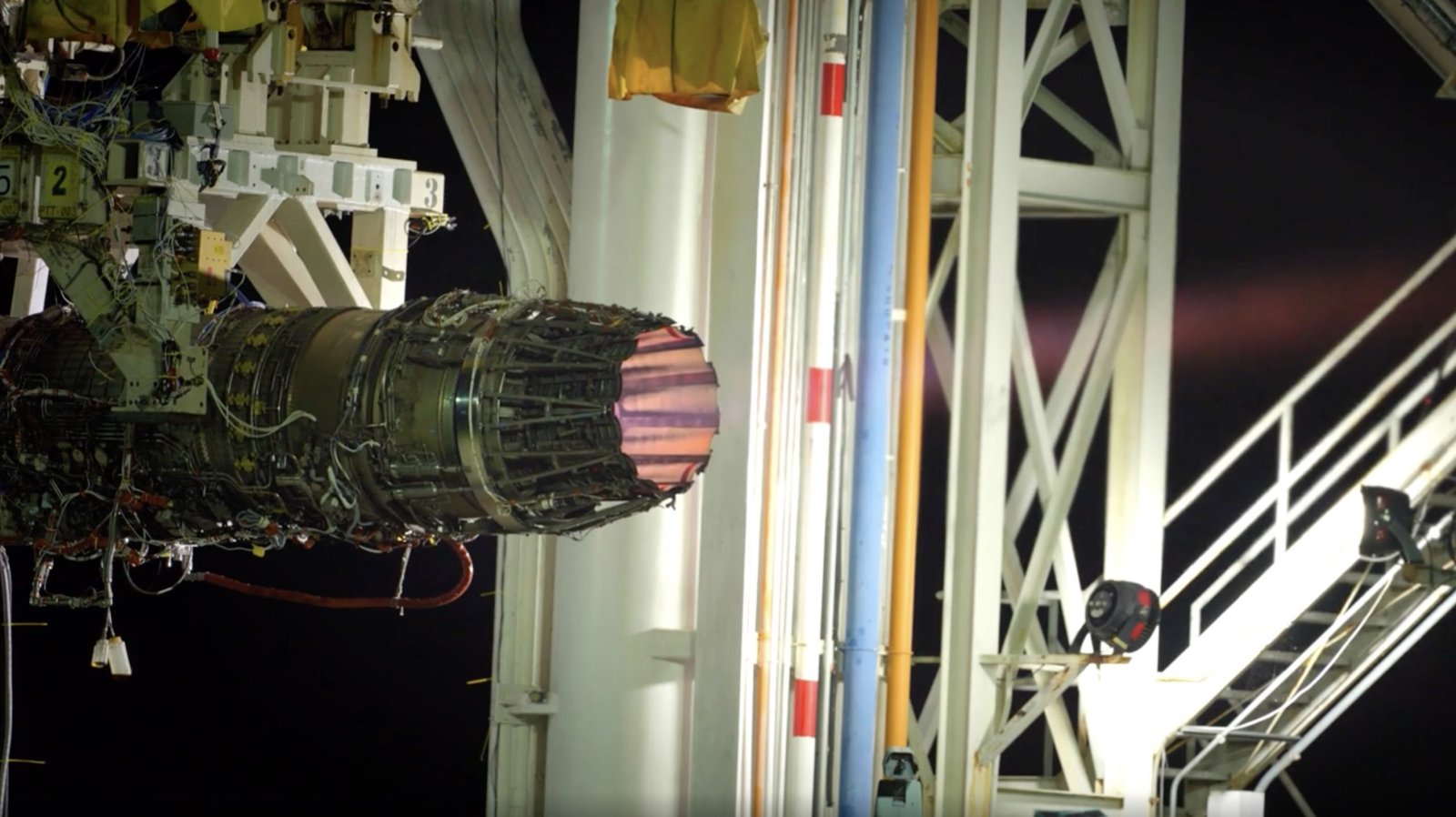
The propulsion project for Shield AI’s collaborative combat aircraft combines the proven fighter engine with an off-the-shelf Axisymmetric Vectoring Exhaust Nozzle system.
Autonomy start-up Shield AI and propulsion manufacturer GE Aerospace have begun stand testing an F110 fighter-jet engine modified with thrust vectoring technology.
Video released by Shield AI shows a nighttime light of the turbofan, which is mounted to an outdoor overhead thrust stand. Actuators from the Axisymmetric Vectoring Exhaust Nozzle (AVEN) system are seen around the engine’s variable nozzle, swivelling thrust exhaust on both vertical and horizontal axes.
The Axisymmetric Vectoring Exhaust Nozzle was originally built to provide the F-16 fighter with a three-dimensional thrust-vectoring capability. Source: Shield AI
The trials are taking place at GE’s test site in Peebles, Ohio, in support of Shield AI’s X-Bat collaborative combat aircraft development effort. A prototype of the uncrewed fighter will use a single thrust-vectoring F110 to take off and land vertically from a mobile rail system.
AVEN is an off-the-shelf experimental device initially intended, in the 1990s, to provide a Lockheed Martin F-16 with three-dimensional thrust vectoring. During testing from that era, the AVEN nozzle accumulated 73 ground test hours and 135 flight hours across 95 sorties.
Shield AI plans to start X-Bat flights before year-end and aims for it to achieve initial combat capability by 2029. Three prototype aircraft will support a flight test campaign.
The maiden flight is to launch from a Shield AI facility in Newton, Kansas – a former US government test range acquired by the company.
The X-Bat will feature a stealthy signature thanks to a low-observable profile and internal weapons bays, and fly autonomously, controlled by Shield AI’s Hivemind technology.
The jets are to have range exceeding 2,000nm (3,700km) and ability to operate at altitudes of 50,000ft, without pilot inputs, the company says.
Shield AI vice-president of aircraft Armor Harris conceived X-Bat after joining the company from SpaceX, where he helped develop the American space launch firm’s signature reusable rocket boosters that return to the launch pad and land upright.
Company co-founder Brandon Tseng told FlightGlobal in May that X-Bat is designed to “create geographically distributed long-range fires with very, very low cost per effect against an adversary like China”.
“China can see every single runway and fighter jet on every single runway that we have,” Tseng says. “Those are day-zero targets. Aircraft carriers make it incrementally harder because they’re mobile, but they’re not that fast.”
The X-Bat is meant to address both dilemmas by being a transportable launch-and-recovery rail system that can be situated on land or ships at sea.
Shield AI launched development of the X-Bat in 2025 using company funding but recently secured a $50 million investment from the US Navy and Department of War’s Defense Innovation Unit.
The post Video: Shield AI and GE Aerospace test thrust-vectoring F110 engine for X-Bat first appeared on FlightGlobal.
