


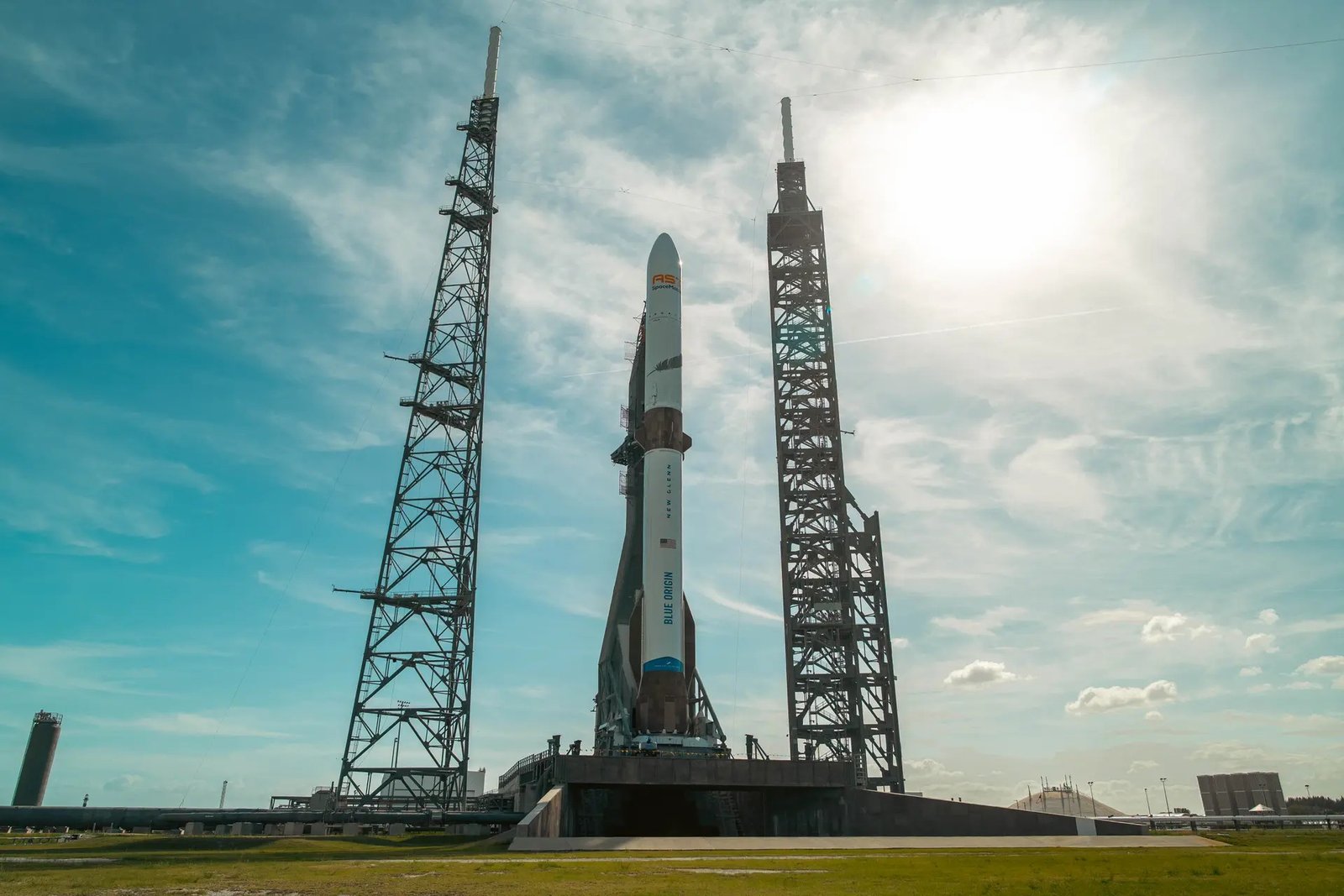
Cape Canaveral Space Force Station (CCSFS) in Florida resumed operations Friday following the explosion of Blue Origin’s New Glenn rocket during a test Thursday night.
Space Launch Delta 45 (SLD 45), which manages the U.S. Space Force’s Eastern Range and oversees all East Coast rocket and missile launches, said Friday that a SpaceX Falcon 9 rocket deployed a batch of Starlink satellites to orbit, less than 12 hours after an anomaly with New Glenn’s engine system surged emergency responders to the scene.
SLD 45 said there were no reported injuries or fatalities, and the FAA told FLYING there was no impact to air traffic. Since the mishap did not occur during a test flight, the agency will not require an investigation, as it did for New Glenn’s most recent test flight in April.
“The FAA is aware that the Blue Origin New Glenn vehicle experienced an anomaly during a static fire test on the pad in Cape Canaveral, Florida around 9 p.m. [EDT] on May 28,” the agency said. “This test was not within the scope of FAA licensed activities.”
Though SpaceX has resumed Starlink missions out of CCSFS’s Space Launch Complex 40 (SLC-40), it could be months before New Glenn returns to action.
The explosion of SpaceX’s Falcon 9 at SLC-40 in September 2016 was the last time a rocket blew up at CCSFS. It took more than one year to restore the pad to usability, during which time SpaceX launched from other sites.
Blue Origin, though, has just one orbital launch site for New Glenn—Space Launch Complex 36 (SLC-36), which it blew up yesterday.
What Happened?
New Glenn is Blue Origin’s two-stage, heavy-lift rocket, designed to compete with SpaceX’s workhorse Falcon 9 and Falcon Heavy vehicles. It debuted with a pair of 2025 demonstration flights for the Space Force’s National Security Space Launch (NSSL) program, which launches some of the nation’s most sensitive satellites to orbit.
NG-3 in April was New Glenn’s first commercial mission, intended to deploy customer AST SpaceMobile’s BlueBird 7 satellite to low-Earth orbit (LEO). But the rocket’s second stage misfired, causing its payload to fall short of the intended orbit and prompting scrutiny from the FAA.
The agency closed its investigation and authorized a return to flight on May 22, after Blue Origin determined that a cryogenic leak froze a hydraulic line, which caused the thrust anomaly. Though it failed to complete its mission, New Glenn did demonstrate first-stage reusability as Blue Origin returned the booster to the pad for the first time.
Thursday’s test—a static fire test of the rocket’s seven main engines, fueled by liquid oxygen and liquefied natural gas—was a precursor to Blue Origin’s planned June 4 launch of 48 Amazon Leo satellites, the first of 24 missions Amazon purchased on New Glenn.
The engines appeared to begin firing before, moments later, the 274-foot-tall rocket suddenly and violently erupted into a massive fireball emanating from the booster. The upper stage appeared to tip over as fires on the ground engulfed it.
The explosion created a cloud of debris that covered the entire field of view of cameras Spaceflight Now had set up to record the test. It appeared to knock out one of SLC-36’s two lighting protection towers, as well as the mechanism that transports New Glenn to the pad and positions it upright. Footage from news helicopters showed what looked to be extensive damage. No Amazon satellites were on board during the test.
“The Eastern Range serves as a Department of Defense test and training range supporting critical development, testing, evaluation, and launch activities that advance national security and space capabilities,” SLD 45 said in a public advisory. “These operations often involve developmental systems and emerging technologies, and the nature of such testing carries inherent risk, including the potential for anomalies.”
Blue Origin and its CEO Jeff Bezos said in social media posts that all personnel were accounted for following the anomaly.
“It’s too early to know the root cause but we’re already working to find it,” Bezos wrote. “Very rough day, but we’ll rebuild whatever needs rebuilding and get back to flying. It’s worth it.”
SpaceX CEO Elon Musk replied with the Latin phrase, “As astra per aspera,” which translates roughly to, “Through hardships, to the stars.” Musk and Bezos have had a longstanding feud over their respective companies’ access to launch infrastructure. The former in 2024 joked about suing the latter.
SpaceX will be unaffected by SLC-36’s restoration, as it launches Falcon 9 and Heavy from other Florida sites and conducts test flights of its larger Starship out of Texas. New Glenn, though, could remain grounded well after Blue Origin figures out what went wrong Thursday, depending on how long the effort takes.
After flying only twice in 2025, Blue Origin had been aiming for its fastest New Glenn turnaround yet, launching in early June less than two months after NG-3 in April. Falcon 9 and Heavy, meanwhile, account for the vast majority of commercial space activity.
Beyond setting back Blue Origin’s aims to compete with SpaceX’s launch capabilities and Starlink satellite constellation, Thursday’s incident could impact the company’s obligations for NASA.
New Glenn’s 7-meter payload fairing is designed to launch Blue Origin’s Blue Moon lunar landers. The company this year hopes to launch a prototype Blue Moon Mark 1, the uncrewed cargo variant. Blue Moon Mark 2, its crewed model, is being evaluated by NASA as the human landing system (HLS) for its Artemis moon missions.
A setback to New Glenn could also mean a setback in HLS testing. The low-Earth orbit Artemis III mission—akin to the Apollo 9 test flight—is scheduled for late 2027 and per NASA will ideally involve both Blue Moon Mark 2 and SpaceX’s Starship HLS. The mission is intended to test the landers’ docking capabilities before they deliver astronauts to the lunar surface. But if New Glenn or SLC-36 are not ready to go, SpaceX could take the opportunity to prove its readiness for a lunar landing as soon as 2028.
“NASA is aware of the anomaly that occurred [Thursday] at Launch Complex 36 involving Blue Origin’s New Glenn rocket at Cape Canaveral Space Force Station,” NASA Administrator Jared Isaacman wrote in a social media post. “Spaceflight is unforgiving, and developing new heavy-lift launch capability is extraordinarily difficult. We will work with our partners to support a thorough investigation of this anomaly, assess near-term mission impacts, and get back to launching rockets.”
On Tuesday, NASA tapped Blue Moon Mark 1 to deliver space agency equipment to the moon later this year. The mission would be its first in pursuit of a multibillion-dollar, permanent lunar base, with two others targeted for 2026.
“We will provide information on any impacts to the Artemis and Moon Base programs as it becomes available,” Isaacman said.
