


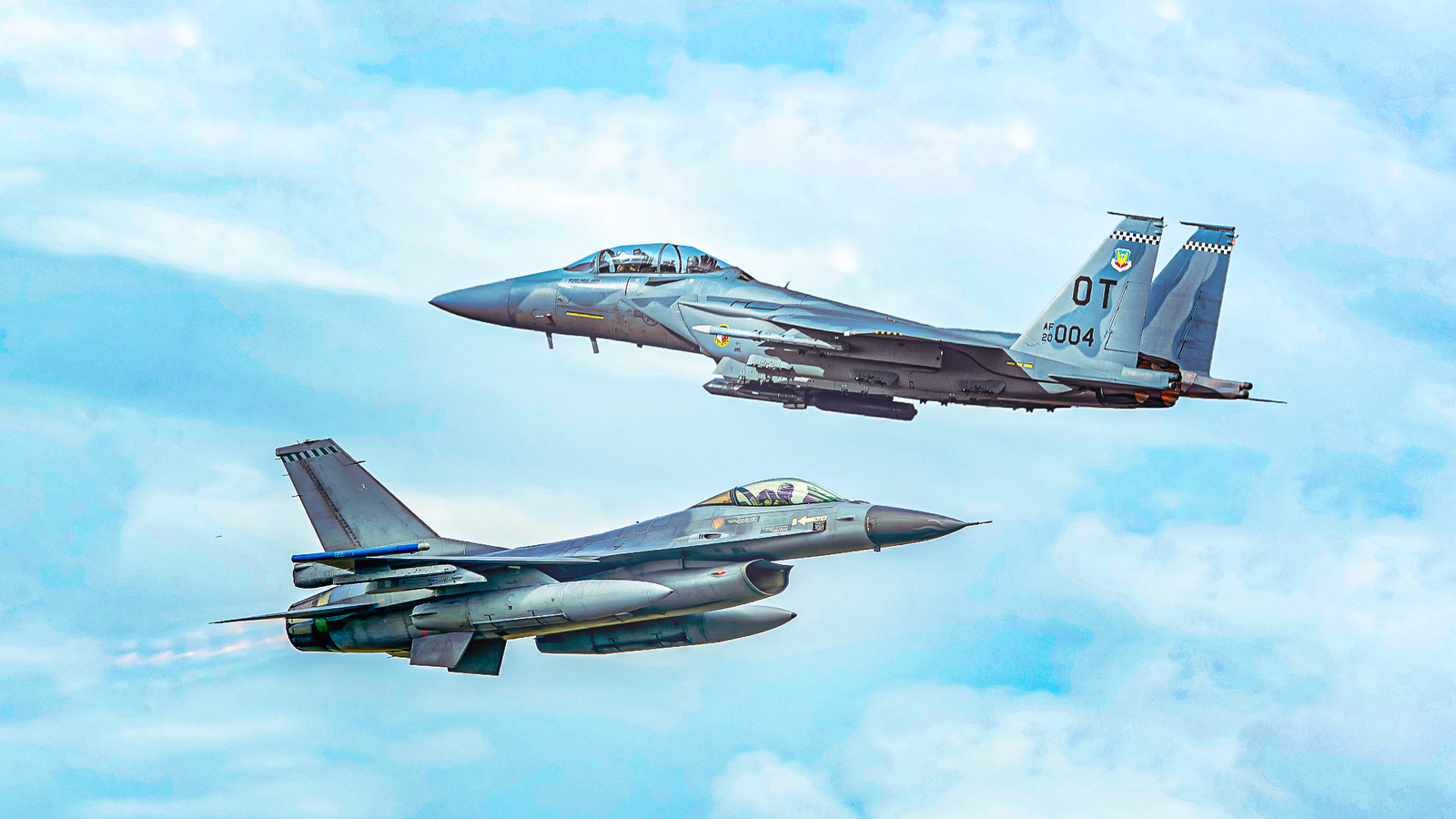
The Boeing F-15EX Eagle II seems like it should cost twice as much to fly than the Lockheed Martin F-16 Fighting Falcon simply because it has two engines instead of one. Add on to that, the Eagle II is a higher performance air superiority fighter with the biggest payload in the US Air Force fighter inventory, and it would seem like it should command a far greater premium per flight hour.
In practice, the actual cost differential is smaller than one might assume. According to Department of Defense records from fiscal year 2025, the F-15EX cost an average of $15,250 per flight hour. Meanwhile, the smaller Lockheed Martin F-16C/D variants are billed at $13,561 hourly. Considering the gulf in capabilities, it is fair to call that a relatively narrow operational cost difference between the two frontline aircraft.
That narrow gap, of approximately 12% of her flight hours, sheds greater light on a debate going on about the validity of continued production of 4.5 generation fighter jets in the 21st century. With the flyaway cost of the Eagle II at or slightly above parity with stealth jets, its considerably cheaper flying cost paired with higher raw performance keeps the venerable F-15EX relevant even in the era of fifth- and sixth-generation warplanes.
Air Power Cost Analysis With The Pentagon

The Eagle II flies faster, higher, and further while carrying a greater payload than any other fighter jet in the Air Force, and it does it all at a cost that is comparable to legacy light jets. On the surface, paying about the same for an F-15EX as a Lockheed F-35 Joint Strike Fighter doesn’t seem like a good deal because the Eagle II doesn’t have stealth. Yet, the Boeing warbird comes in at about half or a third of the flight-hour cost plus far higher readiness-level averages.
A similar argument has kept the F-16 in the fleet with iterative upgrades longer than expected after the F-35 was introduced. Recently, there has even begun to be speculation that the Air Force may order new production F-16 Vipers. Despite the fact that these jets are not and can never be stealthy, they do not suffer from the burden of chronic technical difficulties, high maintenance, and exponentially greater operating cost.
The Pentagon’s cost tables as reported to Congress show the F-15EX averaging 12% and 13% above the F-16 price. Conversely, these modern figures place the Eagle II significantly below legacy platforms like the F-15C and F-15D variants at $24,566 hourly, as well as the F-15E Strike Eagle at $26,243. Even more notably, that is 30% to 40% less than an F-35A. Meanwhile, the legacy platforms have also had a higher combat availability rate on average as well.
Two Very Different Airframes Under The Skin

A massive part of the cost difference comes down to physics. Each airframe endures a function of the mission the aircraft is built to do. Both the F-16 and F-15 are multirole by today’s standards. However, the Eagle II remains optimized for air superiority.
The F-15EX is set up to haul standoff payloads to launch at high speed from over the horizon. In contrast, the smaller F-16 acts as a lighter, quick-reaction workhorse with lower performance limits, but the aggressive tactics take a heavy toll on the jet.
Performance Metric | Boeing F-15EX Eagle II | Lockheed Martin F-16C/D |
|---|---|---|
Powerplant | 2 x General Electric F110-GE-129 | 1 x Pratt & Whitney F100 or GE F110 |
Max Payload | 29,500 lb (13,381 kg) | 17,200 lb (7,800 kg) |
Top Speed | Mach 2.5+ | Mach 2.0 |
Service Ceiling | 60,000 feet (18,288 meters) | 50,000 feet (15,240 meters) |
Airframe Service Life | 20,000 flight hours | 12,000 flight hours |
.
To save money up front, the Air Force leans hard on the F-15EX’s DNA, since it shares over 70% of its parts with older Eagles. It plugs right into existing hangars, simulators, and ground gear without forcing bases to buy all new equipment. That mature infrastructure saves a great deal of cost.
The same logic should apply to the F-16. However, all of those jets are older and therefore incur greater maintenance per sortie. This is best exemplified by the older variants of the Eagle, which all cost about $10,000 more per flight hour to operate. Thus, the incentive to keep these reliable 4.5-gen warbirds in the air is very clear by the accounting alone.
The Mission Of 21st Century Multirole Fighters

The two jets do not actually compete for the same jobs. The Air Force sent its first operational F-15EX squadron to the Oregon Air National Guard to handle homeland defense and coastal air patrol, taking over for worn-out F-15C/D models.
The Pentagon originally planned to buy 144 Eagle IIs primarily to lock down these specific domestic defense roles, keeping the big fighters out of contested airspace where stealth aircraft are better suited to the mission. Meanwhile, the F-16 remains the ultimate multirole workhorse even as the F-35 slowly takes its place on the flight line.
Hundreds of Vipers are still deployed in active duty, Guard, and Reserve squadrons across the US, Europe, and Asia-Pacific. The F-16 remains a battle-tested, familiar platform capable of tackling everything from close air support to hunting enemy air defenses, even as newer F-35s slowly start to replace them.
The F-15EX program has also hit plenty of turbulence. Production was delayed by a strike in St. Louis, where the air dominance division is headquartered. And before that, there was a 2023 inquiry by the Government Accountability Office into defective fuselage sections. Still, the jet has had far fewer challenges than its stealthier successor.
The Contested Price Tag Of The Eagle II

Pentagon leaders originally scaled the total quantity of the F-15EX order back due to intense budgetary pressures and a strategic decision to prioritize fifth-generation stealth assets like the F-35A. This was because they only intended for the F-15EX to replace a small number of rapidly aging F-15C/D models that were facing severe airframe fatigue.
Then came a dramatic reversal to increase the fleet size to 268. The decision was made after ongoing delays in the hardware and software upgrades for the F-35A last year. It was so severe that the Joint Strike Fighter program was forced to pause new stealth jet deliveries. This situation created the threat of a dangerous shortage of flyable combat aircraft at a time of rising global tensions.
Concurrently, the Air Force realized that its workhorse F-15E Strike Eagle fleet was deteriorating much faster than anticipated after decades of heavy utilization. By doubling down on the F-15EX, the military can rapidly replace both the legacy air superiority fighters and the older Strike Eagles with a reliable assembly line with a mature product.
Eagle II And Macroeconomics

Under traditional manufacturing economics, nearly tripling the order size helps lower the baseline flyaway cost of each individual jet because Boeing can achieve better economies of scale and spread fixed development costs over a larger volume. However, because this expansion pushes production out until 2031, the program faces new financial risks related to parts obsolescence.
The later production lots will require a significant redesign and technical refresh for core systems like the radar, mission computer, electronic warfare suite, and engines, which introduce new cost uncertainties. For operating costs, a much larger fleet creates a more efficient and standardized supply chain for spare parts and pilot training, which suppresses the cost per flying hour. Yet, the sheer size of the expanded fleet means the overall lifetime sustainment budget required to keep these aircraft flying for decades will grow significantly.
Meanwhile, the F-16 holds onto its clear financial edge for the missions it continues to fly. While the USAF focuses on flying out the lifespan of its aging fleet over the next decade, advanced Block 70 and 72 variants remain in active production for international buyers. Ultimately, both sides of the debate rely on hard financial data, and neither argument changes the baseline hourly flight cost gap, they simply expose the massive capability differences driving those numbers.
What The Rate Gap Really Tells Us

None of these changes what the Pentagon’s own charts plainly show. Hour by hour, the F-16 remains the cheaper jet to put in the air under standardized government accounting. In fact, the price gap between these two aircraft has actually grown rather than shrunk in the latest rate tables.
That does not mean the F-15EX is a waste of the defense budget. Those extra dollars per hour buy you two engines instead of one, nearly double the weapons payload, and a structural service life built to far outlast the legacy jets it is replacing.
It also covers a homeland defense alert mission that the Air Force decides is well worth paying a premium for, choosing to back it with a larger, harder-hitting airframe. The real question going forward isn’t which jet wins the hourly rate line item. It is whether the Air Force can keep its total fighter fleet large enough to fund both of these aircraft and their different yet similar roles at the same time.
