


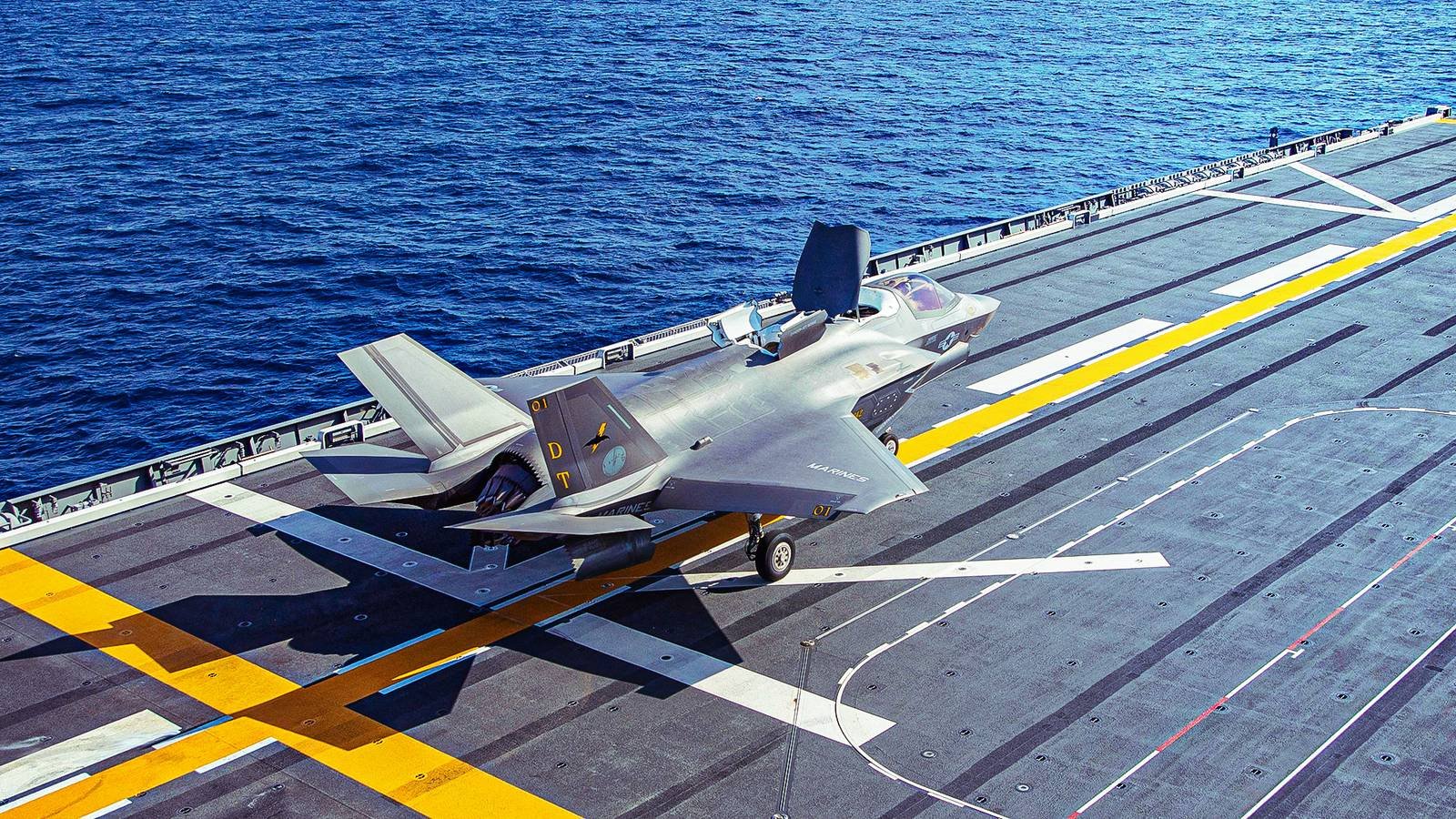
For a fighter aircraft advertised as one of the most sophisticated combat systems ever built, the idea sounds almost absurd: the United States Marine Corps is now taking delivery of Lockheed Martin F-35B stealth fighters with ballast weights installed in the nose instead of their primary radar systems. In an era defined by software-driven warfare and sensor fusion, headlines about “radarless F-35s” naturally create images of a procurement disaster or a multi-billion-dollar mistake. But the reality is more complicated, and far more revealing about how modern combat aircraft are actually built.
The six aircraft accepted by the Marines are not broken jets, nor are they examples of missing equipment overlooked on an assembly line. They are flying manifestations of a problem that has haunted advanced aerospace programs for decades: technology and production rarely move at the same speed. According to Aviation Week, on June 23 of this year, F-35 Joint Program Office (JPO) head Lt. Gen.
Gregory Masiello confirmed to lawmakers that six Marine Corps F-35Bs had already been accepted without their intended AN/APG-85 radar due to ongoing delays in the system’s development and integration. The first production APG-85 units are currently projected to arrive around April 2028, according to current budget documents, creating a multi-year gap between aircraft manufacturing schedules and the systems those aircraft were designed to carry.
The F-35 Radar Is More Than Just A Sensor
When most people think of a fighter radar, they imagine an electronic device that finds targets and guides weapons. On aircraft, the radar is also treated as a physical component integrated into the aircraft’s weight balance and internal structure. Removing it is not as simple as leaving a space behind the nose cone.
The six Marine Corps F-35Bs, therefore, required ballast in place of the missing radar hardware. The added weight preserves the aircraft’s center of gravity and ensures that handling characteristics remain close to those expected in normal operation. Fighter aircraft are designed around extremely tight tolerances in mass distribution, and even relatively small shifts in weight placement can create measurable changes in stability and handling. Instead of leaving an empty cavity behind the nose cone, engineers inserted compensating weights so that pilots experience flight behavior that closely resembles the aircraft’s eventual fully equipped configuration.
This is why describing the aircraft as “unfinished” can be misleading. Structurally and aerodynamically, these are complete flying aircraft. What they lack is the system that enables much of the F-35’s combat identity. The aircraft was designed around sensor fusion, in which radar, electronic warfare systems, and onboard computing combine information into a single operational picture for the pilot. Without its principal radar, the aircraft remains useful for flight operations, but loses one of the central pillars of its intended combat architecture.
The APG-85 Problem Is Bigger Than A Late Delivery

The issue is not merely that Northrop Grumman has not shipped enough radar units. The challenge stems from the fact that the new AN/APG-85 is not a direct plug-and-play replacement for the current AN/APG-81 radar.
Lot 17 F-35 aircraft intended for future upgrades were built around changes associated with the APG-85 installation. Structural modifications involving the aircraft’s forward fuselage and bulkhead geometry mean the existing APG-81 cannot simply be inserted as a substitute. The problem is therefore not simply one of missing electronics; the aircraft itself was prepared for a future radar design whose mounting architecture differs from its predecessor.
In addition to the physical fitting restriction, the APG-85 introduces substantially greater power and thermal demands than previous systems. Lt. Gen. Gregory Masiello indicated power requirements upwards of 80 kilowatts compared to the approximately 30 kilowatts supported by the current cooling architecture. Such changes illustrate why integration becomes an aircraft-level challenge rather than a simple hardware swap.
Why The Marines Accepted The Jets Anyway

Stopping an aircraft production line is one of the most expensive choices a defense program can make. The F-35 is not a single aircraft purchase but a multinational industrial ecosystem involving thousands of suppliers and multiple partner nations. By the end of fiscal year 2029, US services alone expect to field more than 1,100 F-35s, while the total planned American procurement remains above 2,400 aircraft.
The Marines made a calculated decision: accept the aircraft now and use them for activities that do not require their full combat capability. According to reporting surrounding Masiello’s testimony, these aircraft can still conduct flight operations and pilot training despite lacking their principal radar system. Rather than leaving aircraft parked on factory ramps awaiting components, the service can place them immediately into useful roles.
This approach effectively converts the aircraft into advanced trainers until the missing systems arrive. Pilots can still practice takeoffs, landings, formation flying, short takeoff and vertical landing procedures, and general aircraft handling while waiting for future upgrades. The aircraft are not combat-coded, but they still allow aircrews to accumulate valuable flying hours and preserve training pipelines.
Aerospace Has Been Doing This For Decades

Some headlines may make the situation sound unprecedented, but aviation history tells a different story. Military aircraft have repeatedly entered service with missing capabilities or placeholder equipment while development continues. In many cases, governments and air forces have accepted temporary capability gaps because delaying entire production lines often carries greater financial and operational consequences. The practice reflects a long-standing calculation in defense procurement: field-usable aircraft now, and gradually build toward the intended level of combat capability later.
Catch what other flight trackers miss
Emergency squawks, holds, NOTAMs — live signals, no signup.
Open tracker
Catch what other flight trackers miss
Emergency squawks, holds, NOTAMs — live signals, no signup.
Open tracker
During the Cold War, the United Kingdom’s Royal Air Force Tornado ADV F.2s reportedly flew with ballast in their noses while awaiting intended radar equipment. Other programs followed similar paths. Early F-15 aircraft faced delays due to engine and subsystem issues, while later programs increasingly struggled with software and avionics maturity.
The F-35 itself has already followed a comparable trajectory. During Technology Refresh-3 difficulties, aircraft were produced but could not immediately enter full operational service while software issues were addressed. The F-22 also provides an example: approximately 32 Block 20 aircraft remain dedicated largely to training rather than frontline combat operations. Aerospace programs have repeatedly accepted reduced capability in the short term to preserve force structure in the long term.
The Air Force Is Telling A Different Story

Early reports created some confusion by suggesting that the radar issue was isolated strictly to the Marine Corps’ F-35B, creating the impression that the Air Force’s F-35A and the Navy’s F-35C might avoid this fate by continuing to carry the older APG-81 radar. Initial reporting raised hopes that the APG-85 integration delays might affect only a small portion of the F-35 production pipeline, potentially turning a widespread engineering challenge into an isolated variant issue. More recent statements from the Joint Program Office, however, indicate that this is not the case.
While the six Marine Corps F-35Bs represent the first confirmed examples delivered without radar systems, they will not be the last. Because all Lot 17 aircraft share the newly redesigned forward fuselage and bulkhead geometry, the older APG-81 physically cannot be inserted as a substitute on any variant. Consequently, both the US Air Force and the US Navy are slated to follow the Marines later this year, accepting their own radarless F-35A and F-35C models under the same conditions.
That distinction matters because it demonstrates that the challenge is affecting every branch as it moves into Lot 17 production. The F-35 program often appears as a single aircraft project, but in practice, the three variants frequently share the same structural bottlenecks. Rather than reflecting an isolated, single-service problem, current indications suggest the issue is a fleet-wide manufacturing reality that will see all three branches utilizing “ballast jets” for basic flight operations and training pipelines.
Catch what other flight trackers miss
Emergency squawks, holds, NOTAMs — live signals, no signup.
Open tracker
Catch what other flight trackers miss
Emergency squawks, holds, NOTAMs — live signals, no signup.
Open tracker
The Real Story Is The Collision Between Hardware And Software

The six aircraft themselves are unlikely to determine the future of the F-35 program. The larger issue lies in what they reveal about modern fighter development. More importantly, they highlight how building next-generation combat aircraft is increasingly becoming a challenge of synchronizing software, sensors, computing architecture, and production schedules rather than simply assembling the airframe itself.
The Block 4 modernization effort is attempting to synchronize a remarkable number of moving pieces: Technology Refresh-3 computing hardware, software upgrades, weapons integration, electronic warfare improvements, and the APG-85 radar. This work is taking place across a fleet expected to number thousands of aircraft worldwide.
In that sense, the ballast sitting inside these six aircraft is symbolic. It is not merely dead weight occupying space where a radar should be. Earlier generations of fighters often struggled with engines, aerodynamics, or structural problems. Fifth-generation aircraft increasingly struggle to synchronize hardware, software, and digital architecture. The challenge is no longer simply building the aircraft; it is ensuring every component, processor, and line of code arrives at precisely the same point in time.
