


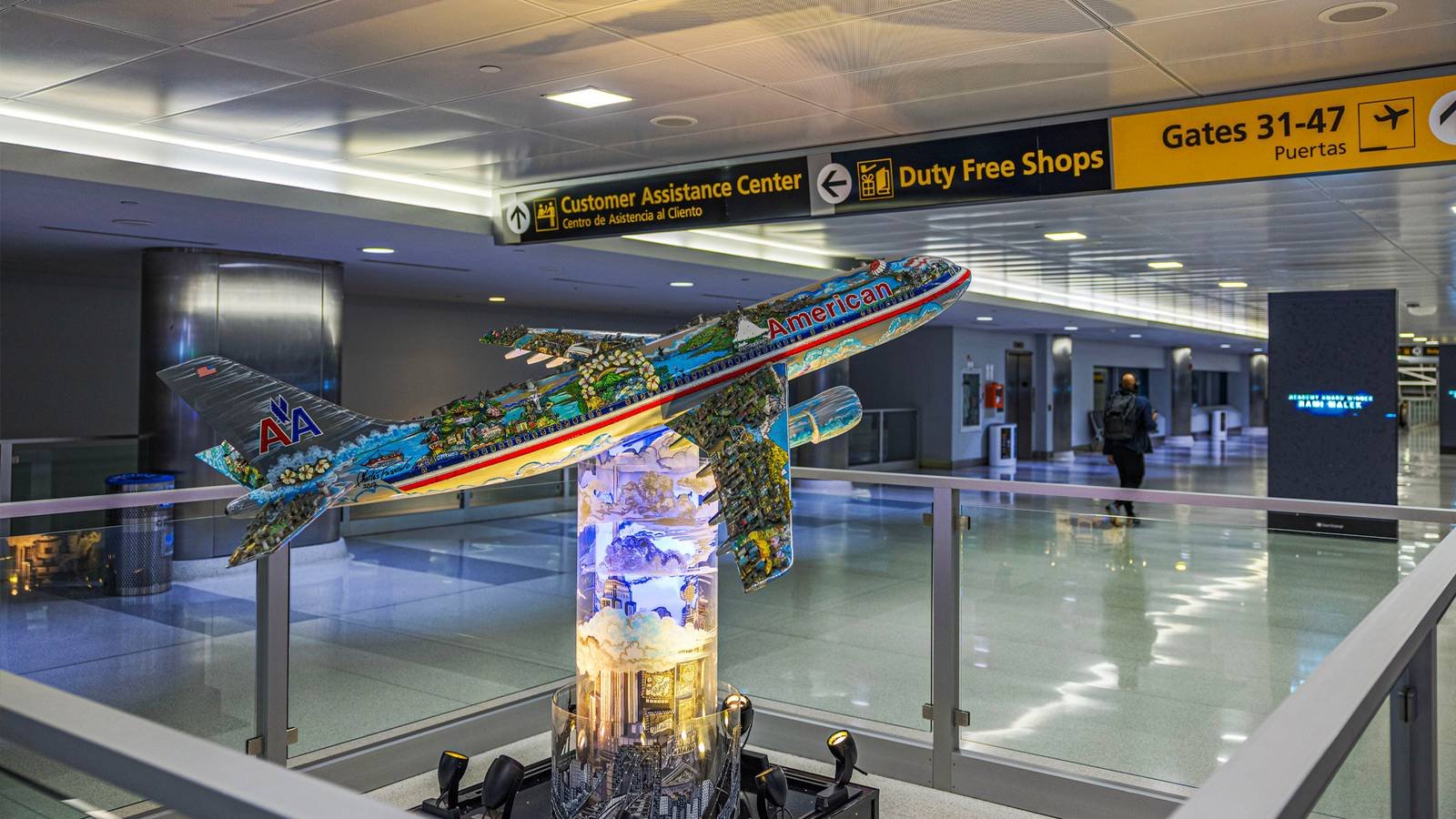
American Airlines is the lead tenant at JFK’s Terminal Eight, and it’s also the terminal’s lead operator. As such, it has a significant stake in ensuring that its passengers, as well as those traveling out of the terminal with its oneworld joint venture partners, have a pleasant experience before boarding or after disembarking from a flight. This is why the terminal has recently been revitalized, with construction beginning in 2024 and being completed on April 21, 2026.
It followed a separate $400 million project to add five new widebody gates and four new aircraft parking positions, along with operational infrastructure improvements, which was completed in 2022. While Terminal Eight as a whole will offer a much-improved experience, one change appears counterintuitive. As part of its $125 million improvement project, American Airlines and its partners are electing to remove moving walkways, a feature typically used to speed passenger flow.
The Makeover Of JFK’s Terminal Eight

The $125 million renovation of Terminal Eight is part of a $19 billion plan to improve  New York JFK Airport. Following the airside project that lasted from 2020 to 2024, this project aimed to revitalize the airport’s dining and retail options. It was undertaken by Unibail Rodamco Westfield, Phoenix Infrastructure Group, and Holt Construction on behalf of American Airlines, in collaboration with the Port Authority of New York/New Jersey, and construction began in November 2022.
The initiative will include 60 new shopping and dining options, prominently featuring new culinary offerings from global brands such as Eataly and Momofuku, while also featuring new locations from prominent New York-based brands. This includes restaurants such as Black Tap, Harlem Chocolate Factory, and Alidoro. It’ll include a Blinded Tiger location, intended to mimic New York’s iconic speakeasy bars, along with luxury boutique shopping from brands such as Longchamp, Breitling, and Lacoste.
Terminal Eight now features a large dining hall lined with restaurants collectively dubbed ‘The Boroughs‘, while the main section of the terminal’s concept has been redesigned into a ‘Great Hall’ concept to house The Boroughs and the building’s new shopping options. As a whole, Terminal Eight now resembles an upscale shopping center rather than a generic airport concourse, designed to give travelers more activities and shopping options. But it’s not intended to allow passengers to move easily throughout the terminal.
Removing The Moving Walkways In The Terminal

Moving walkways are intended to allow passengers to move throughout the terminal more quickly, reducing the time between gates, as well as from the security area. This aligns with the general idea that an airport terminal is fundamentally a waiting place for passengers before their flight, and a place for customers to quickly pass through after a flight. Today, however, airports and terminal buildings have evolved from waiting spaces into large shopping malls that happen to have aircraft parked next to them.
Airports generate significant revenue from retail and dining spaces, and as American Airlines is the primary manager of Terminal Eight, it will also see a major boost in revenue. While there is a benefit to boosting convenience, American Airlines fundamentally wants its customers to be more exposed to the new retail options in the terminal, and removing the walkways will increase passenger dwell time. By slowing down the passenger flow between the security area and the gates, passengers will be more likely to spend money at the new shops and restaurants.
JFK Terminal Eight Airlines | ||
|---|---|---|
Alaska Airlines | Finnair | Qantas |
American Airlines | Hawaiian Airlines | Qatar Airways (moving to Terminal One) |
British Airways | Iberia | Royal Jordanian |
Cathay Pacific (moving to Terminal Six) | Japan Airlines | |
China Southern | LEVEL |
The new layout has 56% more concession and duty-free space compared to before. On average, 14 million passengers pass through JFK’s Terminal Eight annually, and given American’s investment in adding these spaces, it wants those 14 million passengers to spend as much money as possible in shops and restaurants. It ultimately has no impact on the airline and terminal whether passengers pass from the security area to the gates in 15 minutes or an hour, which is why the carrier is actively slowing people down so that they can shop.
New York JFK’s New Terminal One Aspires To Be Among The Best Globally
Simple Flying had a chance to speak with the terminal’s CEO Jennifer Aument at the IATA AGM 2025 in New Delhi.
The Diversity Of Aviation Revenue Streams

While the most obvious source of revenue for an airline is from tickets, some of the US’s largest airlines (including American Airlines) actually lose money just from flying. While American is not performing strongly, its competitors (  Delta Air Lines and
  United Airlines) are making record profits from their loyalty programs. In addition to loyalty programs, however, airlines have several other sources of revenue, including those from terminals they manage or have a stake in, such as JFK’s Terminal Eight for American.
Airports, too, earn money from a variety of sources. The most obvious source of revenue is from aeronautical fees charged to airlines. This includes landing and gate fees, and aircraft parking. In addition, airports collect fees from passengers that are included in ticket prices, and earn substantial revenue from lease agreements with lounge operators, advertisements, and agreements with airport hotel operators. Increasingly, however, there’s been a push to boost revenue from passengers directly.
Vehicle parking fees are extremely high-margin and remain highly lucrative, but the biggest shift is in retail spaces. Airports earn substantial revenue through vendor lease agreements, and the commercial operator also typically establishes a revenue-sharing agreement with the airport. As a side benefit, well-integrated retail and dining spaces tend to elevate public perception, making it more likely that passengers will choose that airport and thereby ensuring a consistent revenue stream.
Examples Of Airports Prioritizing Retail Spaces

New York JFK Airport is not the only airport to remove its moving walkways. Terminal One at  Chicago O’Hare International Airport, home to United Airlines, now lacks moving walkways for the same reasons. Las Vegas Harry Reid International Airport removed them from parts of Terminal One in 2022, and while the airport publicly cited high maintenance costs, this also increases passenger exposure to retail spaces. In the US, this has also occurred at Dallas/Fort Worth, Orlando, San Francisco, Cincinnati, and more.
One common trait of many airports is that many retail and duty-free stores are located immediately past security, with some passengers finding these arrangements to resemble ‘a maze’, found at London Gatwick and Copenhagen, for instance. London Stansted Airport offers a unique shortcut that bypasses duty-free stores, with fees starting at £7. Meanwhile, new terminals are increasingly omitting moving walkways, while airport operators are removing them from existing terminals due to the high costs and lower retail exposure.
One of the most striking examples of an airport pushing its retail offerings is ‘Jewel’ at Singapore Changi Airport. This is a full shopping mall connected to Terminals One, Two, and Three at Changi, and it includes features like the world’s tallest indoor waterfall, over 300 retail and dining outlets, ten stories, early baggage check-in facilities, a hotel, and a movie theater. Jewel helps maintain Singapore’s image as a leading aviation hub in Asia, but it also attracts a huge amount of foot traffic from passengers, partly because of its amenities and partly because of its novelty. In turn, Jewel earns Changi Airport more money.
American Airlines Redefines New York-JFK With A Brand New Terminal 8 Experience
The airline is bringing a taste of the city to the terminal.
Future Projects At JFK Airport

So far, JFK Airport has completed its expansion and commercial redevelopment projects for Terminal Eight, while having also completed an expansion of Terminal Four. In June 2026, the first phase of a new Terminal One will open to passengers, consisting of 14 new widebody gates on the current building’s east side and a new departures/arrivals hall. The final project is expected to be completed by 2030, featuring 23 gates (22 of which will be widebody-capable), and at 2.6 million square feet (241,000 square meters), it will be the largest freestanding terminal in the US.
In addition, the airport will begin a phased opening of the new Terminal Six later in Spring 2026. This new building will be connected to Terminal Five and will eventually replace Terminal Seven, which is set to be demolished. It will feature ten new gates, nine of which will be capable of handling widebody aircraft, and although it’ll be smaller than the new Terminal One, it’ll still be a large structure at 1.2 million square feet (111,000 square meters). In addition, Terminal Six will host 14 airlines.
JFK Terminal Six Airlines | |||
|---|---|---|---|
Aer Lingus | Avianca | Frontier | Lufthansa |
Air Canada (JFK route currently suspended) | Brussels Airlines | Icelandair | Norse Atlantic Airways |
All Nippon Airways | Cathay Pacific | JetBlue | SWISS |
Austrian Airlines | Condor | Kuwait Airways |
One common trait between these projects is that they’re prioritizing retail space. Terminal One will offer over 300,000 square feet (27,871 square meters) of retail space, while Terminal Six will also come with a significant amount of retail and dining outlets. This will lead to increased revenue for JFK Airport and the terminals’ operators, while also elevating passenger perceptions of JFK through elegant interior design and a diverse selection of restaurants, bars, and shopping outlets.
