


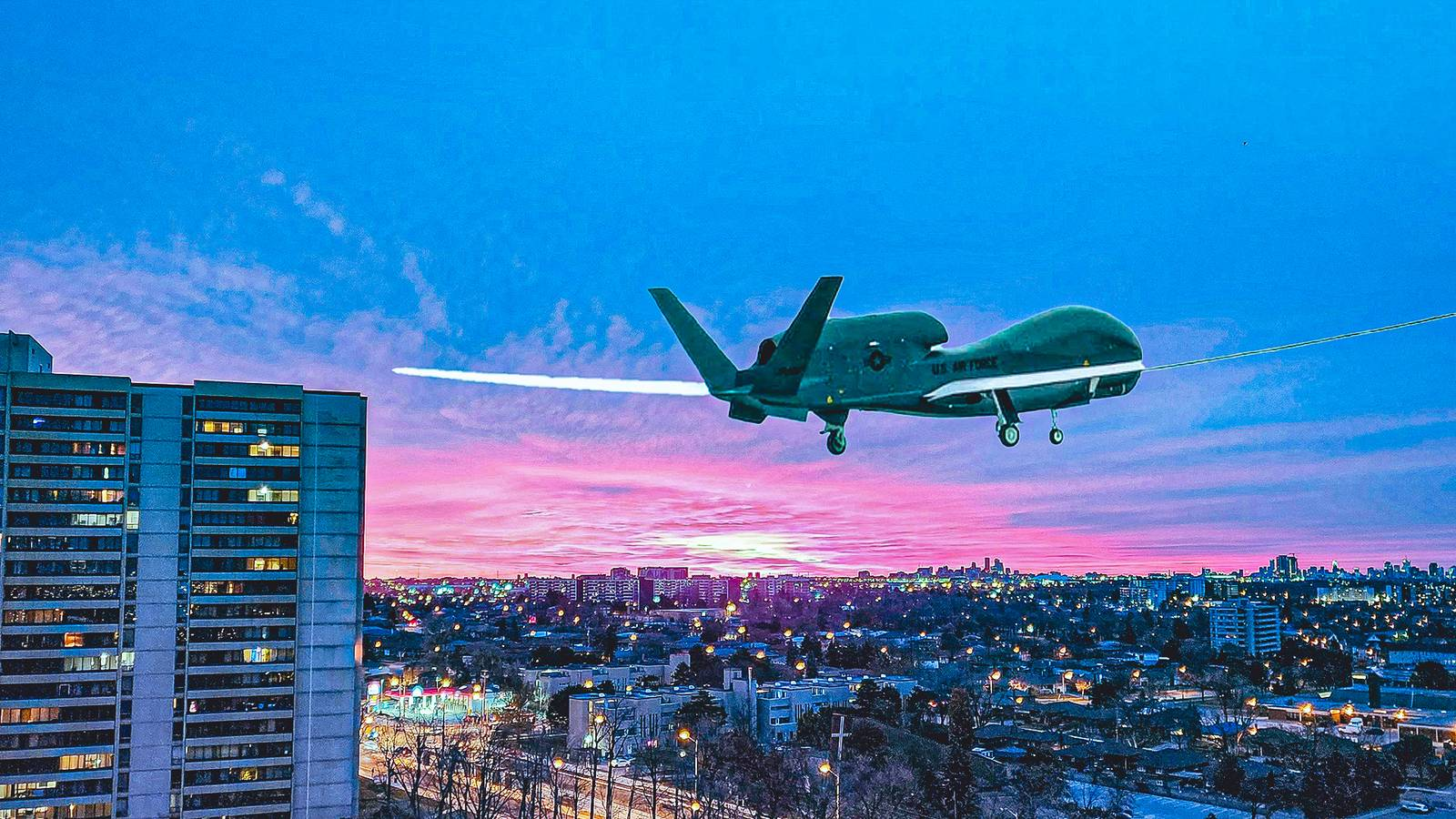
The Northrop Grumman RQ-4 Global Hawk has been one of the US Air Force’s major remotely piloted high-altitude surveillance aircraft since it was introduced in 2001. It was developed into the high-end Northrop Grumman MQ-4C Triton naval surveillance drone, which remains in production.
The Triton relative is now used by the US Navy and the Royal Australian Air Force, with plans for a consortium of NATO states to also purchase it. Years ago, the Air Force said it wanted to retire the RQ-4 Global Hawk by 2022, but now it seems the type will continue flying until 2033. To understand this, it is important to understand the wider intelligence, surveillance, target acquisition, and reconnaissance environment.
This includes the Space Force’s efforts in space and the Air Force’s next-generation fighter jets. The discussion about the Global Hawk’s usefulness is also related to which adversaries are being considered. It’s important to remember that the US’s adversaries are globally distributed and range from smugglers and militants through to the world’s largest and most powerful countries.
Retain Legacy ISR Platforms Vs Invest In Next-Gen
In 2022, Breaking Defense reported that the Air Force was planning to retire its entire RQ-4 Global Hawk fleet by Fiscal 2027. However, Congress stepped in to keep the type flying. The Air Force’s parallel request to retire legacy platforms is also ongoing for the manned Lockheed U-2 Dragon Lady. The Air Force has been asking Congress to retire them for years.
In previous budget cycles, it had appeared as if Congress and the Air Force had reached an understanding to start retiring the Dragon Ladies in Fiscal 2027. However, budget documents suggest that Congress will not only limit retirements, but also require the Air Force to restore some old U-2 spy planes. The Air Force says that it wants to retire the Global Hawks and Dragon Ladies to invest in next-generation ISR capabilities.
It seems that Congress sees that these legacy platforms remain useful, and retiring them would open the possibility of capability gaps and risk a less resilient system. What the Air Force is replacing these aircraft with is only partially understood. There may be a range of secretive, stealthy ISR drones like the rumored RQ-180. A major focus for the Air Force is moving spy assets into space. Because many of these programs are highly classified, their maturity and eventual capabilities remain uncertain.
The US Air Force Will Sustain MQ-4s Until 2033

New government documents appear to suggest that not only will the Air Force’s RQ-4 Global Hawks not retire in Fiscal 2027, but the United States Air Force may be gearing up to keep them in service until 2033. In August 2027, the Air Force Life Cycle Management Center posted a pre-solicitation notice to award a contract for the development, modernization, retrofit, and sustainment activities of the RQ-4.
Retirements for the contract include program management, engineering and onsite support, hardware/software upgrades and sustainment, site modifications, contract field service support, technical analysis and studies, training development and administration, and test and integration activities. It notes that this is a Top Secret/Sensitive Compartmented Information Program.
Tellingly, the pre-solicitation says that “the proposed period of performance is 01 January 2028 – 30 June 2033 (…) with an option to extend up to six months.” In the Fiscal 2026 budget, Congress forbade the Air Force from retiring its RQ-4 Global Hawks until 2030. However, this new pre-solicitation suggests that the type might not be fully retired until 2033.
The USAF’s Fleet Of Global Hawks

The Air Force had originally planned to acquire a total of 63 Global Hawks, but this was later cut to 45. The initial 21 Block 10 and 20 signals intelligence variants have already been retired, leaving the Air Force with its fleet of 27 more advanced Block 30 and 40 aircraft (18 Block 30s and 11 Block 40s). The final Block 30 aircraft was delivered in 2014, while the final Block 40 aircraft was delivered in 2017.
Block 40 variants are equipped with the Multi-Platform Radar Technology Insertion Program sensor for ground-moving target indication and related ISR. In a conflict with a country like China, these are considered to be vulnerable to long-range Chinese aircraft like J-20s and China’s growing suite of very long-range air-to-air missiles.
Northrop Grumman RQ-4 Global Hawk Specs (Per Budget Documents) | |
|---|---|
Date introduced | 2001 |
Number acquired | 45 |
Number remaining in service | 27 (Block 30 & 40) |
Planned retirement | Initially 2027, pushed back to around 2033 |
Modernized naval variant | MQ-4 Triton |
MQ-4 Tritons planned | USN 68, RAAF 4, NATO up to 5 |
Current funding includes money for the Navy’s MQ-4C Triton and its Increment 2 development to incorporate advanced capabilities, including Ground Moving Target Indicator radar modes, enhanced EO/IR detection, High Gain Aperture for improved SIGINT, communications and network resiliency in denied environments, and other capabilities. The documents say that the funding addresses “critical Diminishing Manufacturing Source issues and cybersecurity updates.“
A Washington ISR Debate Snippet

Broadly speaking, all sides in Washington agree that the RQ-4 and U-2 remain extremely useful in permissive environments. They also agree that they are not survivable in contested environments. The disagreement is whether that usefulness justifies the cost of continuing to operate them as the Air Force prepares for war against China or other peer adversaries.
Budget documents explicitly state that the Global Hawk “cannot compete in a contested environment.” Those who support retaining the RQ-4 don’t dispute its vulnerability, but they tend to emphasize that the United States is not only competing with China. The RQ-4 and U-2 can still be useful over the southern border, patrolling parts of the Middle East, in international/NATO airspace while monitoring the Ukraine conflict, or even in the East Pacific with China for as long as peace lasts.
Another argument is that RQ-4s provide redundancy and resilience in case more advanced flagship systems are effectively countered by the enemy. A parallel argument can be found with the A-10 ‘Warthog.’ Those who want to replace it may argue that it is not survivable and has no place in a conflict against China.
Proponents typically agree, but say that the aircraft remains useful in more permissive environments (such as against militias in Syria and Iraq), in a counter-maritime role, and that it can be used as a counter-drone platform. Decision-makers typically agree in principle: the disagreements are more about the practical conclusions.
Replaced By A Family Of Systems

Like the SR-71 Blackbird before it, the RQ-4 is not being replaced by a singular aircraft in the traditional sense. Instead, it is being replaced by a family of systems ranging from penetrating ISR aircraft and sensors across all domains to commercial systems, advanced fighter jets, and space assets.
The idea is that instead of having one exquisite aircraft flying near enemy territory, ISR intelligence will be gathered from a sensing grid where multiple platforms are contributing to build a complete operational picture. Even warships, ground-based radars, and allied sensors can all contribute to the picture. This is easier said than done, as sensor fusion is hard.
However, even here, old platforms like the RQ-4 may still be able to contribute to building the operational picture while operating outside of the engagement zone, even if their ability to look deep into defended territory becomes increasingly constrained. It is also worth noting that some systems are becoming multi-role, and seeing them exclusively through their official designations and traditional roles is becoming problematic.
The F-35 is no longer simply a fighter jet receiving intelligence from AEW&CS and other aircraft, but it is also a sensor node that contributes to the system. Ongoing Block 4 upgrades, upgraded F-22s, Collaborative Combat Aircraft, new F-47s, and the incoming B-21 bomber will all contribute to ISR missions. These are all taking some of the roles once filled by ISR aircraft like the RQ-4.
A Hedge Until Space Matures

Space is being seen as critical to next-generation ISR capabilities, with the potential to seriously degrade the ability of stealth fighters to remain stealthy. Since being established as an independent service branch, the Space Force has seen its funding boom, and Fiscal 2027 has another record budget for the service.
The generational leap in capabilities that space offers contributed to the Air Force announcing it would cancel its planned E-7 Wedgetail AEW&C purchase in 2025, although that decision was reversed in 2026. Future space-based capabilities promise persistent global coverage, no forward basing, immunity to SAMs and fighters, and an incredible ability to gather intelligence.
However, critics argue that space is increasingly becoming a domain of warfare and is no longer a sanctuary. This is especially pertinent with China and Russia developing multiple counter-space capabilities from kinetic anti-satellite weapons through to laser dazzling of imaging satellites.
Overall, the strongest case for training legacy ISR systems like the RQ-4 Global Hawk, the U-2 Dragon Lady, and purchasing new E-7 Wedgetails is the hedge argument. It says that diversification beats optimization and that ISR needs to be a portfolio. Legacy aircraft offer ISR resilience if satellites are jammed or otherwise rendered less effective.
