


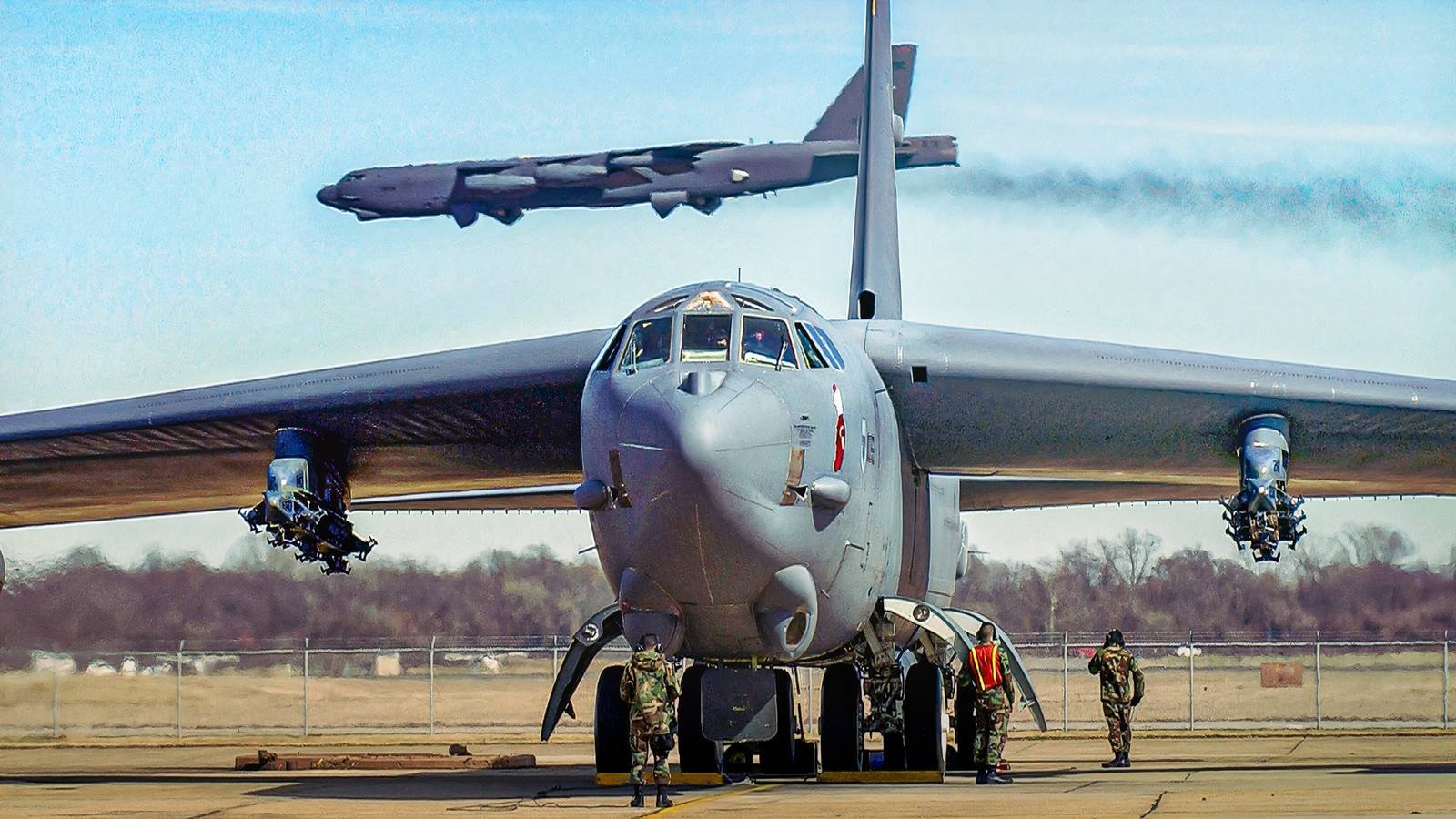
The Boeing B-52 Stratofortress and the Lockheed Martin F-22 Raptor provide critical capabilities for the national security of the United States (US). The Stratofortress gives US military planners a reliable long-range conventional and nuclear strike capability, while the Raptor enables air superiority in any given area of operations, which, depending on the mission requirements, would pave the way for the B-52 to strike ground targets.
While these two highly capable aircraft are expected to remain in service for many years to come, the system enhancement effort for both planes remains at varying levels of difficulty. To this point, the B-52 Stratofortress, for the most part, receives upgrades with relative ease, largely due to its spacious airframe, simpler baseline components, and design that leaves room for improved avionics and weapons integration.
The F-22 Raptor has notably been more difficult to modernize. These differences in the modernization paths of both aircraft are due to their design philosophy. The Raptor, on the other hand, has a highly integrated architecture and was not originally designed with the expectation of extensive future upgrades, making modifications more complex and constrained, particularly when considering stealth performance and tightly coupled avionics systems.
The Difficult Path For Improvement In The F-22

The F-22 Raptor began as a single-step program that did not anticipate the need for numerous enhancements. At the time of its design in the late 1980s and 1990s, the prevailing belief was that the aircraft would remain far enough ahead of the US’s chief competitor—the Soviet Union—such that the F-22 would not require significant work or major changes in mission requirements, such as expansion into roles like electronic warfare.
To this point, it was believed that its stealth coatings, sensor fusion, and air-to-air performance would allow it to maintain its premier status in air superiority. Additionally, its avionics were also considered sufficiently advanced that future improvements would largely be handled through software updates, with only limited need for major hardware improvements.
Some components that have driven modernization requirements include advanced integrated air defense networks such as the Russian S-400 Triumf and China’s HQ-9. These long-range surface-to-air missile systems are most effective when integrated into broader networks of radars, sensors, and command-and-control infrastructure, which significantly enhance detection, tracking, and engagement capabilities across multiple ranges and altitudes.
Together, these interconnected platforms contribute to a robust anti-access/area denial (A2/AD) environment that increases the difficulty of operating in contested airspace. In response, modernization efforts for the F-22 have emphasized improved connectivity, electronic warfare resilience, and weapons integration to help maintain effectiveness in these evolving threat environments.
While upgrades were needed, the aircraft itself made this process difficult, as it was designed with very tight physical and performance constraints. The Raptor’s relatively small airframe is highly integrated and extremely weight-sensitive, leaving limited space, cooling capacity, and electrical margin for new equipment.
Additionally, its stealth performance depends on carefully controlled airframe shaping, radar-absorbing materials, precise antenna placement, and internal weapons bays with strict manufacturing tolerances. The interdependence of these features means that even small modifications can require careful assessment to avoid degrading its stealth characteristics, which would require extensive reengineering to maintain its low observability.
How Lockheed Martin Fighters Stack Up Against Each Other In 2026
Lockheed Martin’s fighters continue to define the shape of Western airpower, but how do the F-22, F-35, and F-16 compare in evolving scenarios?
The B-52 Is Aging Like A Fine Wine & It Is Easy To Modernize

Having entered service in 1955, the B-52 was operating in the earliest stages of the Cold War. Its original intended purpose was to deliver long-range nuclear strike missions deep into the Soviet Union, and it has flown from the 20th to the 21st century, outlasting seemingly countless combat aircraft in service with all US military branches.
A key aspect of the Stratofortress’s incredible longevity is the fact that, as a strategic bomber, it was designed to operate at altitudes ranging from 35,000–50,000 feet (10,700–15,200 meters). At such heights, the air is thinner. As such, it creates substantially less drag, turbulence, and dynamic pressure on the wings and fuselage.
Another notable hallmark of its long service life is its relative lack of flight hours given the age of the fleet, and these hours are spread evenly across all the bombers, over the decades of changing mission demands. A B-52 may accumulate 15,000–30,000 flight hours over several decades of use. That averages out to be roughly a few hundred hours per year, which can vary depending on the operational tempo. Contrasting that with a commercial Boeing 737 or 747, which can accumulate 80,000–120,000+ flight hours over its lifetime spanning two to three decades.
When a B-52 requires maintenance or overhaul, the aircraft has space to spare, and it was designed this way. Seventy-one years ago, when the Stratofortress entered service, it was equipped with large, bulky electronics and other mission equipment that occupied excess space.
Over the decades of use, older analog electronics have been replaced with smaller digital systems. Navigation equipment that once occupied entire racks has been replaced with units a fraction of the size. This in turn created additional space for further enhancements, such as modern communications infrastructure, electronic warfare equipment, mission computers and additional networking and data-link hardware.
Aside from its cavernous fuselage, the B-52 has ample weight, thrust, electrical power, and cooling margins that can support a wide range of enhancement efforts. With any aircraft, modernization generally adds weight, which places additional demands on the aircraft’s ability to supply power and cooling for new or enhanced equipment. The added weight and increased power demand can reduce overall performance, such as range, climb rate, and fuel efficiency, and may also increase structural and engine wear over time. These constraints are generally more significant for the Raptor than for the Stratofortress.

Why America’s B-52 Stratofortress Is More Lethal In 2026 Than When It Was Built
The BUFF keeps leveling up on its path to become the USAF’s centurion.
Two Notable Modifications For The Raptor

In early 2025, the USAF awarded Pratt & Whitney a $1.5 billion sustainment contract for the F-22 fleet’s F119 engines for three years. According to a report by The Aviationist, the contract covers “integrated logistics support, which means engineering, forecasting, manufacturing, purchasing and part order” for around 400 engines. The F-22 fleet consists of around 180 aircraft; therefore, the contract would provide each Raptor with two new engines, leaving forty spare engines.
Another modification to the F-22 involves external low-observable sensor pods mounted on underwing pylons. Thus far, they appear to have only been seen on Raptor test aircraft. These pods are believed to contain Infrared Search and Track (IRST) equipment, a capability referenced in the FY2026 budget request. IRST systems passively detect and track aircraft by sensing their heat signatures, without using radar emissions.
The addition of IRST would allow an F-22 pilot to detect and track other aircraft, including potentially low-observable platforms, without relying on radar. This represents a significant upgrade compared to early-production F-22s, which did not include an integrated IRST capability.
The US Air Force Bases Assigned F-22 Raptors
From the heartland to global deployments, the F-22 Raptor provides air superiority, supporting US troops and allies worldwide.
Keeping the B-52 Viable For The Next Couple Decades

Boeing has been awarded a $2 billion contract by the US Air Force to continue the B-52 Commercial Engine Replacement Program. This program involves the installation of the Rolls-Royce F-130 commercial engines in addition to other subsystem improvements. The installation of the engines will take place at the Boeing San Antonio modification facility, located in Texas. The F-130 engines will increase the efficiency, range, and operational life of the B-52, which should allow the bombers to remain in service into 2050 or beyond.
Beyond the improved F-130 engines, the B-52 fleet is also set to receive modern Active Electronically Scanned Array (AESA) radar equipment, developed by Raytheon Technologies. The advanced radar will replace the antiquated, mechanically scanned AN/APQ-166 system, currently in use across the fleet today. The AESA platform will provide the Stratofortress fleet with updated all-weather navigation and targeting capability. In 2025, a B-52 successfully completed a ferry flight with the new AESA radar. The flight took place from Boeing’s San Antonio facility to Edwards Air Force Base in California.
The F-130 engines and radar are all part of the much-expected B-52 Modernization Program. The capability enhancements will provide the remaining 76 B-52s with the new designation of B-52J. In addition to the engines and radar, the USAF has stated that the Stratofortresses will have upgraded “…crew compartments, conventional and nuclear communication systems, avionics, weapons and other capabilities which will enhance the B-52’s ability to carry out the full spectrum of combatant command and USSTRATCOM-directed missions.”

Why The B-52’s New Rolls-Royce Engines Will Make America’s 70-Year-Old Bomber More Efficient Than Ever
The next chapter in the story of the B-52 is now being written.
Keeping The Fleet Viable

The pace of technological advancement increases with each passing year, and maintaining the lead in the military realm has not been this important since the Cold War. This is due to heightened tensions and competition with China and bellicose Russia, which, as demonstrated in Ukraine, will use military force to achieve its continental aims.
With enhanced technology and attendant modernization programs, aircraft such as the F-22 and the B-52 can retain their utility in global missions. Regarding the Raptor, the aircraft will need to retain its role as America’s top air dominance fighter until the arrival of the F-47, slated for operational status around 2030.
The B-52 will remain in service due to the B-1’s retirement, and once this happens, no other aircraft in the USAF arsenal can carry the amount of ordnance as the Stratofortress. The latter demonstrated its utility in Operation Epic Fury, with its ability to double as a heavily laden standoff platform and stand-in heavy bomber, once fifth-generation aircraft had accomplished their suppression of an air defense mission.
