


This story is from an installment of In the Loupe, our weekly insider newsletter about the best of the watch world. Sign up here.
It’s easy to assume American watchmaking begins with Waltham, Elgin, or Hamilton. Or that the story of fine watchmaking belongs almost entirely to Switzerland. But decades before industrial America transformed global horology in the latter half of the 19th century, the Founding Fathers lived in a world where mechanical timekeeping represented the pinnacle of craftsmanship, technology, and taste.
“The highest level of technology, pure magic that was ever done,” is how antiquarian horologist Richard Newman describes watchmaking in colonial America. “Only the very wealthy could afford a watch or personal timekeeper.”
That rarity is precisely why collectors should care. Today’s enthusiasm for independent watchmakers, artisanal finishing, and provenance has surprising parallels to the late 18th century. Newman sees the current renaissance of small-scale makers as a return to an earlier ideal. “Back in an era when the maker that signed the watch or the clock actually had his or her hands on it, they did the work,” he tells Robb Report. “That’s what I love about what’s been happening for the last 30 years. These makers are actually designing and putting their stamp on what they want to offer in fairly small quantities again. It’s sort of a resurgence.”
Colonial America Wasn’t Making Many Watches—but That’s the Point
Documentation is scarce, and surviving examples even scarcer. Newman says probate records and newspaper advertisements suggest pocket-watch production in British America probably dates to the 1760s, perhaps earlier, but almost none of those watches survive with definitive provenance.
Instead, colonial watchmaking existed largely as finishing and assembly rather than complete manufacture. American makers relied on unfinished movements imported from England, much as English makers themselves depended on highly specialized cottage industries.
“There could have been 80 to 130 individuals that actually were involved in making a pocket watch,” Newman explains. Specialized craftsmen produced everything from fusée chains to wheels before the components reached the watchmaker who would regulate, finish, assemble, and sign the completed watch.
For collectors accustomed to discussing ébauches or movement suppliers today, the model feels remarkably familiar.
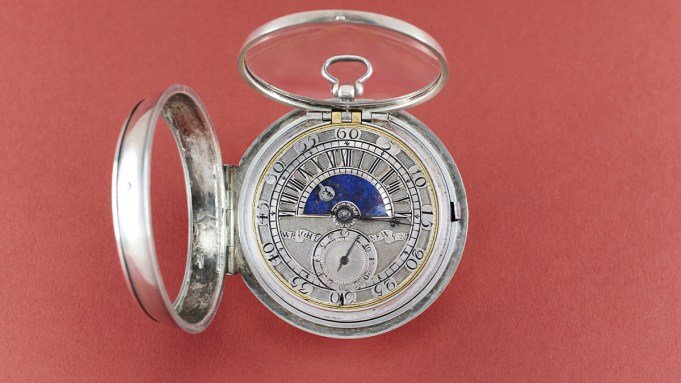
Trends in the current watch market have parallels to the late 18th century.
Richard Newman
Look Beyond Switzerland—and Beyond the Movement
Modern enthusiasts often obsess over calibers, but Newman argues that collectors should approach 18th-century watches as works of decorative art as much as feats of engineering.
“Watches are fashion, jewelry, status, phenomenal design, decorative arts,” he says. “The whole idea of this being jewelry has largely been ignored.”
He believes museums have historically overlooked early watches because they don’t fit neatly into categories like furniture, silver, or decorative arts. Yet many of the finest craftsmen of the era—the same goldsmiths and silversmiths creating luxury objects for aristocratic clients—were also producing watches.
That perspective changes what collectors notice. Instead of looking only for escapements or technical innovation, Newman encourages appreciation of cases, dials, proportions, engraving, and overall design—the same qualities that define today’s most desirable independent watches.
Washington Knew Good Design—and Good Timing
The Founding Fathers were discerning buyers.
George Washington coveted French horology, purchasing watches from Paris at a time when French design represented the height of fashion. Newman notes that acquiring a watch by Jean-Antoine Lépine placed Washington among the best-informed collectors of his day.
“You’re talking about him buying the best of the best,” Newman says. “Getting a Lépine was… wow. You’re talking Ferrari.”
Washington also understood the practical value of precision. According to Newman, he was likely the first military commander in history to coordinate an attack using a watch, synchronizing his generals during the Revolutionary War.
Thomas Jefferson approached horology differently. Fascinated by mechanics, he corresponded with Philadelphia watchmaker Robert Leslie and even designed the movement for a clock installed at Monticello.
Unfortunately, his enthusiasm exceeded expertise. “He wasn’t a clockmaker,” Newman says with a laugh. “He actually designed the movement and had Leslie’s firm make it and it didn’t run well. I tell you, he was a crappy clock designer.”
Still, Jefferson’s curiosity illustrates how closely America’s founders followed advances in mechanical technology, long before industrialization.

A piece from Robert Leslie.
The Details Collectors Should Notice
If you’re fortunate enough to handle an 18th-century watch, Newman suggests paying attention to more than just the name on the dial. Notice the elegance of the case proportions. Study the quality of the dial. Look at the decorative engraving, the materials, the finishing, and the overall balance of the design. These were luxury objects competing for sophisticated clients who understood fashion as well as mechanics.
Even when colonial makers such as Thomas Harland, John Cairns, Robert Leslie, or Henry Voight worked from imported components, their skill lay in the finishing, regulation, and execution. Much like today’s independent watchmakers, their reputations rested not simply on manufacturing every part themselves, but on transforming components into exceptional finished watches.
Peeling Back the Onion
For Newman, the explosion of interest in modern wristwatches should naturally lead collectors further into history. “There’s more people interested in horology today than at any time in history,” he says. “It’s mostly focused, of course, on wristwatches. That’s great. But hopefully those that are involved in wristwatches will start to peel the onion back.”
Do that, and today’s conversations about independents, craftsmanship, hand-finishing, provenance, and artistic identity begin to look far less modern than we imagine. The names have changed. The watches have moved from pockets to wrists. But the questions collectors ask—and the genius required to answer them—remain remarkably familiar 250 years later.
Authors

Victoria Gomelsky

