


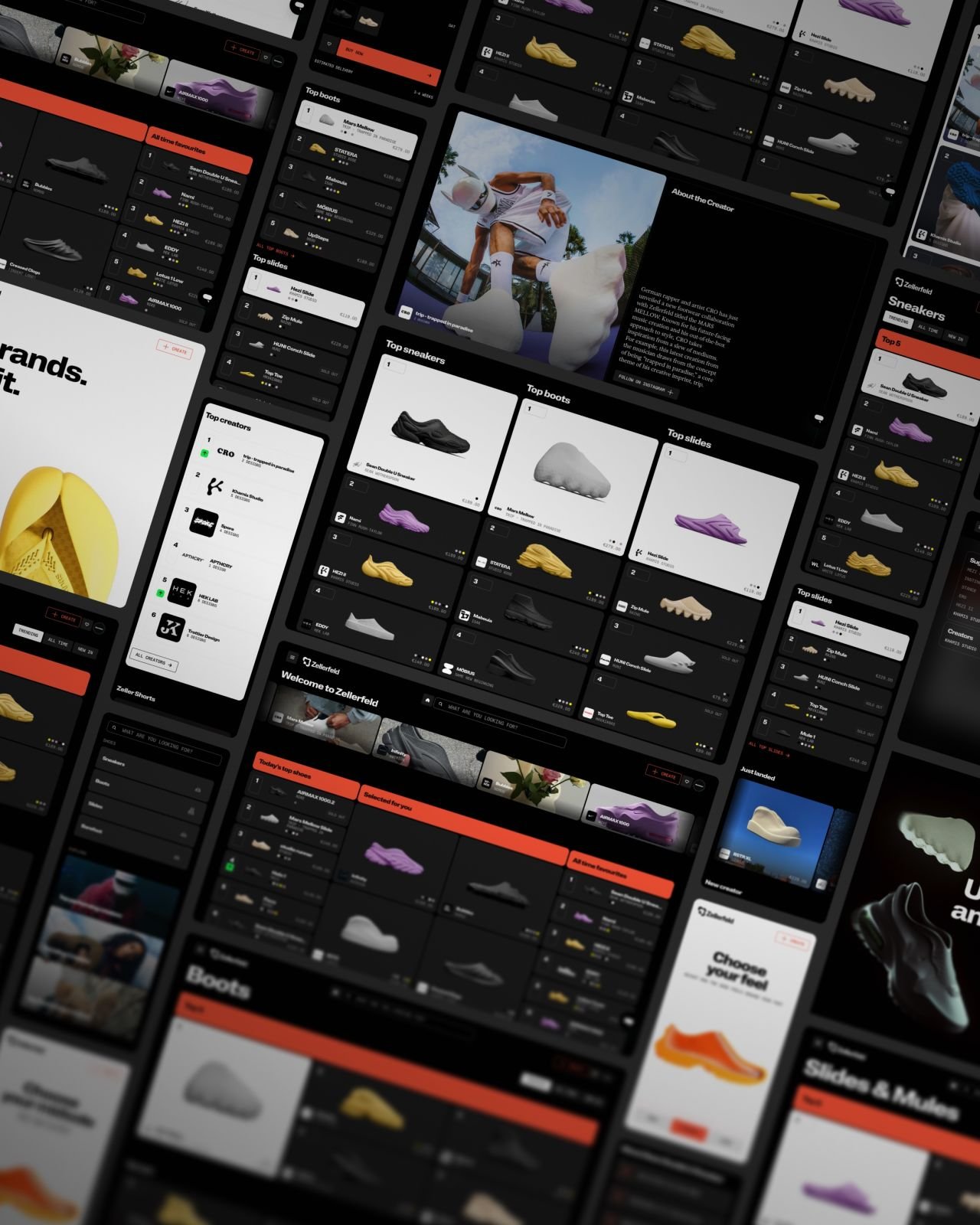
3D printed footwear company Zellerfeld has relaunched its website and marketplace at zellerfeld.com, rolling out what the company is calling its biggest platform update since it opened its printing service to outside designers.
The redesign, unveiled July 21, 2026, rebuilds how the site presents products, expands a personal fit system across the platform, and previews a subscription model for its 3D printed shoes.
A marketplace built to rank and personalize
The updated site introduces personalized discovery, smarter search, and live rankings for creators and products, with visibility shifting based on real-time demand rather than fading after a single launch. Zellerfeld has framed the move in explicitly platform terms: cofounder and CEO Cornelius Schmitt has compared the ambition to Spotify‘s effect on music and YouTube‘s effect on video, arguing footwear is reaching a similar inflection point after years of proving that printed shoes were technically viable.
“We always said we wanted to digitize footwear in the same way music and video were digitized, and the last years were spent building the fulfillment infrastructure to make that possible,” Schmitt said. “We never had time to give our users or creators the platform they deserved.”
The company also previewed a subscription tier that would give members four pairs of shoes a year, produced on demand from Zellerfeld’s design catalog and matched automatically to each member’s fit profile.
ZellerFIT and the Volumental data pipeline
Central to the relaunch is an expanded version of ZellerFIT, Zellerfeld’s fit system, which builds a persistent profile from a foot scan and personalization choices, then applies that same profile to every product a customer orders across creators and collaborations. The company has positioned it as a way to replace standardized shoe sizing, which varies across brands and lasts, with stored measurement data that follows the customer instead.
The feature builds on a commercial partnership Zellerfeld struck with Volumental in June 2026, under which foot geometry captured through Volumental’s in-store and online scanning tools feeds directly into Zellerfeld’s printing pipeline so each shoe can be produced to an individual customer’s foot contours. Zellerfeld said it evaluated foot-scanning providers globally before selecting Volumental, weighing measurement precision, the accuracy of resulting 3D foot models, and ease of use for customers.
The partnership followed a strategic investment by Zellerfeld of roughly $900,000 to $950,000 in Volumental, first made in 2025; Volumental has stated it remains an independent company rather than a Zellerfeld acquisition. Volumental brings a database of more than 66 million foot scans gathered across more than 3,000 retail locations worldwide, a dataset that could become as significant to mass-market custom footwear as the printing technology itself.

Fit as a One-Time Build vs. a Persistent Profile
The gap Zellerfeld’s ZellerFIT expansion is solving is specific: most scan-to-print footwear captures foot data once, per order, and starts over on the next purchase. ZellerFIT instead treats the scan as a durable asset, a Fit Profile that persists across every creator and product a customer buys on the platform, so precision compounds instead of resetting each time.
HEZO shows the more common model. HEZO uses a smartphone app to capture around 1,000 data points per foot, feeding that data into proprietary software that generates a shoe built to the customer’s exact measurements, with every pair produced individually after the order is placed. The scan exists to build that one shoe; it doesn’t carry forward as a profile a customer can reuse elsewhere on HEZO’s small, single-brand lineup.
Lore Cycle follows the same logic at a different price point. In partnership with Lubrizol, it built a scan-based cycling shoe with a TPU upper tailored to individual biomechanics, offered across three models starting at $1,349, again a per-product fit exercise rather than a portable identity spanning multiple creators or drops. Zellerfeld’s bet is that the profile, not the individual shoe, is the more durable product.
3D Printing Industry is inviting speakers for its 2026 Additive Manufacturing Applications (AMA) series, covering Energy, Healthcare, Automotive and Mobility, Aerospace, Space and Defense, and Software. Each online event focuses on real production deployments, qualification, and supply chain integration. Practitioners interested in contributing can complete the call for speakers form here.
To stay up to date with the latest 3D printing news, don’t forget to subscribe to the 3D Printing Industry newsletter or follow us on LinkedIn.
Explore the full Future of 3D Printing and Executive Survey series from 3D Printing Industry, featuring perspectives from CEOs, engineers, and industry leaders on the industrialization of additive manufacturing, 3D printing industry trends 2026, qualification, supply chains, and additive manufacturing industry analysis.
Featured image shows New website and marketplace at zellerfeld.com. Image via Zellerfeld.
