


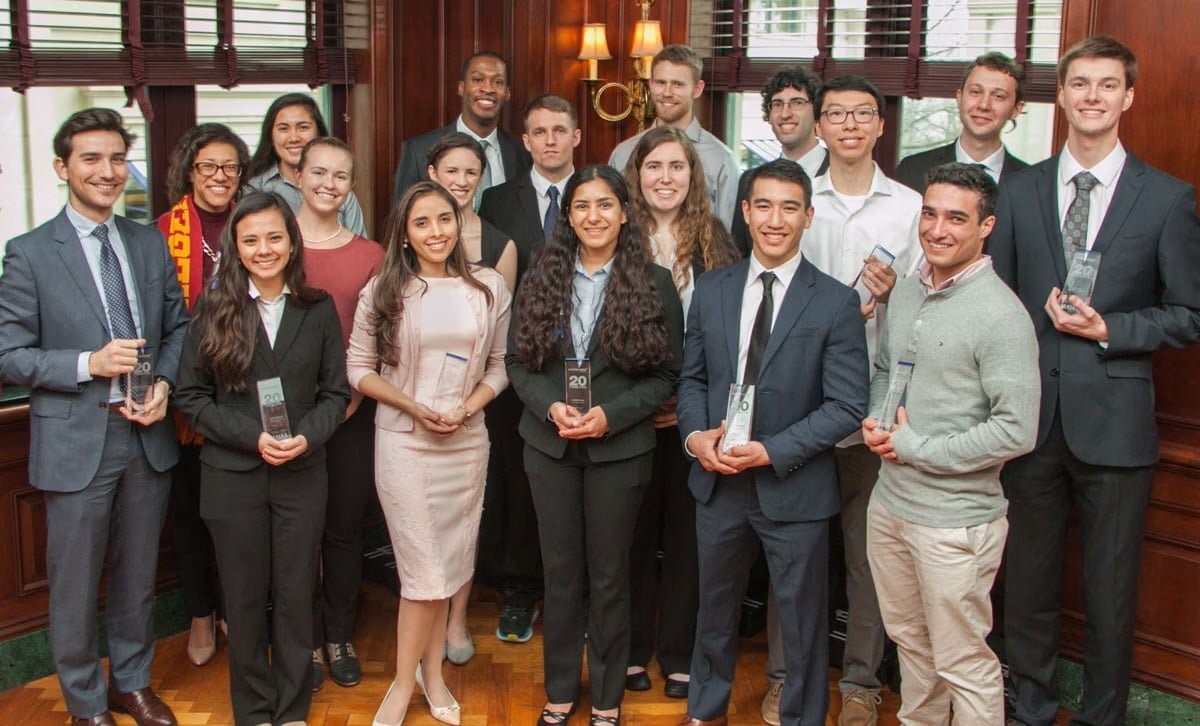
Since the 20 Twenties award, Jocelino Rodrigues has gone from Portugal to NASA Ames, where he brought online the mARC II arc-jet facility—now used by SpaceX and Blue Origin—and developed a measurement technique on track to become an ASTM standard. He also mentors undergraduates and interns, finding success in enabling others.
Can you share more about your current role? What are your key responsibilities and focus areas?
I am currently a NASA Postdoctoral Research Fellow at NASA Ames Research Center, where I have been for approximately three years. My responsibilities have evolved quite a bit during that time. I was originally brought on to help develop and characterize a 30-kW arc-jet facility called mARC II. One can think of arc-jets as a type of wind tunnel that produces extremely high-speed, high-temperature flows—sometimes reaching temperatures on the order of 10,000K (17,500F) and turning the gas into plasma.
My role initially focused on leading the characterization of the facility so that we could better understand what it can and cannot do. Over time, though, it grew into quite a bit more, which I have really enjoyed. My work has included project management, instrumentation, data-acquisition system development, imaging, spectroscopy and developing new methods for measuring plasma flows.
It has been a very rewarding role because I have had the opportunity to delve into many different subjects, wear different hats and work closely with a great team along the way.
Since receiving the award, is there a particular project, achievement, or milestone that you’re especially proud of?
Over the past couple of years, my current role has provided some really rewarding moments, both as part of a team and as an independent researcher. One of the things I am most proud of is helping bring the 30-kW mARC II facility online and seeing it reach the point where external customers (including SpaceX and Blue Origin) have been able to test in our facility. A lot of people contributed to making that happen, which made it especially rewarding to see the facility come “online.” It also has given Ames a new capability for relatively low-cost, high-throughput sample screening that had not previously been available.
In parallel, I developed a new method for estimating a critical parameter in arc-jet facilities, and that work is now forming the basis of a draft ASTM International standard. That is something I never imagined I would be involved in at this stage of my career, and I am very proud of how far the work has come.
Many 20 Twenties winners are passionate about paying it forward. Have you had opportunities to mentor others or contribute to your community? What has that meant to you?
I have! Over the past year, I volunteered with the University of Bristol Alumni Mentoring Programme, where I had the opportunity to mentor a talented undergraduate aerospace engineering student for a year. Even though it was virtual, it was very rewarding to see their progress over time and to be able to share some of the lessons I have learned from my own experiences.
I have also mentored interns at NASA Ames during the summer, which has been a different kind of experience because it involves much more hands-on interaction in the lab and with their research. Beyond mentorship, I have taken part in occasional STEM outreach activities, such as representing NASA’s Entry Systems division at the Open Sauce Technology & Creator Festival and answering questions from members of the public about NASA and the work we do. I also recently joined a virtual Q&A about space with my former high-school chemistry teacher’s current class.
So, a little bit of everything! What I value most about mentoring is helping students realize that they are not alone in some of the experiences and uncertainties they encounter. Careers are rarely linear, and sometimes even taking a role that turns out not to be the right fit can teach you a great deal about what you do and do not want from a career in aerospace. I also think we can sometimes define failure a little too harshly. Success is not binary, and it is rewarding to see students begin to recognize that for themselves.
How has your definition of “success” in aerospace changed since you won the 20 Twenties award?
When I received the 20 Twenties award, I think I defined success much more closely in terms of my own research output and individual achievements. Naturally, I have grown both personally and professionally since then, and my definition of success has broadened with that.
I now see success as something that goes beyond what I accomplish individually. It also includes the success of the team I work with, the branch I contribute to, the division that supports us and ultimately the NASA center and agency as a whole. I have also learned that I feel a real sense of success from helping enable other people to grow. Supporting someone through their first conference paper as first author, or creating an opportunity for someone to test a new technology when I was in a position as principal investigator to make that possible, were both genuinely rewarding experiences for me. Seeing what those opportunities meant for their growth made me very happy.
Being able to contribute to something larger than my own work, and occasionally help create opportunities for others along the way, has become an increasingly important part of how I think about success in aerospace.
If you could sit down with your younger self—right before winning the award—what would surprise you most about where you are today?
Honestly, I think what would surprise my younger self most is that I made it to NASA. Working at NASA had been a dream of mine for years before receiving the 20 Twenties award, but at the time I was not sure it would ever be possible. I was also told by the award organizers that they had never previously had a 20 Twenties honoree from Portugal, which made receiving the award particularly meaningful to me. Between not being a U.S. citizen and knowing how competitive the aerospace field is in the United States, the path ahead still felt very uncertain.
The route here was also not especially linear, and there were definitely points along the way where I could not have predicted where I would end up. I am incredibly grateful not only to have been given the opportunity to work at NASA Ames, but also to the many people who supported and encouraged me, mentored me and took chances on me along the way.
I think my younger self would be genuinely surprised by how much has happened over the past five years and where that path has taken me.
What keeps you passionate about working in aerospace, especially on challenging days?
Curiosity. There are still so many unanswered questions in the areas my work touches, from aerothermodynamics to plasma physics, and I genuinely enjoy trying to understand them a little better and finding ways I might be able to contribute to answering them.
Having people around me who share that same sense of curiosity makes a huge difference as well. On challenging days, being surrounded by colleagues who are excited by the science and willing to work through difficult problems together helps keep that enthusiasm alive. I have been very fortunate to find both of those things in my current role.
