


As the freight cycle shows signs of heating up, third-party logistics (3PL) providers and freight brokers face a critical window to capture new customers. Yet a new benchmark from LeadCoverage warns that not all marketing dollars are created equal. The company’s Supply Chain Growth Index (SCGI) for Q4 2025 shows a sharply widening performance gap in how effectively logistics firms turn go-to-market (GTM) spending into qualified pipeline.
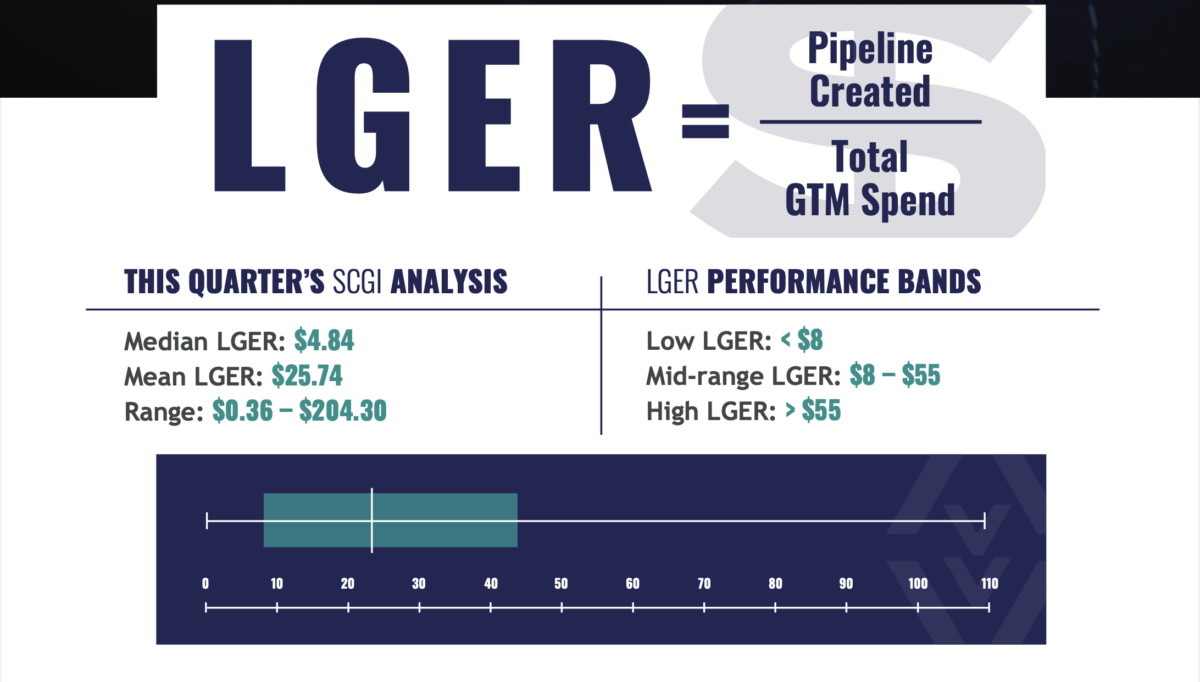
The SCGI, a quarterly benchmark of GTM efficiency and pipeline impact in supply chain and logistics, is built on anonymized data from roughly 30 LeadCoverage clients. Its core metric, the Logistics Growth Efficiency Ratio (LGER), measures pipeline created (sales-accepted leads and opportunities) divided by total GTM spend. Unlike traditional metrics that focus on closed deals, LGER isolates what the marketing and sales engine itself can control.
In Q4 2025, the median LGER fell to just $4.84 in pipeline per dollar of GTM spend, down sharply from prior quarters. The mean held at $25.74, but the range exploded to $0.36–$204.30. Six companies exceeded $20 LGER, with top performers reaching approximately $200 in pipeline per dollar spent. Those elite programs drove a disproportionate share of total pipeline impact across the dataset.
In other words, among 3PLs, marketing performance bifurcated dramatically. Low performers (bottom 25 percent with an LGER below $8) generated far less pipeline per dollar, often relying on legacy outbound dialing, minimal account-based marketing (ABM), and little paid media. Mid-range companies (middle 50 percent) hovered between $8 and $55 but risk sliding into the bottom quartile if they stand still. High performers (top 25 percent, above $55) dramatically widened the gap through data-forward strategies.
LeadCoverage CEO Kara Brown, whose firm provides end-to-end GTM services to freight and logistics companies, said the divergence reflects deliberate investment choices.
“We believe there are three strategies that work in freight, and if you’re following them, are you able to beat the market?” Brown told FreightWaves. “As we study our clients who are beating the market, we’re going to learn over time what makes a great GTM strategy that gives a logistics service provider an actual edge.”
LeadCoverage itself operates the full GTM engine for its clients. The 40-person team handles revenue operations, CRM and marketing automation, email campaigns, content, initial lead qualification and dialing, and heavy investment in paid media, programmatic advertising, and ABM. The company also helped shape Gartner’s Redwood 4PL Magic Quadrant and positions itself at the cutting edge of AI applications in freight marketing.
Brown modeled the SCGI after Greg Crabtree’s “Simple Numbers” small-business benchmarks. With only 30-ish clients in supply chain and logistics, LeadCoverage anonymized their data to answer freight-specific questions: Is a 20 percent open rate good? Is $7 per click acceptable? More importantly, how much pipeline should a dollar of combined marketing and sales spend (minus headcount costs) realistically generate?
The market backdrop makes these questions urgent. Freight activity in 2025 never followed a classic recovery. Imports surged to $419 billion in March as shippers front-loaded ahead of tariff changes, but manufacturing remained in contraction with an ISM PMI of 49.1. Export orders were weaker still. Operating costs hit record levels at $2.26 per mile, compressing margins. Activity levels, the report notes, became a “poor proxy for underlying market health.”
In this environment, Brown explained, efficient GTM spending separates winners from the rest. “The ones who are crushing it are pulling away from the pack,” she said. “I would like to believe this is a result of really good GTM strategy and investing in AI and what’s coming.”
High performers share common traits: strong adoption of intent data, sustained ABM execution, programmatic and paid media investment, and tight sales-marketing alignment. Intent data comes in multiple forms. Primary intent lives inside a company’s own CRM (typically HubSpot), flagging when a decision-maker visits the website; top clients act within minutes. Secondary and broader signals scan the internet for shipper “pain before the pain”, when they’re searching for services that match a 3PL’s offerings. Providers such as CarrierSource and Bombora supply these signals, though Brown noted AI tools like Claude, Clay, and ChatGPT are democratizing access. The real differentiator, she said, is execution: “How you use those intent signals to target the human that should be your customer is probably the biggest gap we see.”
As freight volumes potentially rebound and shippers seek new partners, 3PLs investing in modern GTM tools can generate scalable, measurable pipeline without simply “banging the phones.” Underperformers risk wasting spend on transient demand or outdated tactics.
LeadCoverage plans to release its third index in the coming months, with early indications that market tightening in Q1 and Q2 2026 may further reward precision GTM. Brown expects the spread between leaders and laggards to continue widening.
For freight executives, the SCGI offers a new operating baseline. The median $4.84 LGER is today’s midpoint, but top performers operate four to ten times above it. 2026 is shaping up to be a year when 3PLs have the best opportunity to add new customers they’ve had since COVID. LeadCoverage’s report suggests that smart marketing spend, powered by AI, intent data, and disciplined execution, will increasingly determine who wins market share and who simply watches from the sidelines.
The post 3PL marketing spend efficiency diverged dramatically in Q4: LeadCoverage appeared first on FreightWaves.
