


The Boeing 777 is the most successful widebody airliner of all time, with nearly 1,800 units having been delivered since the type’s introduction in 1995, and it’s received nearly 2,500 orders across three generations (including the still in-development 777X). Large, efficient, and capable, these planes pioneered the idea of using twin-engine airliners on true long-haul routes, which has since become standard practice in the industry, and the upcoming 777-9 variant is the largest commercial aircraft on sale.
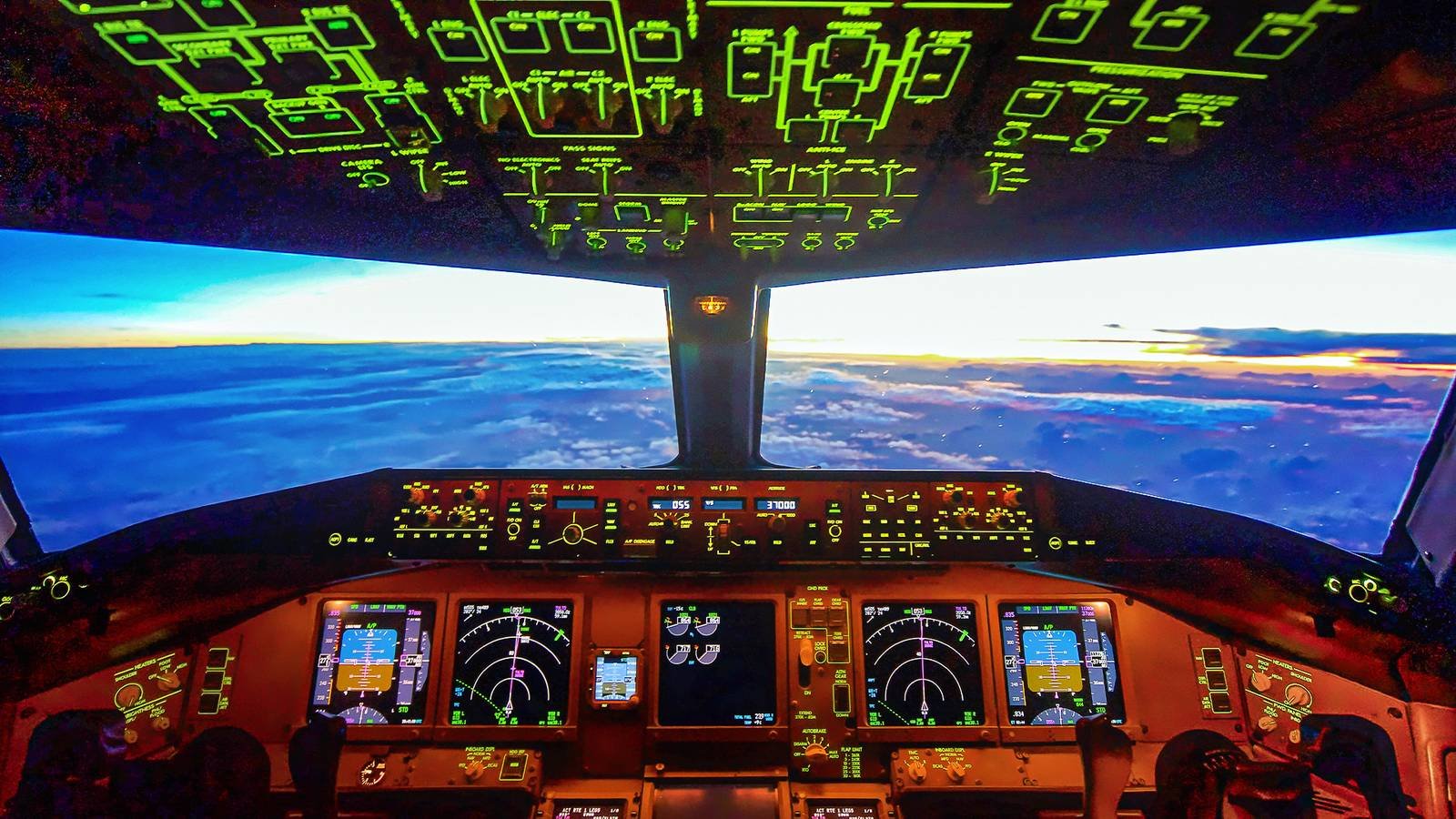
The 777 was Boeing’s first fly-by-wire airliner, and also debuted with the company’s most advanced flight deck yet. Even today, the 777’s flight deck is fairly modern, despite being over 30 years old, and it’s largely the same as on the newer 787, other than the colors and displays. But while cockpit design has generally become cleaner and more standardized with recent generations of airliners, the 777’s flight deck still comes with some obscure features. Some of these are present on all airliners but are rarely talked about, while others are less common.
Cockpit Heating Switches In The 777
Flight attendants working on the Boeing 777 have access to temperature controls in the cabin, which allows them to adjust the temperature in the cabin by a few degrees up or down. However, the master switch to control the cabin temperature is located in the flight deck. This works by mixing hot bleed air from the aircraft’s engines with air from the air conditioning packs, mixing the two sources of air to achieve the desired temperature. Ultimately, this can be rather imprecise, with subtle changes resulting in significant temperature differences in different parts of the cabin.
What’s comfortable for the pilots ultimately might not be comfortable for passengers and the cabin crew, due to the different air flows in the flight deck as well as the large cockpit windows. It’s not uncommon for flight attendants to request temperature changes, but this may cause discomfort for the flight crew, who may end up being too hot. Conversely, they also end up being too cold. To provide extra comfort for the pilots, the 777 features heaters in the flight deck.
Essentially all modern airliners include cockpit heaters. On the 777, the controls for the heaters are located on both sides of the instrument panel, with one set for each pilot. There’s one switch to control heated air flowing to a crew member’s shoulders, and another to control heated airflow to a pilot’s feet near the rudder pedals. These are dial switches, with the shoulder switch having variable settings up to ‘High’, while the foot switch has a ‘Low’ and ‘High’ setting.
Ground Maneuvering Cameras On The 777-300/300ER

The 777-300 was the longest  Boeing airliner ever built at the time of its debut in 1998, at roughly 242 feet (73.8 meters). Pilots typically cannot view the aircraft’s wings from the flight deck, which makes navigating in tight areas challenging. The 777-300, with its increased length, would have a larger turning radius than the prior 777-200 and 777-200ER, requiring extra precision from pilots during taxiing. As such, Boeing installed taxi cameras on the 777-300, as well as on the later 777-300ER.
There are two cameras positioned on both sides of the 777’s rear fuselage, offering a clear view of its main landing gear, along with a third camera positioned behind the nose gear. The video can be viewed on any one of the 777’s screens, and there are thick black lines painted on both wings to highlight the edges of the main landing gear. This greatly improves situational awareness during taxiing, allowing pilots to easily view the aircraft’s position in relation to the centerline.
Boeing did not offer taxi cameras on the 747 as standard, although  Lufthansa did install cameras on its 747-8 fleet. The Airbus A340-600 also introduced the same challenges for pilots as the 777-300, and Airbus also installed taxi cameras. On the A340-600, the cameras are positioned behind the nose gear and on the tail, rather than behind the wings. Airbus installs the same setup on the A380 and the A350 as well.
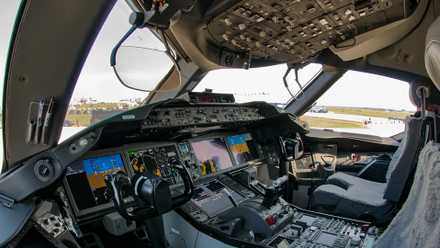
Here’s What Pilots Notice First When Switching Between The Airbus A350 & Boeing 787 Cockpits
Comparing the flight decks of the world’s two most advanced widebody airliners.
The 777’s Cursor Control Devices

Located below the two Flight Management Computers (FMCs) are two large, unusual-looking bumps. These are called Cursor Control Devices (CCDs), and they essentially mimic a computer mouse by featuring a trackpad on top. This is not used to control the FMCs, but is rather used to navigate the aircraft’s avionics via the two Multi-Function Displays (MFDs). These two screens can be used to display crucial information, such as aircraft systems, electronic checklists, ACARS, and CPDLC.
The presence of the CCDs makes navigating through these pages much easier for pilots compared to having to turn knobs on the instrument panel, as on older aircraft types. The 777 was the first commercial jetliner to introduce a touchpad control for the aircraft’s avionics, but it’s since been installed on almost every clean-sheet commercial aircraft since. The 787 also features CCDs, as do the Boeing KC-767 and KC-46 Pegasus aerial refuelers (these are not present on commercial 767s).
Boeing 777 Variants | Entry Into Service |
|---|---|
777-200 | 1995 |
777-200ER | 1997 |
777-300 | 1998 |
777-300ER | 2004 |
777-200LR | 2006 |
777F | 2009 |
777-9 | 2027 (projected) |
777-8F | 2028 (projected) |
In addition, Airbus has installed a similar device on the A380 and A350, but consisting of a trackball and wheel rather than a touchpad. These planes also feature a keyboard and track pad located within the famed Airbus tray table, which can be hidden at will. Elsewhere, the Embraer E-Jets (and the subsequent E2) feature a similar trackpad system as the 777, while the A220 has a similar device as the A380 and A350. However, the upcoming Boeing 777X will not have CCDs, as all flight deck displays will be touchscreens.
Integrated Electronic Flight Bags

Boeing offers a Class 3 Electronic Flight Bag (EFB) on the 777, located on the outer consoles for the captain and first officer. The first 777 with the Class 3 EFB was delivered to KLM in 2003 (a 777-200ER), while the first 777 to be retrofitted with the Class 3 EFB was a MidEast Jet 777-200ER in 2004. At the time, pilots had to carry paper charts and manuals, which could weigh upwards of 60 pounds (27 kilograms) and were comparatively cumbersome to use. The 777’s integrated EFB was extremely useful in reducing pilot workload.
But while the Class 3 EFB was an innovative design, it didn’t prove to be a ‘must-have’ option for airlines. In the 2010s, operators began widely issuing iPads or tablets with EFB software to their pilots, which essentially provided the same functions as a Class 3 EFB, but were portable. Crucially, this meant that they could be used before or after the flight. What’s more, these carriers gave out EFBs to pilots on all fleets, whereas the 777’s Class 3 EFB was tailored to the aircraft. As such, some later 777 customers did not opt for the integrated EFB.
Boeing Aircraft With Integrated EFB | Airbus Aircraft With OIS |
|---|---|
Boeing 777 (since 2003) | Airbus A380 (since 2007) |
Boeing 787 (since 2011) | Airbus A350 (since 2015) |
Rather curiously, whereas the Class 3 EFB was optional on the 777, Boeing included an updated version as standard on the 787, despite the fact that it’s essentially made redundant by iPads and tablets. Meanwhile, the Airbus A380 and A350 feature a similar system titled the ‘Onboard Information System’ (OIS), but this differs in that the screens dedicated to the OIS essentially project software that is specified by the customer, rather than using bespoke software. In other words, they act as a second screen for what’s displayed on the iPad/tablet.
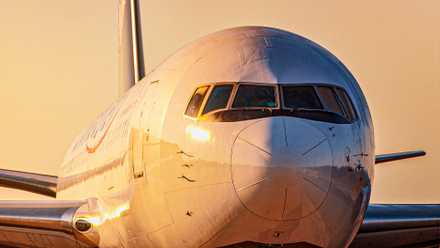
The Striking Differences Pilots Notice Between Flying The Boeing 767 & 777
Two iconic Boeing aircraft that have a lot in common, but also, plenty of interesting differences. What really makes these aircraft unique?
A Master Dimming Switch On The 777

This is perhaps the most obscure detail of the 777’s flight deck, but it still holds value for pilots. Boeing’s prior clean-sheet widebody, the Boeing 767 (which shared its cockpit with the 757), featured 32 dimming switches to control the brightness of various cockpit displays and lights. This can be viewed in a YouTube video published by American Airlines pilot Kent Wein in 2012. What’s beneficial about these dimming switches is that it allows pilots to selectively choose which areas of the flight deck they want to be brighter and which ones to be dimmer.
The challenge, however, is that managing the cockpit’s lighting via 32 separate switches can be a time-consuming task. With the 777, however, Boeing installed a master brightness knob on the overhead panel to control all lighting in the cockpit, with a separate push-button switch next to it labeled ‘Storm’ to activate maximum brightness. Meanwhile, individual areas of the cockpit and displays still have individual lighting switches, in case pilots want to brighten or dim a specific section.
As a whole, the 777’s flight deck was a significant improvement over Boeing’s previous flight decks regarding design and functionality. It remains highly advanced even by today’s standards, and the type is beloved by pilots not only for its modern technology, but also its excellent handling and power. With the 777X, meanwhile, Boeing will be incorporating design elements from the Boeing 787 to further modernize a flight deck that’s already largely state-of-the-art.
