


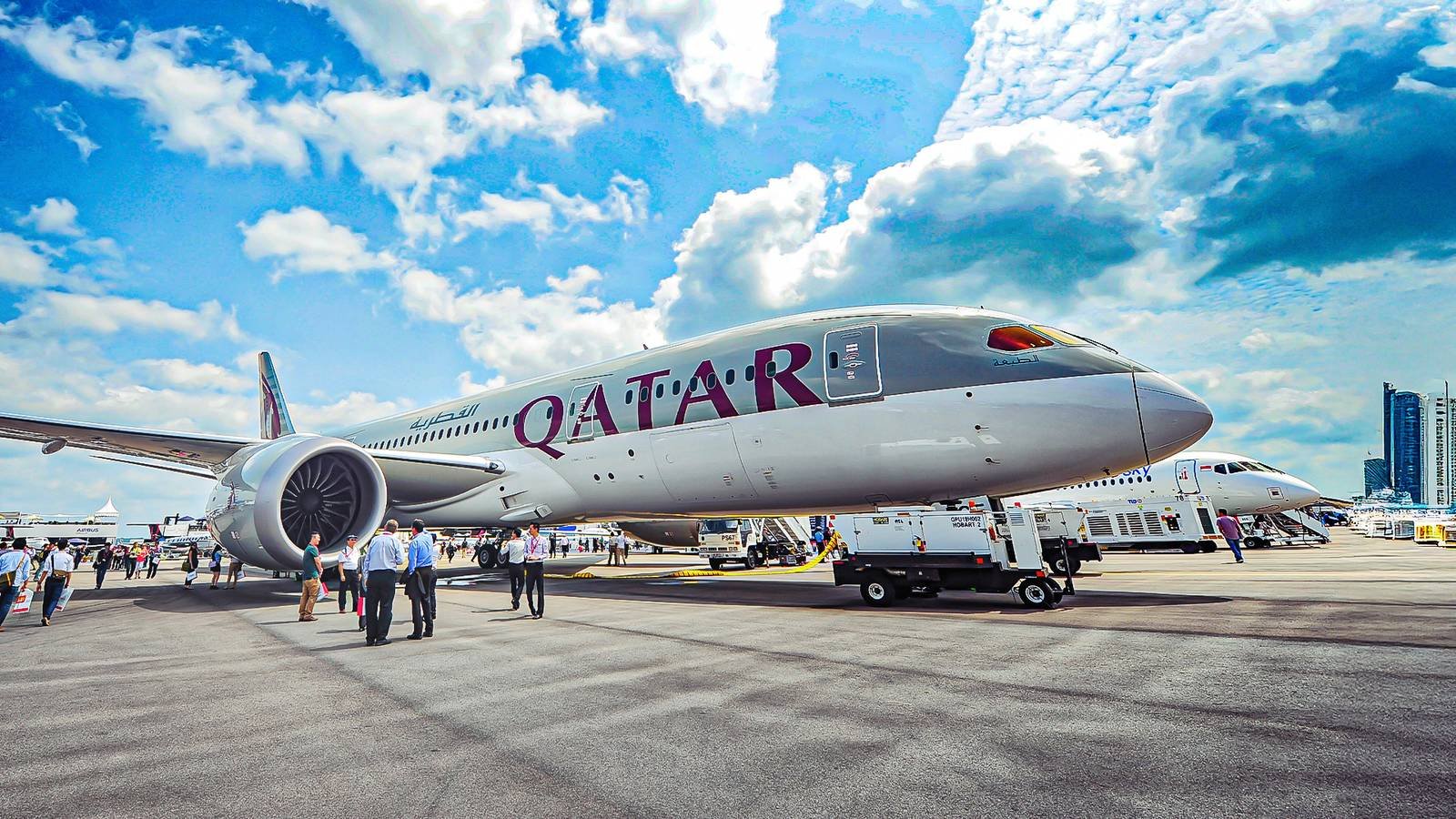
Qatar Airways has announced its full-year results for the 2025/26 financial year, which ran from April 1 to March 31. All in all, the Doha-based Qatari flag carrier and oneworld member enjoyed a very fruitful 12 months, with a profit of almost $2 billion. However, the last month of the financial year saw it come to terms with the operational impacts of the conflict in the Middle East, which will likely have a bigger impact on its bottom line this year.
Even so, there were still plenty of reasons for  Qatar Airways to be cheerful, as its financial and operational success in the last financial year extended far beyond its impressive profit figure. Indeed, the carrier also enjoyed strong growth in both passenger and cargo.
Qatar Airways 2025/26 Results By The Numbers

The main headline of Qatar Airways’ 2025/26 financial results was its QAR 7.08 billion (US$ 1.94 billion) full-year post-tax profit. This was the result of a QAR 15.2 billion (US $4.1 billion) operating profit, which Hamad Al-Khater, the Qatar Airways Group’s Chief Executive Officer, explained was “the highest in the Group’s history.” During the 2025/26 financial year, the airline carried 41.8 million passengers, with its cargo division shifting more than 1.43 million tons of chargeable weight, further cementing its position as the world’s largest air freight carrier, holding a 12% global market share.
The results highlight the continued strength of the airline’s recovery and growth strategy, with passenger demand, cargo performance, and operational efficiency all contributing to higher revenues across the Group. Despite ongoing geopolitical tensions and wider economic uncertainty, Qatar Airways maintained strong yields. Mr Hamad Al-Khater, Qatar Airways Group Chief Executive Officer, said:
“It is not often that a single financial year asks an organisation to demonstrate both the best of what it can achieve and the depth of what it can withstand. The 2025/26 financial year did both, and the Qatar Airways Group rose to each in turn.
Building A Fleet For The Future

Qatar currently operates a fleet of around 270 aircraft serving over 160 destinations worldwide, making it one of the largest long-haul airlines in the Middle East. The airline’s network is centered primarily around widebody aircraft, including the Airbus A350-900 and A350-1000, the Boeing 777 family, and the 787 Dreamliner. Qatar also operates the A380, although these are currently grounded.
The carrier is now preparing for a major expansion after announcing plans to acquire up to 210 new aircraft from  Boeing. The order constitutes 130 787s, setting the record as the largest Dreamliner order ever, alongside 30 Boeing 777-9s, with 50 options for 787s and 777-9s. The order represents the largest widebody order in Boeing’s history. The expansion will significantly increase Qatar Airways’ future capacity while also securing long-term aircraft delivery slots at a time when demand for new-generation widebody jets remains exceptionally strong.
The investment forms part of Qatar Airways’ broader strategy to maintain a younger and more fuel-efficient fleet. With a current average fleet age of roughly 10 years old, new aircraft will significantly reduce this number. Like many carriers, the airline has increasingly prioritized twin-engine aircraft that offer lower fuel consumption, reduced maintenance costs, and improved environmental performance. The additional 210 aircraft will support both route expansion and the gradual replacement of older jets over the next decade, while also helping the airline strengthen its position against regional competitors such as Emirates and Etihad Airways in the global premium travel market.
8,200 Miles: Qatar Airways Adds One Of Its Longest Flights With Bogota-Caracas Triangle Route
This new route is certainly set to turn a few heads, as the airline becomes the only gulf carrier to serve both Bogota and Caracas.
The Continued Impact Of The Iran Conflict

Rising tensions involving Iran have placed additional strain on the aviation sector, particularly for airlines operating throughout the Gulf region. A major concern has been the effect on global energy markets, with Brent Crude Oil prices reaching a high of $138 per barrel on April 7, according to the US Energy Information Administration. Because jet fuel can represent between 15% to 20% of an airline’s total operating costs, even relatively small increases in oil prices can have a substantial impact on profitability.
The conflict has also disrupted normal air traffic patterns across the Middle East. Several countries temporarily closed sections of their airspace, forcing airlines to divert flights onto longer routings across Central Asia, the Mediterranean, or the Arabian Sea. For long-haul operators such as Qatar Airways, these diversions increased both flight times and fuel burn, particularly on heavily traveled Europe-to-Asia services. Some journeys reportedly became between 30 minutes and, in some cases, up to four hours longer depending on the route, while operational disruption led to delays, cancellations, and additional crew and maintenance costs throughout the region.
Simple Flying Quiz
Easy (15s)Medium (10s)Hard (5s)
Despite higher fuel prices and regional airspace disruption, Qatar Airways still reported a record profit for the 2025/26 financial year. Strong passenger demand and cargo revenues helped offset the increased operating costs linked to the conflict in the region. No doubt the operator will be keen to continue this into the next financial year, to maintain their reputation as one of the leading global carriers.
