


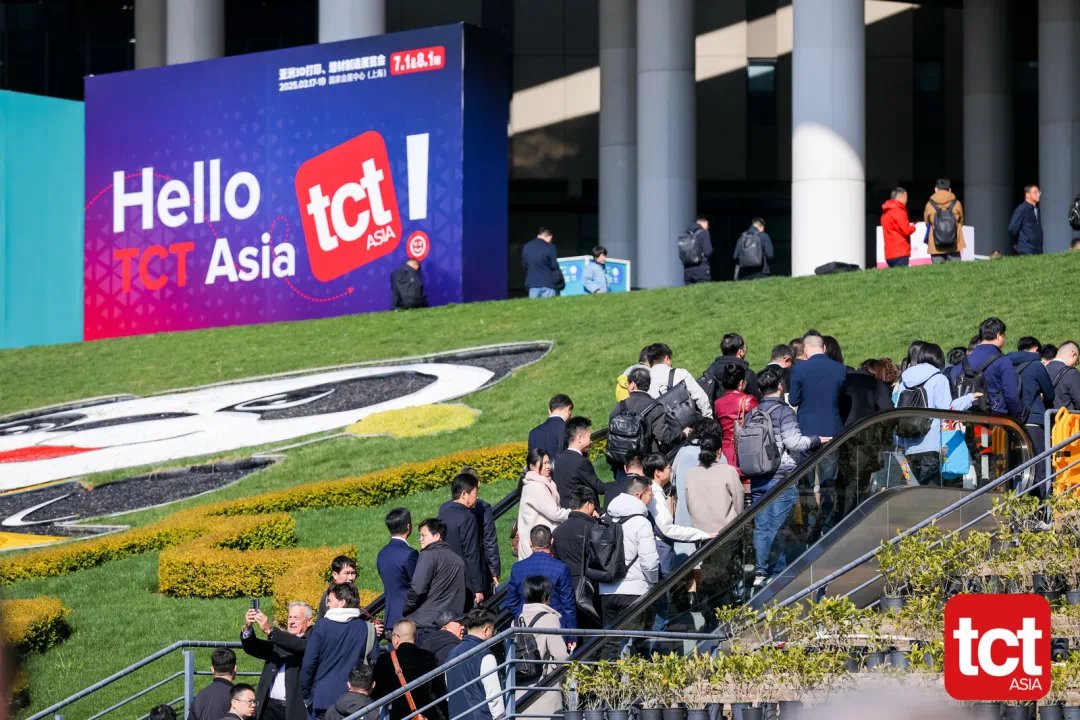
Additive manufacturing has come a long way in a short time, and TCT Asia 2026 is a decent measure of that. When the show opens at the National Exhibition and Convention Center in Shanghai on March 17 to 19, it will do so with 550 exhibitors across 55,000 sq. m., expecting more than 40,000 visitors over three days.

For an industry that was still making its case to mainstream manufacturers not long ago, those figures say a lot.
The broader market context helps frame it. According to TCT Asia, the global 3D printing market was valued at $20.24 billion in 2024, with forecasts projecting $56.21 billion within five years at a compound annual growth rate of 22.66%. That kind of growth tends to concentrate minds, and the 2026 show floor reflects it.
Of the projected 550 exhibitors, 527 companies are already confirmed with 849 products registered, spanning metal powder bed fusion (PBF) systems, polymer AM platforms, advanced metal powders, post-processing equipment, and much else besides. Among those confirmed for 2026 are Farsoon Technologies, Xi’an Bright Laser Technologies (BLT), Eplus 3D, ZRapid Technologies, UnionTech, and Avimetal AM Tech, alongside a broader field of materials specialists and software providers.
Beyond the trade floor, the show also draws a sizable creative community, with more than 5,000 makers, designers, and creative practitioners expected to attend through the dedicated Fans of Creative programme.

More Than a Trade Show Floor
What makes the 2026 programme particularly worth noting is the shape of the conference running alongside the exhibition.

It will kick off a day early, on 16 March, with an ASTM Certificate Course covering the foundations of additive manufacturing standards, a useful primer for those looking to make the most of the three days that follow. The TCT Asia Summit, free to attend and held on the main stage in Hall 8.1, will then run across all three days with tracks covering healthcare, aerospace, consumer goods, mold and industry, and architecture and design.
The sessions will lean on clinicians, engineers, and researchers presenting documented case studies and real deployment experience, the kind of content that tends to be more useful to practitioners than panel discussions about where the industry might be headed.
Running alongside the Summit will be a broader slate of programming that reflects just how much ground the industry now covers.
The Tech Stage will give universities and research institutes room to present current work, while the Insight Stage Series will take on business strategy and global market perspectives, including a C-suite View session where entrepreneurs and industry commentators will discuss market conditions and investment opportunities.
On 18 March, the LabTec Bio3D Forum will turn the spotlight on life science and biotech applications, one of the faster moving corners of the industry at the moment. TCT Introducing on 17 March will give more than 30 companies structured slots to launch new equipment, materials, and technologies to a live audience.
And for those working at the consumer end of the market, the 3D Genius Hub will offer a dedicated 800 square meter creative space with more than 30 curated booths, maker talks, and roundtable sessions running across the show.
The Audience Speaks for Itself
Last year’s edition offers a useful sense of who to expect in the room. The 2025 show drew 31,352 visitors, up 31% on 2024, and the crowd skewed heavily toward senior decision-makers and active buyers.
Over 60% came from end-user companies rather than vendors. Additionally, more than one in eight carried a purchasing budget exceeding $700,000. The visitor list itself read like a cross-section of global industry, taking in Tesla, BMW, Porsche, Huawei, Samsung, Foxconn, Johnson & Johnson, Bosch, Honeywell, among many others.
International attendance has been one of the more notable recent trends. Overseas buyer delegations have more than tripled over the past two years, and China’s expanding visa-free entry agreements and a transit policy allowing stays of up to 240 hours for visitors from 54 countries have quietly removed some of the friction that used to keep international buyers away.
Korea, Singapore, Japan, Malaysia, and the United States were the top five sources of overseas visitors in 2025, giving the show a genuinely international character that sets it apart from most regional trade events.
The cumulative picture is of a show that has grown well beyond its regional roots. With the conference programme taking on more depth each year and the exhibitor base expanding to reflect the full breadth of the industry, TCT Asia has become the kind of event that is difficult to ignore if additive manufacturing is central to your business, whether you are there to buy, sell, or simply stay current.
3D Printing Industry is inviting speakers for its 2026 Additive Manufacturing Applications (AMA) series, covering Energy, Healthcare, Automotive and Mobility, Aerospace, Space and Defense, and Software. Each online event focuses on real production deployments, qualification, and supply chain integration. Practitioners interested in contributing can complete the call for speakers form here.
To stay up to date with the latest 3D printing news, don’t forget to subscribe to the 3D Printing Industry newsletter or follow us on LinkedIn.
Explore the full Future of 3D Printing and Executive Survey series from 3D Printing Industry, featuring perspectives from CEOs, engineers, and industry leaders on the industrialization of additive manufacturing, 3D printing industry trends 2026, qualification, supply chains, and additive manufacturing industry analysis.
Featured image shows a crowd of attendees arriving at TCT Asia 2025 at the National Exhibition and Convention Center, Shanghai. Photo via TCT Asia.
