


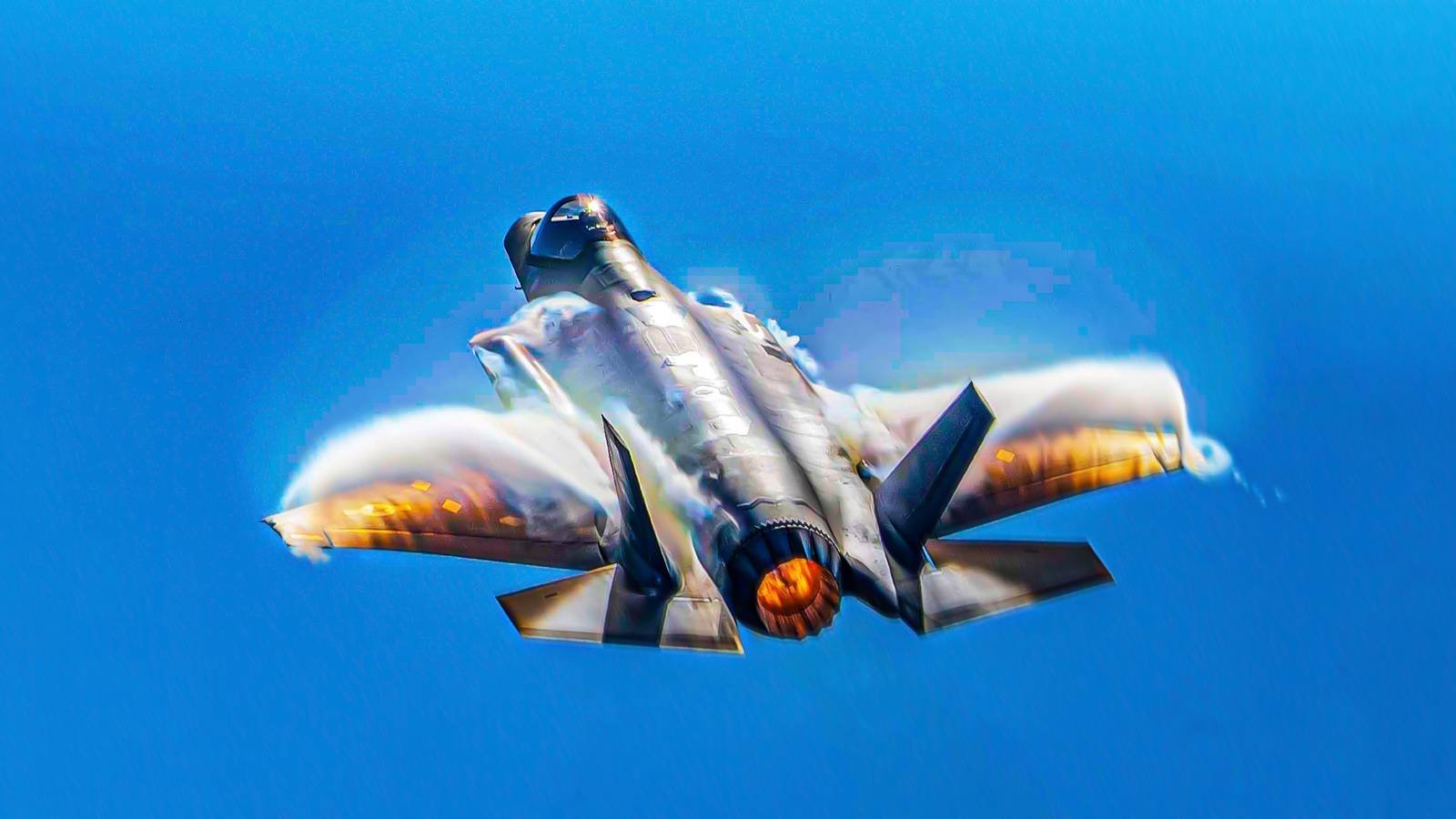
Compared to the period from the first fighters up until the 1960s or 1970s, modern fighter jets’ top speeds have been deprioritized for decades. Between World War I and World War II and then into the early Cold War, it was largely believed and seen that faster was better and that future aircraft would set new speed records. But that changed with the Vietnam War and the introduction of stealth.
The Lockheed Martin F-35 Lightning II may be the most advanced fighter jet on the planet today, but it is also one of the slowest frontline fighters with a top speed of just Mach 1.6. Supersonic speeds are cool, but often overrated in the real world. Fighter jets basically only operate at subsonic speeds, except for very specific scenarios requiring a dash.
Slowing Aircraft Down
After reviewing thousands of flight hours, the USAF found that the F-4 Phantom II’s top speed of Mach 2.2 was never used in combat. The F-4 Phantom only spent a few minutes above Mach 1.4 in some 100,000 combat sorties over Vietnam, and none over Mach 1.6. Only a few hours were spent between Mach 1.2 and Mach 1.4. The US Air Force would go on to design its air superiority F-15 and F-22 fighter jets with a top speed of over Mach 2, but it was not the priority to set new records that it once was.
The F-22 Raptor is notable for its ability to supercruise at Mach 1.5+ without afterburners. This makes it far more efficient at sustaining Mach 1.5 speeds relative to the F-15 it was designed to replace. Modern Russian/Soviet fighter jets are also slower compared with their older cousins. The MiG-25 famously had a top speed of around Mach 3.1, while the MiG-31 is regarded as the fastest fighter jet in service today with a top speed of around Mach 2.8.
But the MiG-25 is retired, and the MiG-31 is aging and has been out of production since the mid-1990s. The fastest in-production Russian fighter jet is believed to be the Su-35 with a speed of around Mach 2.3, while its Su-57 is thought to max out at around Mach 2.0, a similar speed estimated for the Chinese J-20. Something similar has happened with bombers. In the 1960s, the US built the North American XB-70 Valkyrie with a top speed of Mach 3.1, but the next-generation Northrop Grumman B-21 Raiders it is building now are high subsonic.
Poor Performance At High Mach

There are multiple reasons why flying at supersonic speeds delivers major penalties. One issue is that it increases airframe fatigue. This is particularly an issue for the US Air Force’s fleet of B-1B Lancer bombers that are designed to fly low and up to Mach 1.25. Now their airframes are aging, and the Air Force is struggling to keep them in service. B-1Bs are the first on the retirement list, expected to retire in the late 2020s. By contrast, the high and slow-flying ancient B-52s have many flight hours remaining.
But for fighter jets, one issue is that high speeds reduce their turn rate and make them less maneuverable. The best speed for fighter jets to maximize their turn rates is around Mach 0.7, and this is why most air-to-air combat occurs at subsonic speeds. One of the biggest penalties is that fuel consumption spikes, collapsing combat radius, and time on target. More on that below.
One particular penalty acute for the F-35 is that high speeds increase the heat friction on the aircraft. The heat friction compromises its stealth, and stealth is what the F-35 prioritizes. This is one of the reasons why the F-35’s design was slowed down from an original top speed of Mach 1.8 to Mach 1.6. In the early Cold War, the idea was “You can’t hide, but you can run.” Now the F-35’s philosophy is “you can’t run, but you can hide.” Fighter jets can’t outrun modern interceptor missiles.

The 6 Most Significant System Differences Between The F-22 Raptor & F-35 Lightning II
The F-22 & F-35s system differences reflect the different time periods they were developed as well as different mission sets.
Collapsed Combat Range

The biggest issue for fighter jets is that supersonic speeds guzzle the aircraft’s fuel and collapse its range and time in the air. That is why fighter jets do not sustain supersonic speeds, instead using them for dashes. Fighter jets will typically not fly to the combat zone at supersonic speeds, even in an emergency, because the range and endurance collapse. That said, there are exceptions, and sometimes modern fighter jets are seen taking off with full afterburners to intercept munitions in the Middle East.
At supersonic speeds, fighter jets use their fuel at unsustainable rates. For example, the F-15, flying in a clean configuration at subsonic optimal cruise, can be expected to use around 600 to 900 gallons per hour, or about 1 to 1.5 gallons per mile. Pushing the aircraft to Mach 1.5 will consume 6,000 to more than 15,000 gallons an hour (or five to over nine gallons a mile). Going up to max speeds, and it will be burning over 14,000 to even 23,000 gallons an hour. The F-15 only carries around 2,000 gallons internally.
Flying clean, without external drop tanks and without external munitions, most fighter jets are designed to have an endurance of one to two hours. This is increased when they carry external drop tanks. The F-15 is notable for having a longer endurance of two to three hours, as is the Soviet/Russian Su-27 Flanker family. That said, Russia has a token fleet of tankers (fewer than 20), mostly tasked with its strategic bomber patrols. Russian fighter jets are generally not refueled in the air, unlike Western fighter jets.
The Thermal Limits Of Engines

Another factor is that fighter jets are also limited by the thermal limits of their engines. Afterburners work by injecting fuel directly into the hot exhaust gases downstream of the turbine. This creates a second combustion stage, guzzles the fuel, and overheats the engine. The engines overheat, and so the aircraft is often restricted below the theoretical max to prevent damage to the engines. Note that the time estimates below may be inconsistent. The estimates may mix recommended durations to prevent damage with what the engines can actually tolerate.
At max Mach, lower-end fighter jets like the F-16 Fighting Falcon and MiG-29 Fulcrum are believed to be able to sustain speeds for up to 10 minutes. The F-35 is estimated to be able to do it for between less than a minute and up to two minutes. This is also believed to be true for the US Navy’s Super Hornet. The MiG-31 is regarded as the fastest fighter jet in service and was specifically designed for interceptions over the Soviet Union’s vast territories. Even so, it is thought to only be able to sustain those speeds for around five to 15 minutes and then only at very high altitudes.
Select fighter jet top speeds (per US Air Force, etc.) | |
|---|---|
F-4 Phantom II | Mach 2.2 |
F-15 Eagle | Mach 2.5 |
MiG-25 | Mach 3.1 |
MiG-31 | Mach 2.8 |
F-22 Raptor | Mach 2.2 |
F-35 Lightning II | Mach 1.6 |
The F-15 Eagle family and the Su-27 family are thought to be able to tolerate these speeds for three to eight minutes before overheating. The F-22 Raptor may be able to reach over Mach 2.2 with afterburners, but it is constrained by its stealth and can only sustain it for around two to five minutes. Although the Raptor has its supercruise hat-trick discussed below.

SR-72: 5 Advances Expected In The Hypersonic UAV “Son Of Blackbird”
Setting the stage for a new era in aerospace innovation.
Supercruising Fighter Jets

Where the F-22 Raptor stands out is that it can sustain its Mach 1.5 to perhaps Mach 1.8 supercruise for tens of minutes or even up to over an hour. The F-22 Raptor is regarded as the most capable and most impressive supercruiser in service, although the Eurofighter Typhoon can also supercruise at around Mach 1.3 to Mach 1.5, and the Dassault Rafale can supercruise at around Mach 1.4.
Fighter jets that are able to supercruise can sustain supersonic speeds for longer without overheating their engines. Often this is tens of minutes. There are claims that the Russian Sukhoi Su-57 can supercruise, but this is not fully verified. The aircraft is also not yet fitted with its intended AL-51 (Izdeliye 30) engines.
There are also increasingly credible claims that the Chinese J-20 has the ability to supercruise, or at least the more recent models powered by the modern WS-15 engines. Some also claim the Saab JAS 39 Gripen can supercruise at around Mach 1.2, but this is very limited and situational. Currently, the Raptor is the supercruising gold standard, with the Eurofighter and Rafale following.
Future Is Mixed Subsonic, Supersonic, Hypersonic

The future picture for fighter jets going supersonic is mixed. The upcoming Boeing F-47 is believed to be designed for a top speed of around Mach 2, even though the Increment 1 Collaborative Combat Aircraft (aka loyal wingman drones) being developed now are subsonic.
Some companies see the future of combat aircraft as supersonic and even hypersonic, with some designing unmanned supersonic and hypersonic combat and spy aircraft. One example is the secretive hypersonic Lockheed Martin SR-72, intended to be the successor to the famous manned SR-71 Blackbird. It is reported to have a speed of around Mach 6.
Russia still has its supersonic Tu-22M3 bombers, although these airframes are wearing out and likely won’t be sustained for much longer. It has put its large, supersonic, prestigious but out-of-date Tu-160 back into production. At any rate, there is no evidence that Russia has flown these two aircraft supersonically on any of their Ukraine sorties in more than four years. For now, it seems the days of supersonic bombers are functionally over. The US is building the subsonic B-21, while China is developing the likely subsonic Xi’an H-20.
