


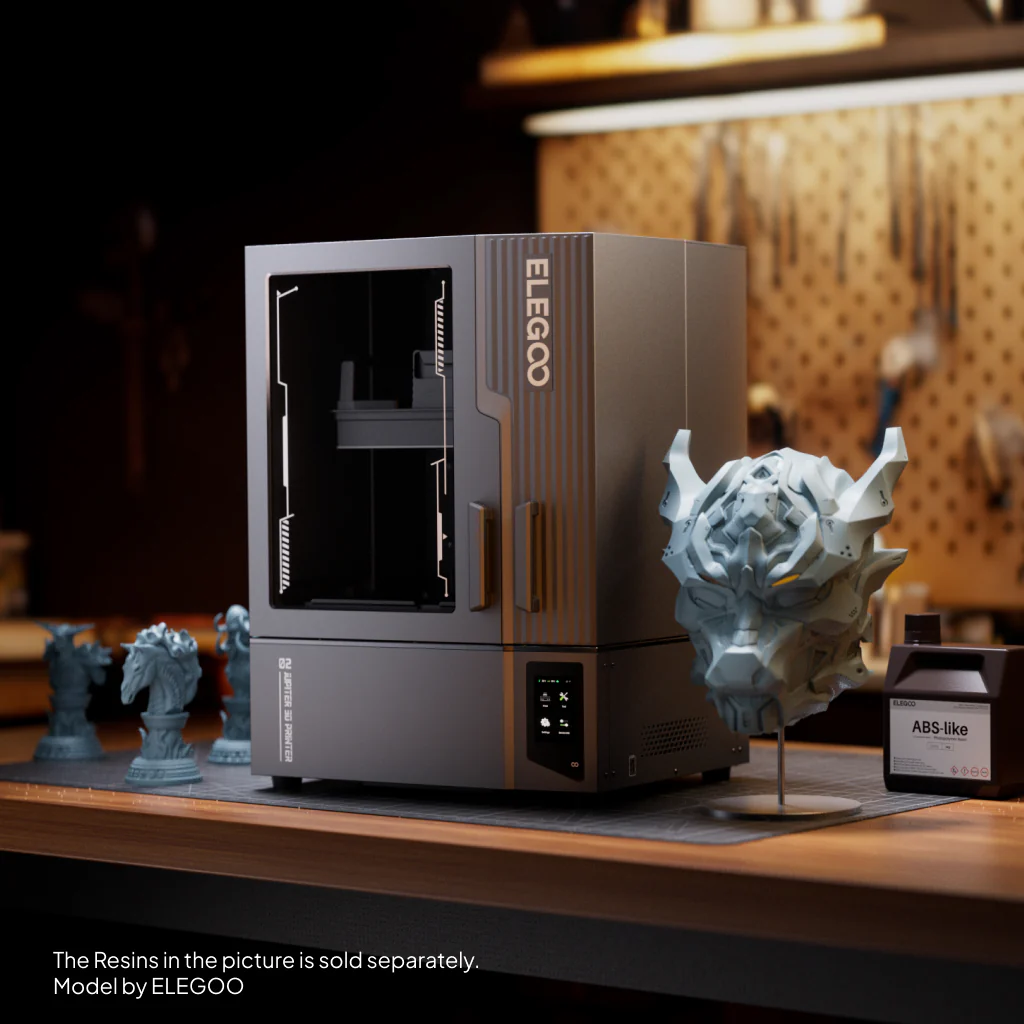
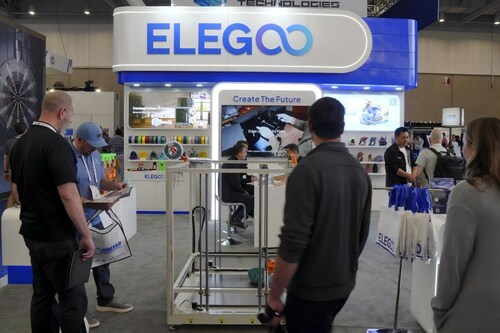
Chinese 3D printing brand ELEGOO used its presence at RAPID + TCT 2026 in Boston to unveil two headline products: the Jupiter 2, an ultra-large format resin printer, and the CANVAS multicolor system for its Centauri Carbon platform, the latter making its first public appearance at the show.
Hardware in the Spotlight
The Jupiter 2 anchors the lineup with 16K resolution, multi-point auto-leveling, and automated resin management, targeting users who need consistent output at scale across applications from jewelry and character modeling to functional prototyping and batch production.
The CANVAS multicolor system, designed for smooth color transitions on the Centauri Carbon, drew notable attention on the show floor. The system is expected to reach full availability by the end of April, with pricing still to be confirmed.
Rounding out the hardware display were the Centauri Carbon 2 Combo, Saturn 4 Ultra 16K, and OrangeStorm Giga, alongside a materials and accessories range that gave attendees a broader view of where ELEGOO’s product lines currently sit.
Ecosystem and Community
ELEGOO also used the event to demonstrate the connective tissue around its hardware, the Matrix remote control app and Nexprint model platform, framing the booth as a showcase for an integrated workflow rather than a collection of individual machines.
On the community side, the company hosted a “Print What You Scan” activation running alongside the exhibition, walking attendees through how 3D scanning feeds into the printing workflow. Industry creator Frankly Built participated throughout, leading Q&A sessions and hands-on activities with makers at the booth.
Going forward, ELEGOO remains committed to putting users first, building on its 3D printing know-how to keep raising the bar on the overall experience.
Building Platforms, Not Just Printers
ELEGOO’s approach at RAPID + TCT reflects how the industry is moving from selling standalone machines to building integrated ecosystems. Hardware alone is no longer the differentiator,the brands gaining ground are those that wrap their printers in software, materials, and community layers that keep users inside a single, connected workflow.
For instance,Materialise has pushed its CO-AM software suite toward open, modular architecture specifically to improve workflow interoperability and help manufacturers scale operations without being locked into a single vendor’s stack. Elsewhere, Formlabs’ continuous expansion of its PreForm software and materials workflow shows how resin-focused brands are increasingly competing on ecosystem depth rather than hardware specs alone.
The pattern holds at the industrial end of the market too. At RAPID + TCT 2026, Stratasys rolled out new materials and software capabilities explicitly designed to lower adoption barriers, framing workflow integration, not printer novelty, as its core competitive lever.
For ELEGOO, the Matrix app, Nexprint platform, and community activations are the connective tissue that turns a hardware lineup into a longer-term relationship with its user base. The company is not just selling printers, it is building the infrastructure around them.
3D Printing Industry is inviting speakers for its 2026 Additive Manufacturing Applications (AMA) series, covering Energy, Healthcare, Automotive and Mobility, Aerospace, Space and Defense, and Software. Each online event focuses on real production deployments, qualification, and supply chain integration. Practitioners interested in contributing can complete the call for speakers form here.
To stay up to date with the latest 3D printing news, don’t forget to subscribe to the 3D Printing Industry newsletter or follow us on LinkedIn.
Explore the full Future of 3D Printing and Executive Survey series from 3D Printing Industry, featuring perspectives from CEOs, engineers, and industry leaders on the industrialization of additive manufacturing, 3D printing industry trends 2026, qualification, supply chains, and additive manufacturing industry analysis.
Featured image shows Jupiter 2. Photo via ELEGOO.
