


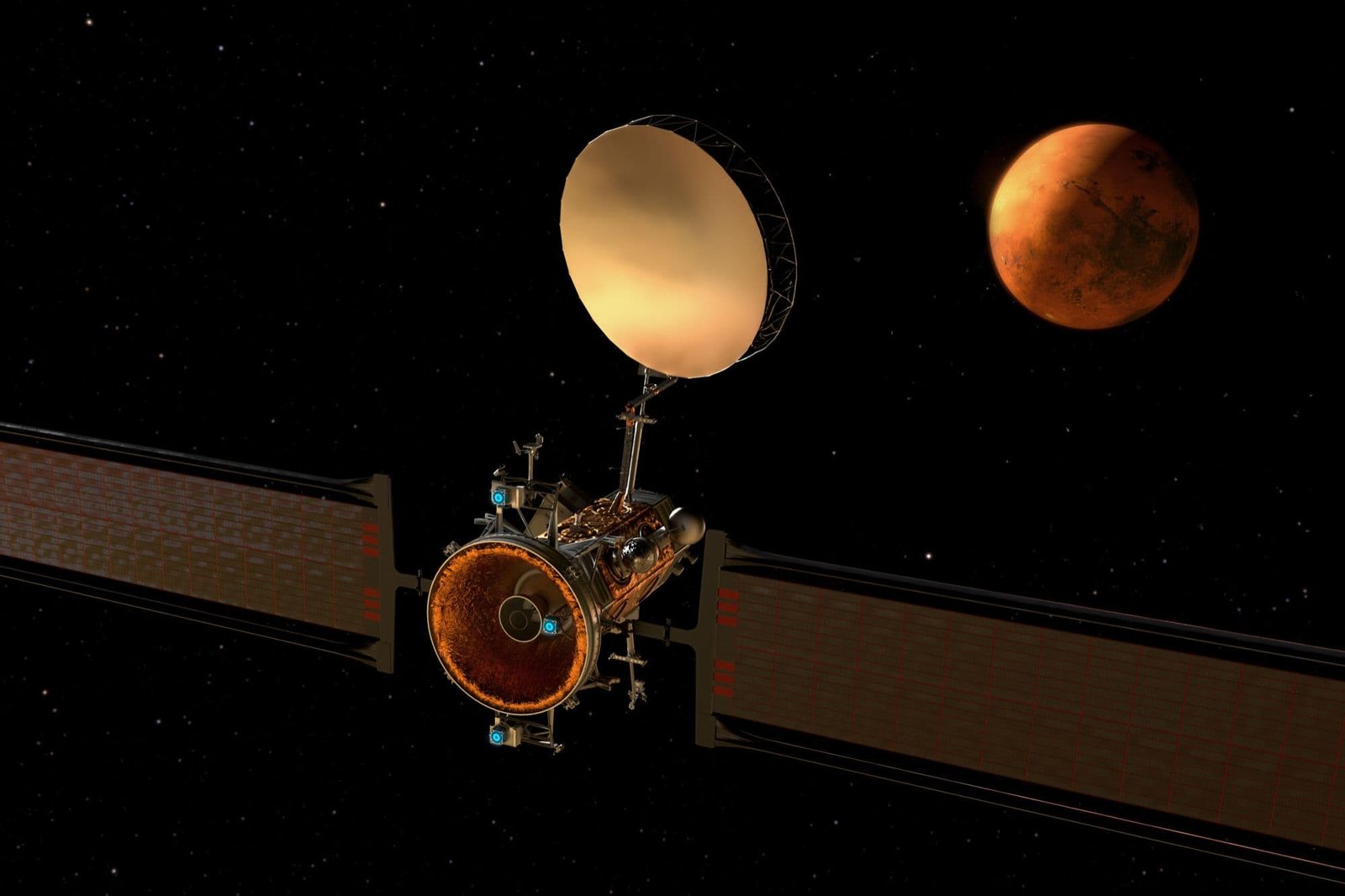
WASHINGTON — NASA is reserving a small amount of space on a Mars telecommunications spacecraft for science, which could be one or more cubesats.
NASA issued a draft request for proposals April 2 for the Mars Telecommunications Network, or MTN, a mission to serve as a communications relay at Mars for other spacecraft there. A budget reconciliation bill enacted last July provided $700 million for the mission, with a requirement it be “delivered to the Administration” by the end of 2028.
The draft RFP, like a list of draft objectives and requirements published in February, did not include any mention of science roles for the mission. This contrasted with comments by NASA leadership that they would include science on every mission.
However, in slides from an April 9 industry day about the mission, published by NASA on a procurement website April 24, the agency said it was adding a requirement for supporting a small science payload.
Under the new requirement, missions would have to include a science payload weighing up to 20 kilograms in a volume of 55 by 55 by 45 centimeters. The payload would consume up to 60 watts and generate between 200 and 1,000 megabits of data per day.
NASA will provide the science payload. “All payloads will be negotiated with the NASA team and will not impact MTN schedule requirements,” an updated requirements document stated.
That payload could be cubesats. “There is consideration for deploying free-flying CubeSat payloads in Mars orbit,” the presentation stated.
NASA has not discussed what science instruments or cubesats it is considering, given the limited size, weight and power available for it on the mission, or how it might select and fund a payload.
“We are in discussions right now,” Louise Prockter, director of NASA’s planetary science division, said of flying science payloads on the mission during an April 21 meeting of the Mars Exploration Program Analysis Group. “We are in discussions about what could be flown there, when does it have to be ready by, things like that.”
NASA wants to move quickly on MTN. In those draft procurement documents, it states it expects to launch the mission in late 2028, its interpretation of the “delivered to the Administration” language in the budget reconciliation bill. The agency expects the mission to be fully operational at Mars by the end of 2030.
Because of that requirement, as well as one to obligate the funding for MTN by the end of fiscal year 2026, the agency plans to release the final RFP on May 1, with proposals due a month later. NASA anticipates making an award by the end of the fiscal year in September.
Several companies have expressed an interest in MTN, notably Blue Origin and Rocket Lab. Other companies that participated in the industry day include Firefly Aerospace, Intuitive Machines, Lockheed Martin, Quantum Space and SpaceX. While the language in the budget reconciliation bill appeared to limit the procurement to companies that had participated in earlier architecture studies for Mars Sample Return, NASA stated in the cover letter for the draft RFP that it was running MTN as a full and open competition.
Whitley Poyser, director of exploration at Lockheed Martin Space, said at an April 13 briefing that the company plans to leverage its decades of experience with Mars missions for its MTN proposal. She declined to provide details about its proposed approach.
