


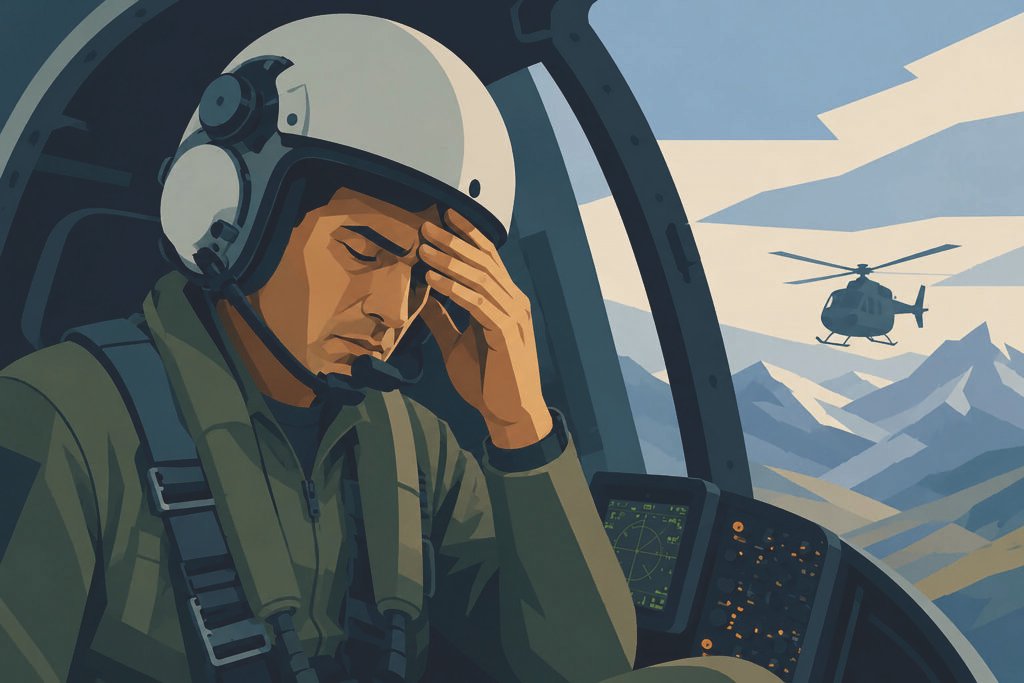
Sooner or later, motion sickness will affect most people in aviation. Sean Reynolds explores the idea that elevated stress or anxiety might sometimes be the trigger.
“Can you take control please, I’m not feeling great.” I can remember uttering these very words and fighting to get my oxygen mask off and the sick bag out of my pocket as a 19-year-old student pilot in a Jet Provost Mk5 basic jet trainer.
It was getting towards the end of the fast jet lead-in course, with lots of high-G manoeuvring in preparation for the next stage of our training, which was on the Hawk TMk1.
Suffice to say, my sickness problem got worse, and I was offered a course of desensitisation – six weeks of spin tables and centrifuges – to try and build up my resistance to motion sickness or helicopters.
Clearly, in reading this publication and possibly having seen my previous articles, you will have guessed that I chose helicopters. That said, I have never suffered from air sickness since – and that includes several flights in fast jets including with the Red Arrows.
I have often wondered why me at that point in my training? My curiosity was further piqued recently when a very experienced Flight Instructor (FI) student of mine suddenly started to suffer from motion sickness in relatively smooth and benign conditions.
To try and help them, I started to research and investigate to see if there was any correlation between what I experienced 40 years ago and what I was now seeing with my student.
It soon became apparent, when talking to other instructors and examiners in the industry, that this issue was more prevalent than I had thought – and particularly under check and test conditions. Could these random occurrences of air sickness be triggered by anxiety?
Sean Reynolds was offered a course of desensitisation as a young RAF trainee. All images: RHI
Fight or flight
So where does anxiety come from? With my “Human Factors Facilitator” hat on I would posit that anxiety is the body and mind’s natural reaction to stress and/or perceived danger.
Clearly, a healthy amount of stress can be beneficial, as this “fight or flight” mechanism enables us to operate at a high level of performance.
The flip side of this, of course, is that too much stress, which becomes overwhelming, can rapidly degrade our performance – and if it starts to interfere with your daily life, then it can develop into an anxiety disorder which may need professional help.
Delving into some of the theory behind anxiety leads to some interesting conclusions. It would appear that anxiety and motion sickness are tightly linked.
The “fight or flight” reaction results in our body releasing a number of stress hormones which include adrenaline and cortisol. These hormones can severely heighten our sensitivity to motion and trigger nausea.
Conversely, of course, the physical discomfort of travel sickness can spark anxiety or panic, which can aggravate the situation even further. So why do these hormones interact with anxiety and motion sickness?
Gut instincts
Stress hormones increase nervous system activity, making us aware of subtle body movements, and can sometimes cause a feeling of dizziness even when we are completely still.
There is also a notion called anticipatory anxiety. If we are worrying about feeling sick when travelling, then this can become a self-fulfilling prophecy.
There can also be a type of gut-brain connection. Stress neurotransmitters can directly affect our stomach, leading to the nausea, cramping and sweating that is often triggered by both anxiety and travel sickness.

The author feels his fear of failure was a contributing factor.
When I think back to my own personal journey, I start to recognise some of these concepts. As the workload and failure rate on my course started to ramp up, I distinctly remember a very pronounced fear of failure – complete with the attendant sleepless nights, lack of appetite and general feeling of fatigue.
I now know that I was definitely suffering from stress-induced anxiety. Being on edge gave me a kind of queasy feeling which, when airborne and manoeuvring hard under increased Gs, just seemed to tip me over the edge.
Then, once I had been ill in the air, with all of the attendant embarrassment, I was convinced that it would happen every time I pulled G. Not a good look for a potential fighter pilot.
Conversely, however, I loved low-level navigation, formation and instrument flying. I seemed to be good at it and because of that I didn’t worry, stress or have the attendant anxiety that came with it. I wasn’t sick!
The R-word
So, knowing all of this, how might we better manage it? Particularly for students or pilots who are experiencing some self-induced stress or anxiety.
Well, clearly, we just need to relax! Of course, this is easier said than done. But the good news is that there are some really good relaxation techniques available.
Due to various domestic reasons, I spend a lot of my time in India, and have embraced yoga and meditation – which, culturally, seem to be just part of people’s everyday routine out there – like going for a walk.
Despite some initial scepticism, my helicopter hunch is disappearing, and it has had a noticeably relaxing effect.

Breathing, visualisation and self-awareness techniquess can have a positive impact
I have now tried some of these meditative techniques with a couple of my students, with really positive results, and frequently use them in my executive coaching practice.
Most of it revolves around breathing, self-awareness and visualisation. I start with five minutes of deep and regular breathing with their eyes closed, before asking the individual to notice how they are feeling and why, before getting them to visualise a pleasant place and some of the things they can see, hear, touch and smell.
I do this after we have briefed and before walking out to the aircraft. I also encourage them to not eat too much before flying and to avoid caffeine, both of which are potential triggers to that gut-brain reaction.
Once in the aircraft, I make sure that their seating position is correct, that they are comfortable and that they have enough ventilation. I also offer my own personal remedy, which is a ginger biscuit!
Apparently, ginger has some form of calming effect on the stomach. Not sure if this is apocryphal or just a placebo, but it seems to work.
With some students, I also find that getting them to verbalise what they are thinking and doing seems to have a calming effect, thus reducing anxiety. Again, this a coaching technique which seems to have some merit.
Building resistance
I know from my own personal experience that various Air Arms, such as the RAF, US Air Force and US Navy, have their own desensitisation programmes.
There is now a lot of evidence and data to suggest that exposing students to this sort of training over a period of days and weeks can build up resistance and, more importantly, confidence that motion sickness can be managed and overcome.
The US Air Force uses a piece of equipment called a Barany Chair. This is a swivel chair where the subject is spun around the vertical axis, blindfolded and with their head tilted, while being asked to perform a number of tasks.
Fundamentally, this is used to demonstrate spatial disorientation while in cloud, but has also proved to be very good for motion sickness therapy, with an 85% success rate in reducing the onset of motion sickness.
This then reduces the worry, anxiety and stress that it will reoccur.
I know of a number of friends and colleagues who this has worked for. Indeed, later on in my flying career I was exposed to high-G manoeuvring without any adverse effects.
Could this be due to more time in the air, being more comfortable in the environment and fundamentally not being worried about any fear of failure.
So the next time you come across someone suffering from air sickness, it might be just worth exploring whether there might be some underlying stress or anxiety that is triggering this, and whether some form of relaxation therapy might be of help.
This article “Pass the sick bag” was published in the Volume 20 Issue 3 of RotorHub International. To read more articles like this, apply for your complimentary subscription today.
The post Training: Pass the sick bag appeared first on RotorHub International.
