


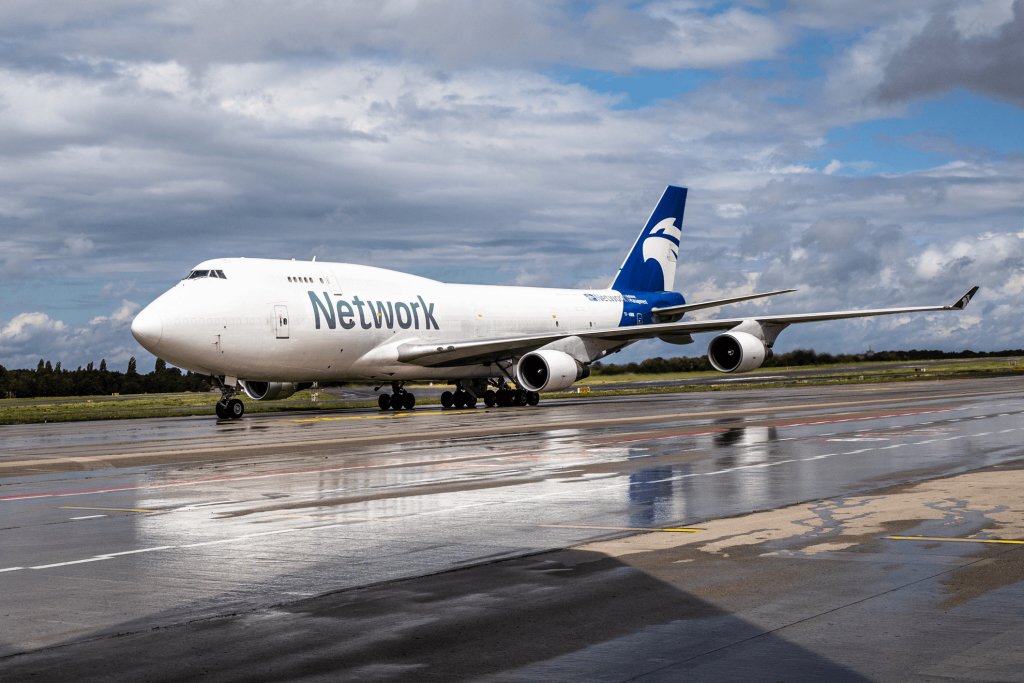
Network Airline Management (NAM) has expanded its freighter fleet with the addition of a fifth aircraft as it looks to keep pace with strong customer demand.
The additional Boeing 747-400 converted freighter joined NAM’s fleet at the end of July and will operate out of the company’s primary hub of Liege Airport.
The freighter addition brings NAM’s fleet of aircraft to five – all of which are Boeing 747-400Fs operated by Air Atlanta.
According to FlightRadar 24, the aircraft has so far conducted flights to Sharjah, Liege, Lagos, Accra, Entebbe and Nairobi.
The company said that the additional aircraft would solidify its commitment to providing “robust, reliable capacity to the global air cargo market”.
“This latest addition boosts the company’s operational capability to handle high-volume general cargo, oversized freight and specialised shipments across its expanding international network,” the company explained in a press release.
Jonathan Clark, chief executive of parent company Network Aviation Group, said: “The 747 remains the undisputed workhorse of heavy-lift air cargo and adding another converted freighter to our fleet allows us to keep pace with strong customer demand.
“This expansion directly enhances our flexibility, frequency and overall service delivery for our charter and scheduled service customers worldwide.”
In a recent interview with Air Cargo News, Network Aviation Group vice president for the UK, Ireland and Malta, John Gilfeather, said that continued uncertainty in container shipping had helped boost the firm’s performance this year.
He explained that perishables exporters, particularly flower shippers, that had been considering switching to ocean freight have instead remained with air cargo following disruption caused by the Red Sea missile crisis and, more recently, the closure of the Strait of Hormuz.
The trend had supported demand for NAM’s Liege-based Boeing 747-400 freighter operation.
“That has sustained and even increased our regular business, which has been the perishables from Nairobi back to Europe,” Gilfeather explains.
E-commerce has also continued to drive growth for the airline, despite the US ending the de minimis exemption for low-value imports last year.
Europe has also tightened up on its e-commerce import rules this year.
“The volumes of e-commerce remain strong,” said Gilfeather. “We operate flights from Hong Kong to Europe, and as of 2026, we have commenced scheduled charter routes between Hong Kong and Johannesburg, which has again been utilised for e-commerce.”
He explains that online retailers have increasingly targeted alternative markets, including Africa, following the introduction of US duties on e-commerce shipments.
Looking ahead, Gilfeather expects the European Union’s €3 charge on e-commerce imports to have a similar impact to the US policy change.
NAM added that it would consider future fleet expansion and growth opportunities to further support its global customer base.
