


Specialty pharmaceutical company PharmaTher Holdings is collaborating with Craft Health Pte. Ltd., a Singapore-based pharmaceutical technology company, to test whether Craft Health’s CraftMake 3D printing platform can produce personalized peptide doses. PharmaTher Holdings announced the partnership on July 29, 2026, two days after launching its Personaliz3D Peptides division.
The work will focus on six peptides: BPC-157, KPV, TB-500, MOTS-c, Epitalon, and Semax, that the FDA’s Pharmacy Compounding Advisory Committee (PCAC) recently recommended for inclusion on the Section 503A Bulks List, the roster of substances compounding pharmacies are permitted to use. If the PCAC’s recommendation is adopted, it would open a regulated path for pharmacies to compound these peptides, and PharmaTher wants 3D printing lined up as the manufacturing method before that happens.
Why peptide compounding needs a manufacturing fix
Peptide therapies like the ones on PharmaTher’s list are typically dispensed as fixed-dose injectables, with prescribers, compounding pharmacies, and technology vendors often operating as separate, disconnected pieces. That leaves little room to adjust a dose to an individual patient or to build in features like sustained release, and GMP-compliant manufacturing controls aren’t guaranteed across every compounding pharmacy in that chain.
Personaliz3D Peptides, the division PharmaTher launched on July 27, is meant to close those gaps through a three-part plan the company calls Connect, Personalize, and Deliver: a telemedicine platform at PersonalizedPeptidesRx.com to link patients with prescribers, 3D printing and AI tools to build patient-specific formulations, and partnerships with 503A pharmacies to actually prepare and dispense them.
“Patients and healthcare providers should not have to rely on a one-size-fits-all approach when individual treatment needs can differ significantly,” Fabio Chianelli, Chairman and Chief Executive Officer of PharmaTher said when the division launched.
What CraftMake brings to the table
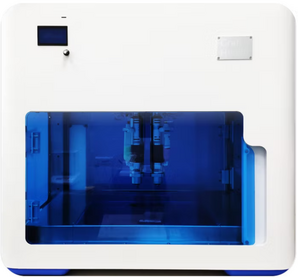
Craft Health’s platform is built around three components. CraftMake, the printer itself, uses semi-solid paste extrusion at room temperature, with no heat or UV curing, a detail that matters for peptides, since heat and UV exposure can degrade sensitive active ingredients. The printer can produce multi-material and “pill-in-pill” structures, letting a single dose combine ingredients or stage them for sequential release. A GMP-oriented version, CraftMake Production Plus, runs in an enclosed printing environment with dual printheads and reports roughly ±1% dosing accuracy with repeatability above 99%.
Around the printer sit CraftControl, workflow software that handles no-code print jobs, audit trails, and multi-printer coordination, and CraftBlends, a formulation database covering immediate, delayed, sustained, and orally disintegrating release profiles.
“Personaliz3D Peptides is not intended to simply repackage traditional compounding,” said Chianelli. “Our objective is to build a repeatable technology and formulation platform that may give qualified healthcare providers greater control over dose, combination, release profile and dosage format.” Craft Health co-founder and CEO Dr. Wei Jiang Goh said the fit was direct: “We believe there is a strong strategic fit between our technology platform and PharmaTher’s vision for personalized peptides.”
The current agreement is an evaluation, not a manufacturing deal. PharmaTher and Craft Health will assess formulations, dosage designs, and release profiles for the six target peptides before either company commits further. But both sides have flagged where this could lead: a broader commercial relationship that would put CraftMake printers directly inside Section 503A compounding pharmacies, with PharmaTher supplying the peptide strategy, prescriber relationships, and partner network, and Craft Health supplying the hardware, software, and formulation science.
Fixing a fixed-dose industry
The gap PharmaTher and Craft Health are targeting isn’t peptide-specific, it’s the one-size-fits-all model that still governs most pharmaceutical manufacturing. Standardized tablets and fixed-dose injectables suit the average patient and adjusting a dose usually means manual compounding, not a repeatable, GMP-consistent process. PharmaTher and Craft Health are teaming up to close that gap: pairing PharmaTher’s peptide strategy with Craft Health’s printing platform.
Other pharmaceutical 3D printing specialists have been chipping away at the same problem from different starting points. CurifyLabs sells GMP-developed “Pharma Inks” that let hospital and compounding pharmacists print patient-tailored medicines on-site instead of hand-compounding them, aiming the technology specifically at dosing-error-prone groups like children.

On the research side, scientists at the Max Planck Institute for Informatics and UC Davis developed a 3D printing process that shapes pills to control how fast they release a drug in the body, a shape-based approach to dosing precision the team believes could extend well beyond pharmaceuticals, into areas like fertilizers and catalytic materials.
Fixed doses were always a manufacturing compromise, not a clinical ideal. What’s changing is that printing, not pressing, is beginning to make the individual dose a practical alternative rather than a niche exception.
3D Printing Industry is inviting speakers for its 2026 Additive Manufacturing Applications (AMA) series, covering Energy, Healthcare, Automotive and Mobility, Aerospace, Space and Defense, and Software. Each online event focuses on real production deployments, qualification, and supply chain integration. Practitioners interested in contributing can complete the call for speakers form here.
To stay up to date with the latest 3D printing news, don’t forget to subscribe to the 3D Printing Industry newsletter or follow us on LinkedIn.
Explore the full Future of 3D Printing and Executive Survey series from 3D Printing Industry, featuring perspectives from CEOs, engineers, and industry leaders on the industrialization of additive manufacturing, 3D printing industry trends 2026, qualification, supply chains, and additive manufacturing industry analysis.
Featured image shows CraftMake GMP-ready Pharmaceutical 3D Printer. Image via PharmaTher.
