


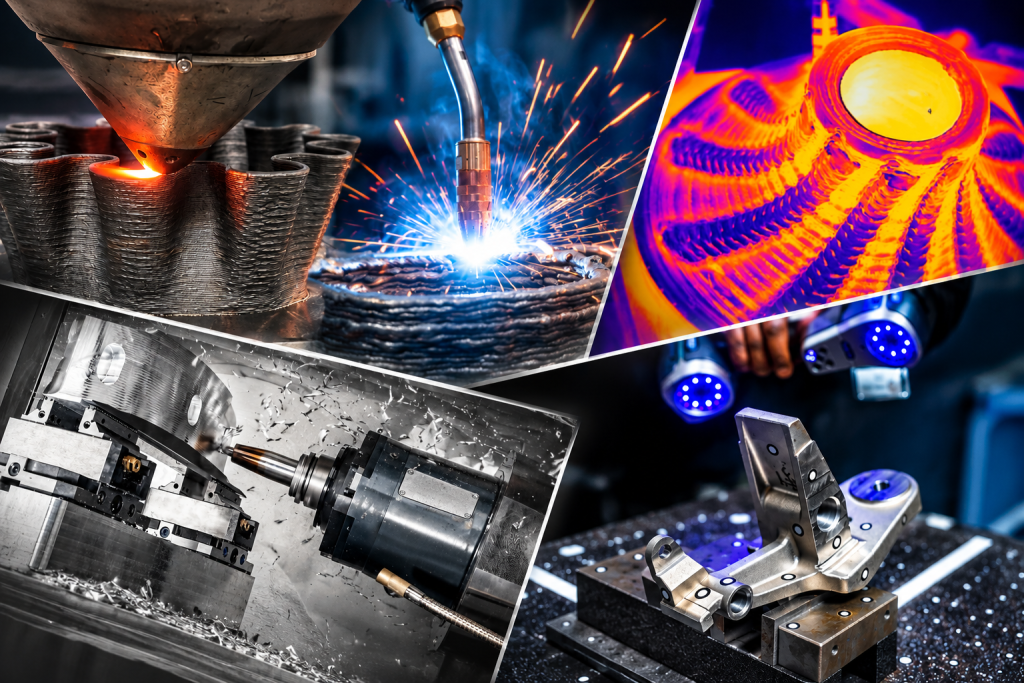
US advanced manufacturing specialist FASTECH is establishing a UK production facility in Greater Manchester, with operations targeted for early 2027. Jason Hutt explains how the company plans to bring its experience of manufacturing metal components for Siemens Energy and the US maritime sector to Britain.
US metal additive manufacturing specialist FASTECH has secured a facility in the Bolton area of Greater Manchester, marking a significant step in its planned expansion into the UK. The company expects to establish its first British manufacturing capability using a Meltio robotic laser directed energy deposition (DED) system during the first quarter of 2027, with larger wire arc additive manufacturing (WAAM) and subtractive machining equipment potentially following.
The expansion will bring FASTECH’s experience producing large metal components for the American energy and maritime sectors into a market where industrial adoption of wire-based additive manufacturing remains comparatively limited.
Speaking to 3D Printing Industry ahead of Formnext 2026, Jason Hutt, Director of UK and International Business Development at FASTECH, confirmed that the company has established a UK entity and signed an agreement for premises. Hutt expects to lead the British business as Managing Director. The initial investment in laser wire deposition would be followed by additional manufacturing capability as demand develops.
For FASTECH, the objective is not simply to establish another additive manufacturing demonstration facility. It is to reproduce a production-led model developed in the United States, where the company already manufactures repeat orders of components for industrial customers.
From Danville to industrial metal additive manufacturing
Founded in 2018 by CEO Alan Pearce, FASTECH is headquartered in Danville, Virginia, close to the North Carolina border. The company has developed alongside a growing regional manufacturing ecosystem supporting American defence, maritime and industrial programmes.
Its early investment in five-axis wire arc additive manufacturing systems from Gefertec established the capability to produce large metal components using wire feedstock, including titanium, stainless steel and nickel-based alloys. The company subsequently expanded its equipment portfolio to incorporate AML3D systems and laser wire deposition technology from Meltio.
Unlike metal powder bed fusion, these processes deposit molten metal wire to build near-net-shape components. WAAM offers relatively high deposition rates for larger structures, while laser wire DED can provide greater control over smaller features and reduce the material subsequently removed during machining. FASTECH combines these processes with design for additive manufacturing, simulation, heat treatment, CNC machining, inspection and other finishing operations.
“We’re not an R&D house. We want to be productionising additive,” Hutt told 3D Printing Industry. According to Hutt, approximately 60-70% of FASTECH’s American workload now consists of repeat or industrialised manufacturing rather than research and prototyping, although the precise measure underlying that estimate was not specified.
The company’s capabilities include equipment intended for very large metal components. Hutt described its AML3D technology as capable of manufacturing parts weighing up to approximately 3,000kg. The Danville operation also supplies components for maritime applications associated with the US submarine industrial base, including work involving copper-nickel and nickel-aluminium bronze alloys.
FASTECH’s development has been supported by its proximity to the Accelerated Training in Defense Manufacturing (ATDM) programme, which provides intensive practical instruction in additive manufacturing, welding, CNC machining, metrology and non-destructive testing. Hutt said the company recruits engineers from the programme, connecting its manufacturing operations with a developing regional workforce.
The relationship between production demand, equipment development and technical training is one element of the American model FASTECH hopes to replicate in Britain.
Siemens Energy demonstrates repeat metal AM production
One of FASTECH’s clearest examples of established industrial production comes from its relationship with Siemens Energy. The company manufactures five variants of Inconel ISO rings for gas turbines using wire arc additive manufacturing and subsequent machining.
Hutt said the work involves recurring orders of approximately 16 components per set, with three to five sets produced each month. At that reported rate, production would amount to approximately 48 – 80 rings monthly, depending on the order mix. The components follow a manufacturing cycle encompassing deposition, heat treatment, machining, inspection and other post-processing operations.
According to Hutt, the economic case for additive manufacturing is particularly strong for these components because high deposition rates and reduced material removal can lower costs compared with machining the rings from solid Inconel. Nickel-based superalloys are expensive and challenging to machine. Conventional production from solid stock may therefore involve substantial material removal and long machining times.
By depositing material closer to the required geometry, FASTECH reduces the amount of metal that must subsequently be machined away. However, Hutt stressed that the company does not regard additive manufacturing as the best solution for every application. He described another Siemens Energy project involving resonator rings in which producing the complete component through additive manufacturing would have required too much deposition time.
FASTECH instead developed a hybrid approach, starting with a forged Inconel ring before adding features through metal deposition and completing the component through machining. That combination of additive and conventional manufacturing provides an alternative to treating 3D printing as a replacement for every stage of production.
The decision depends on component geometry, material requirements, quantity, manufacturing costs and delivery times. For some applications, forging or conventional machining remains the more economical option. For others, additive manufacturing can reduce material waste, shorten procurement schedules or avoid the tooling associated with conventional production.
Selecting the right deposition process
FASTECH’s use of both WAAM and laser wire deposition allows it to evaluate alternative manufacturing routes. Hutt estimated that WAAM can deposit material approximately four to five times faster than laser-based wire deposition, depending on the application. However, deposition speed is only one part of the calculation.
Laser deposition can produce a component closer to its finished geometry, reducing the amount of machining required. In some cases, that reduction can outweigh the additional time spent depositing material. Hutt described situations where laser deposition proved more economical than WAAM despite the slower build process because the final machining requirements were significantly lower. Thin-walled components may also favour laser-based deposition, while larger structures requiring substantial material deposition can benefit from WAAM.
Component size, geometry, material and finishing requirements determine the preferred process. The company also evaluates the overall production cycle rather than deposition alone. Hutt said some components can be delivered in weeks rather than the months associated with conventional manufacturing routes, although complex large-format deposits may themselves require several weeks of machine time. Inspection and qualification remain important constraints. External CT scanning, non-destructive testing and specialist inspection can introduce delays, particularly for unfamiliar components or parts requiring additional validation. Even established deposition processes still involve significant human intervention.
The company has also undertaken materials qualification and fatigue-testing work. Hutt referred to NASA-related testing involving titanium and Inconel alloys, although the precise programmes, standards and results were not detailed in the interview. For customers, these activities matter because repeatable production requires more than demonstrating that a component can be deposited successfully.
UK facility to begin with Meltio technology
FASTECH’s British operation will initially be considerably smaller than its American manufacturing base. Hutt confirmed that the first phase is expected to involve a Meltio robotic laser deposition cell, with WAAM equipment and subtractive machining capability potentially added as the business grows.
The company has selected the Greater Manchester area partly because of its industrial base, manufacturing expertise and opportunities for collaboration with local organisations. Defence and maritime customers are important targets, alongside energy and other industrial markets. Hutt said the initial operation will draw on technical support from FASTECH’s American engineers while recruiting and training personnel locally.
The staffing model is expected to combine experienced engineers with technicians who can be trained in the company’s processes. FASTECH’s experience in Danville provides a precedent. Some of its engineers entered advanced manufacturing through accelerated training without extensive previous experience of additive manufacturing. The company intends to explore similar connections between industry and technical education as its UK operation develops.
Hutt acknowledged that uptake of large-format metal additive manufacturing in Britain remains challenging. Prospective customers are often more familiar with metal powder bed fusion and may not have considered wire-based deposition for their components. The company therefore expects to participate in development and qualification projects while establishing relationships with potential industrial customers. Its longer-term objective, however, is recurring commercial production.
The decision to establish a UK facility is also intended to support customers that would benefit from local manufacturing, shorter supply chains and closer technical collaboration. The strength of FASTECH’s proposition will depend on whether it can transfer the production experience gained in the United States into an operation capable of serving British and European customers competitively.
FASTECH brings production examples to Formnext 2026
FASTECH will participate in the UK Partner Country presence at Formnext 2026 in Frankfurt from 17-20 November. The company plans to display examples of manufactured components and explain its established production work alongside the development of its UK operation.
Additive Manufacturing Technology Manager Daniel Pulska is scheduled to participate in an industrial applications discussion on Wednesday 18 November, followed by a technical presentation on Thursday 19 November. The exhibition will provide an opportunity to meet prospective customers, equipment suppliers and industrial partners as FASTECH prepares for the first phase of British operations.
For Hutt, the immediate challenge is demonstrating that large-format metal additive manufacturing can progress beyond research and technology demonstrations into reliable industrial production. FASTECH’s recurring Siemens Energy work provides an example of that transition, supported by the integration of additive manufacturing with conventional machining, inspection and qualification.
Whether the same model can be developed successfully in Britain will depend on customer demand, technical capability and the economics of the new facility. For now, the Bolton investment represents a concrete step towards bringing the company’s established American manufacturing approach into the UK market.
This article forms part of 3D Printing Industry’s UK additive manufacturing series ahead of Formnext 2026, where the UK is the Partner Country.
Vote now in the 2026 3D Printing Industry Awards.
To stay up to date with the latest 3D printing news, don’t forget to subscribe to the 3D Printing Industry newsletter or follow us on LinkedIn.
Explore the full Future of 3D Printing and Executive Survey series from 3D Printing Industry, featuring perspectives from CEOs, engineers, and industry leaders on the industrialization of additive manufacturing, 3D printing industry trends 2026, qualification, supply chains, and additive manufacturing industry analysis.
Featured image shows a composite image illustrating the technology available at Fastech. Image via Fastech
