


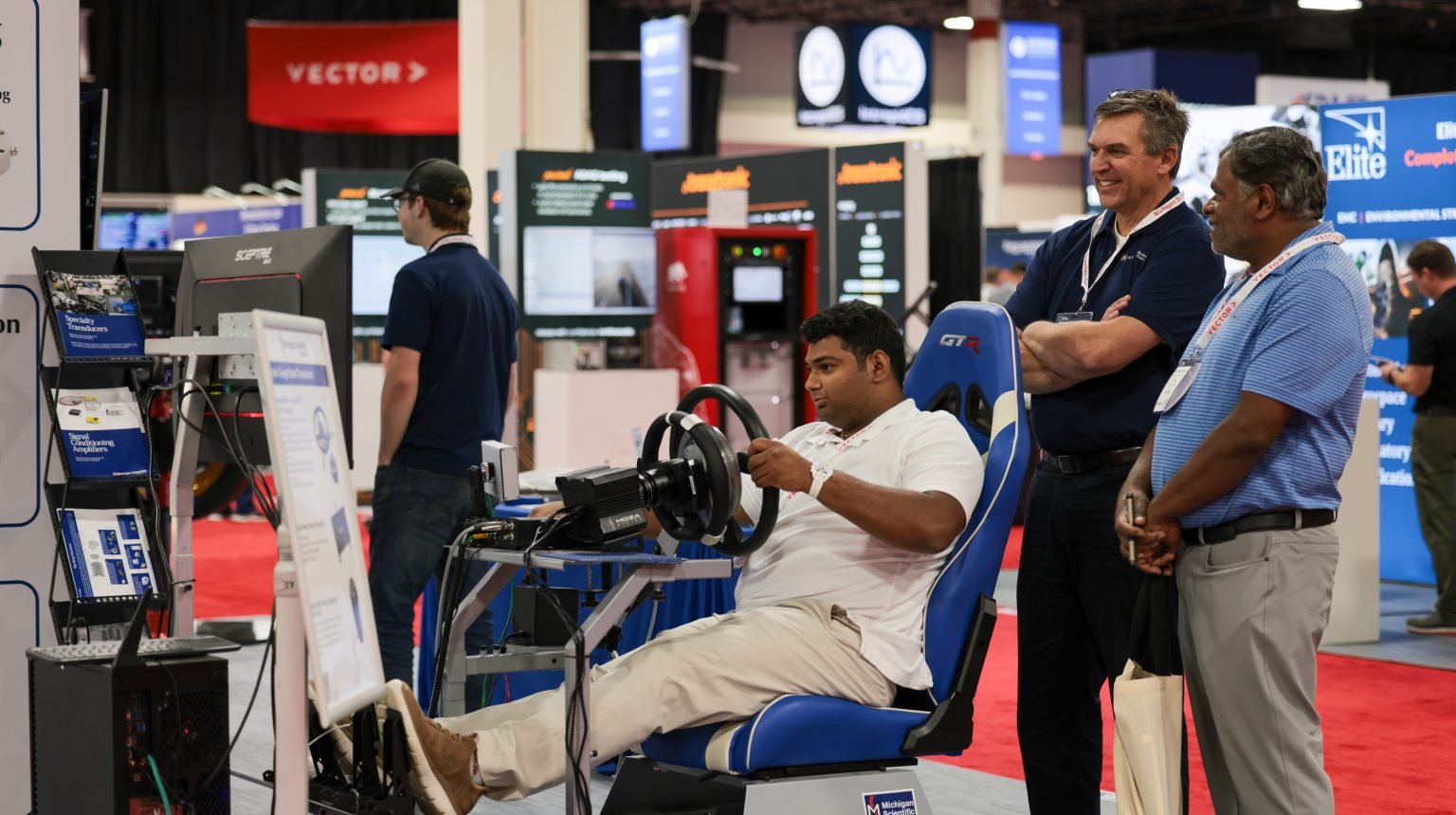
It was hard to overlook the prominence of AI at the newly established Vehicle Tech Week North America. That was true across the three exhibitions and their related conferences – Intelligent Vehicle Expo, Automotive Testing Expo and Automotive Design & In-Cabin Expo. Adoption of the technology has been ramping up, and it was evident at the show that it will be a game-changer in some fields.
From software-defined vehicle platforms and AI-driven systems to ADAS, sensors, connectivity, cybersecurity and intelligent user experiences, Intelligent Vehicle Expo connected the engineering community developing the next generation of intelligent mobility.
Summing up his presentation at the Automotive Design & In-Cabin Conference, Abdul Salam, lead ADAS platform system hardware engineer at Ford, said, “My presentation focused on how increasingly connected cockpit systems are creating new challenges for functional safety and reliability. One of the key messages I wanted to share was that making vehicle interiors smarter is only part of the challenge. As driver monitoring, occupant sensing, displays, HMI and centralized computing become more integrated, we also need to ensure that these systems remain predictable and dependable under real-world conditions.”
Commenting on his expo experience generally, Salam said, “It was also valuable to see the broader industry discussions around intelligent vehicle interiors, software-defined architectures and system integration.”
ATTI’s columnist Jon M Quigley, who moderated the Future of Automotive Testing Conference, also noted the prominence of AI, highlighting its usefulness in anomaly detection and the exploration of multiple design concepts – two applications he had not previously been aware of. Although the general theme of the conference was shift-left and data-driven testing, Quigley commented, “I would say that the overarching theme was use of AI in shifting left.”
Innovation on show
It was great to see a diversity of visitors on the expo floor this year, including a high percentage of women, and engineers with varying backgrounds. “Bringing the industry together in one place at one time is super important for relationships, for progress and for technology development,” said Liz Kerton, CEO and founder of the Autotech Council, an industry partner of Vehicle Tech Week North America. “Putting that all into one place gives me, as a tech scout in the automotive industry, one place where I can meet the people and see the technologies that will be affecting our industry over the next 12 months.”
A central part of the show was the Women Leading Technical Innovation panel.

The event also introduced PeerTalks, a new networking initiative within the VIP Executive Club that brought together senior automotive professionals for intimate, small-group roundtable discussions. Designed to encourage open conversations around real-world challenges and practical implementation, sessions explored topics including From Physical to Virtual: Re-Engineering the Test & Validation Business Model for SDVs, and Designing the Software-Defined Cabin: Balancing Personalization, Sustainability & Human-Centric UX.
With up to seven participants per table, these PeerTalks provided an opportunity for attendees to exchange experiences, share practical insights and connect with industry peers facing similar challenges.
Preeti Sali, senior technical program manager at Ford, who attended the Physical to Virtual roundtable, was enthusiastic about the opportunity to converse with engineers from other spheres: “It was a good experience meeting with people from diverse backgrounds to learn how they’re transitioning from virtual through to physical testing. I am in project management, and I got to speak with people who work in HIL and with dynos.”
Sali added that her interest was piqued by a presentation in the Intelligent Vehicle Conference discussing a fresh approach to SDV development.
Vehicle Tech Week North America featured 272 exhibitors and more than 90 conference speakers, with presenters representing auto makers, service providers and research organizations including Tesla, General Motors, Ford, Toyota, Stellantis, Lucid Motors, J.D. Power and Carnegie Mellon University.
Read AVI’s Day 1 roundup here and Day 2 roundup here.
Looking ahead to 2027
Building on the success of this year’s event, Vehicle Tech Week North America will return to Novi on October 26-28, 2027, continuing to bring together the automotive testing, design and intelligent vehicle communities.
Vehicle Tech Week Europe will take place June 2-3, 2027, at Messe Stuttgart, Germany, providing another opportunity for automotive professionals to explore emerging technologies and connect with industry peers.
For more information, visit www.vehicletechweek-northamerica.com
