


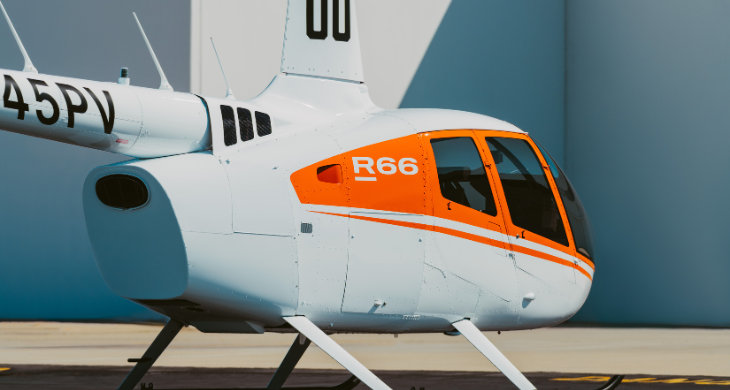
The race is run and future generations of US Army Aviators will cut their teeth in an R66.
Dallas area based M1 Support Services has been named as the successful bidder for the US Army’s USD 10 billion Flight School Next programme. Under the terms of the award M1 will be the prime contractor for the Army’s Initial Entry Rotary Wing (IERW) and will be expected to train between 800 and 1500 army aviators annually at Fort Rucker. While the army has a history of contracting out initial training to civil contractors dating back through the Vietnam era to World War II the elements like aircraft ownership and MRO have remained with the service or managed under separate contracts.
With FSN all elements of the programme including aircraft ownership maintenance, instruction the entire package is supplied as a turn key operation. As its aircraft platform M1 proposed Robinson’s turbine single R66 a move which surprised many although a cursory examination of the aircraft revealed that it ticks most of the boxes set out in the Army’s bid profile. Indeed no less than three of the Prime bidders selected the R66 as their platform which says much about how will the aircraft matched the RFP. Another factor in the success may also have been the outcome of the Sage TH-66 IERW test programme recently concluded and operated by Helicopter Institute using R66s. Which some including Helicopter Institute’s CEO Randy Rowles says answers any questions about the robustness of the R66 when used in a high cycle training mission “We’ve got the R66 dialled in we know what it can do”
Most recently, IERW training has been carried out using UH-72A Lakotas (essentially an H145C2) which some in the service argued was too complex an aircraft to effectively teach foundational pilot aircraft handling skills though that assertion was disputed by Airbus who pointed out that it would be a simple matter to disable the types advanced features like stability augmentation (SAS) while skills like hovering are taught and switched back on moving to more advanced training evolutions pointing to a number of other service schools who follow that procedure.
Other, perhaps more cynical observers ,noted the difference in operating cost between the R66 proposed by M1 and two other bidders and the UH-72A might also have been a deciding factor a point addressed by Maj. Gen. Clair A. Gill, commanding general of the U.S. Army Aviation Center of Excellence in the Army’s announcement “Flight School Next delivers a critical improvement in our Initial Entry Rotary Wing Training model. Simply put, it delivers new military helicopter pilots with far better foundational skills. The fact that it delivers this increased capability at a significant long-term savings to our Army is a great added benefit.”
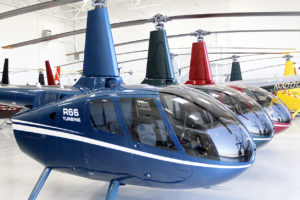
R66 production rates have been plagued by poor engine delivery rates at Rolls Royce.
Some argue that that saving in cost in the IERW phase will yield greater cost to the Army further along in the process with one former aviator, now working for one of the non R66 bidders argued the simplicity of the R66 my make conversion to operational types more demanding and therefore costly saying “When I was coming through the transition from a TH-67 to a UH-60 was an emotional experience, what’s it going to be like for a kid in the future to transition from an R66 to an MV-75?”. Rowles says he believes the optimal solution would be to have an IERW phase similar to the SAGE programme followed by a move to UH-72s for instrument and tactical training as an interim step before operational type conversion.
The arguments over the efficacy of the proposals and solutions will doubtless continue but for now the decision has been made and it is up to M1 and its subcontractors to make the programme work. Not least among the elements is the supply of around 200 R66s. The Army has an ambitious timetable for implementation which will require delivery rates of 50 aircraft a year over the next four years. Given some of the issues with engine availability that has blighted R66 production in recent years that’s a challenge that doubtless been exercising the grey matter in Torrance as well as Indianapolis.
Images: Robinson
