


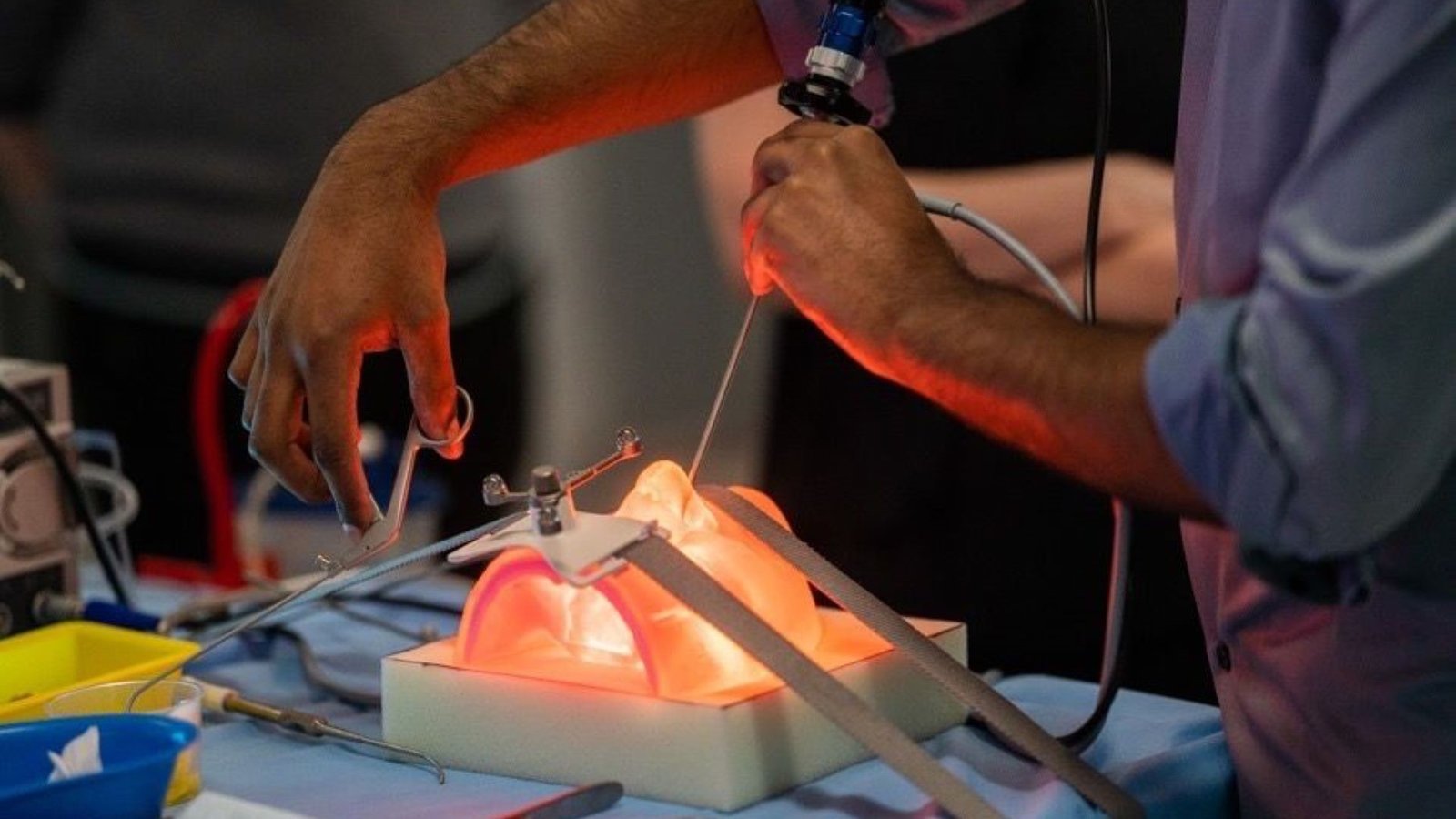
Australian medical training device company Fusetec, Adelaide University, and the Additive Manufacturing Cooperative Research Centre (AMCRC) have embarked on an $800,000 collaborative research project. The project will develop a new generation of biomimetic dental training models, replicas designed to mechanically respond the way real teeth, jawbone, and soft tissue do under surgical force.
The 18-month project targets one of dentistry’s persistent training bottlenecks: preparing clinicians for complex procedures like wisdom tooth removal without reliable models of how human tissue actually behaves when it’s cut, drilled, or fractured.
“We’re developing dental models that don’t just look like anatomically correct – they respond like real tissue during surgery. That gives clinicians greater confidence when planning procedures while providing a for more realistic training experience,” said Fusetec CEO Mark Roe.
Why existing training models fall short
Associate Professor Ling Yin of Adelaide University’s School of Electrical and Mechanical Engineering, who is leading the research alongside the university’s School of Dentistry and Future Industries Institute, said realistic surgical training remains one of dentistry’s biggest unsolved problems, since “existing training models cannot accurately replicate the feel and behaviour of human dental tissue.”
The project will combine advanced clinical imaging, digital modeling, and multi-material additive manufacturing to produce patient-specific biomimetic replicas, while researchers separately develop simulation tools aimed at understanding the fracture-force thresholds involved in complex extractions, data intended to make procedures safer, more predictable, and less invasive once applied in real clinical settings.
Sovereign manufacturing as a strategic goal
AMCRC Managing Director Simon Marriott framed the project as much as an Australian manufacturing play as a healthcare one, noting that, “The opportunity starts with industry. Fusetec identified a clear clinical challenge and partnered with Adelaide University to develop an advanced manufacturing solution with strong commercial potential.”
Marriott added that the project reflects a template AMCRC wants to see more of, where locally developed additive manufacturing capability produces medical technology with export potential alongside domestic use. If the resulting models make it to market, the partners are positioning them as an Australian-made training platform for a global dental education sector where training fidelity has historically been limited.
An Established Partnership With Adelaide
The dental project isn’t Fusetec’s first collaboration with Adelaide’s medical establishment. The company’s earliest proof point came through work with ENT surgeon Professor Peter-John Wormald at the University of Adelaide’s Medical School, who had previously relied on ordering 20 cadavers to train 40 international surgeons in sinus surgery, each trainee limited to practicing on half a nose.
After switching to Fusetec’s 3D printed sinus trainers in November 2019, each surgeon instead received four separate specimens, enabling roughly 48 operations’ worth of practice for the cost of a single cadaver. The resulting FESS training course at Adelaide University now runs exclusively on Fusetec models, with no cadavers involved.
“Fusetec is changing how we train our surgeons. The pathology on cadavers can’t be ordered or predicted; hence, surgical training is a limited and uncontrolled experience. Yet, with Fusetec appearing on the scene, surgeons can now order pathologies in large quantities. Not only can surgeons and students get more practice, but they could also choose different levels of complexity and difficulty, which means that they can tackle challenging conditions step by step. Furthermore, as all students get the same models, it is much easier for the teacher to monitor their progress,” said Peter-John Wormald.
The Push Toward Surgical Models That Behave Like Real Tissue
Additive manufacturing in surgical education is increasingly focused on reproducing how tissue mechanically behaves under a surgeon’s tools. Fusetec and Adelaide University’s dental training project is part of that move.
That strategy has been playing out across other companies. In February 2026, Stratasys introduced a dedicated dental anatomical model preset for its multi-material systems. The models replicate the biomechanical response of bone, teeth, nerves, and soft tissue while maintaining repeatability across batches, a step up from conventional plastic models that lack detailed anatomical behavior or biological specimens that vary case to case. Generated directly from Cone-Beam Computed Tomography scan data, the models can be built to reflect patient-specific conditions such as atrophic jaws, sinus elevation procedures, and bone grafting scenarios, and support realistic drilling, cutting, suturing, and implant placement.
Similarly, Otosurg, a multi-material ear surgery training model built using Stratasys PolyJet printing, where hard and soft tissue are combined in a single build within anatomically critical zones. The model goes further than passive realism, incorporating theatrical blood that changes texture and introduces tissue adhesion during simulated bleeding, with printed cartridges that can be color-coded or stripped of specific structures to isolate individual training stages.
Across these applications, printed models are being engineered to fail, flex, and resist force the way real tissue does, rather than to replicate appearance alone.
3D Printing Industry is inviting speakers for its 2026 Additive Manufacturing Applications (AMA) series, covering Energy, Healthcare, Automotive and Mobility, Aerospace, Space and Defense, and Software. Each online event focuses on real production deployments, qualification, and supply chain integration. Practitioners interested in contributing can complete the call for speakers form here.
To stay up to date with the latest 3D printing news, don’t forget to subscribe to the 3D Printing Industry newsletter or follow us on LinkedIn.
Explore the full Future of 3D Printing and Executive Survey series from 3D Printing Industry, featuring perspectives from CEOs, engineers, and industry leaders on the industrialization of additive manufacturing, 3D printing industry trends 2026, qualification, supply chains, and additive manufacturing industry analysis.
Featured image shows 3D Print Dental Models That Respond Like Real Tissue. Photo via Adelaide University.
